
The Application Gallery features COMSOL Multiphysics® tutorial and demo app files pertinent to the electrical, structural, acoustics, fluid, heat, and chemical disciplines. You can use these examples as a starting point for your own simulation work by downloading the tutorial model or demo app file and its accompanying instructions.
Search for tutorials and apps relevant to your area of expertise via the Quick Search feature. Note that many of the examples featured here can also be accessed via the Application Libraries that are built into the COMSOL Multiphysics® software and available from the File menu.
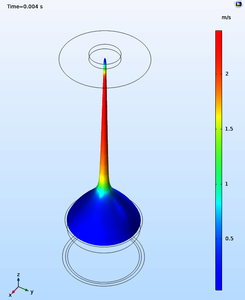
This model deals with electrohydrodynamics (EHD), where a charge separation on the phase boundary between a liquid and air involves the formation of a charged layer. This charged layer allows for a net force to be induced at the interphase when a large electric field is applied. The ... Read More
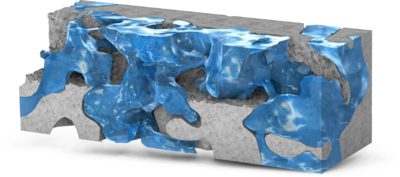
Digital Rock technology utilizes high-resolution imaging techniques, such as SEM and X-ray CT, to characterize the pore structures of rock cores. This approach enables pore-scale modeling of reservoir rocks, offering valuable insights into pore morphology, connectivity, and fluid ... Read More
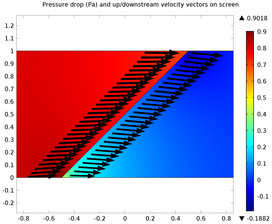
This model simulates the flow through a uniform inclined screen using the Screen feature in Single-Phase Flow physics and compares the results with an analytic solution. Read More
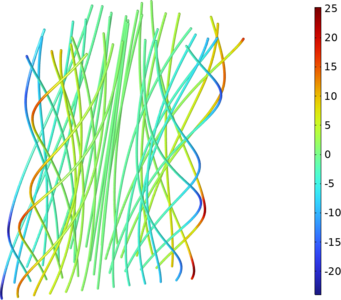
Turbulent flow, SSG-LRR interface is employed to investigate turbulent flow in a straight semicircular duct. The resulting flow pattern is characterized by slow secondary motions in the plane normal to the duct axis. The order of magnitude of velocity of those motions is 1% of the ... Read More
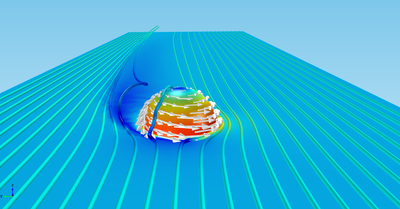
The Magnus effect explains the curl that soccer players can give the ball, resulting in the enjoyable goals that we can see in every FIFA World Cup™. This model looks at the Magnus effect in the laminar and turbulent flow regimes for transient and stationary flows. It also discusses ... Read More
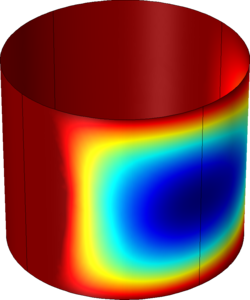
A journal bearing is composed of an outer cylinder (bearing) wrapped around an inner rotating journal (shaft), with a lubricant separating the two. Under certain operating conditions, cavitation can occur between the bearing and the journal, leading to component damage and failure. ... Read More
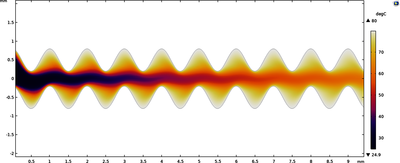
The model has its emphasis on heat transport in a very small heat exchanger that is commonly used in the field of microelectromechanical systems (MEMS). In this case, it might be a reactive processes that needs heating. The heat exchanger itself is constructed by stacking several ... Read More
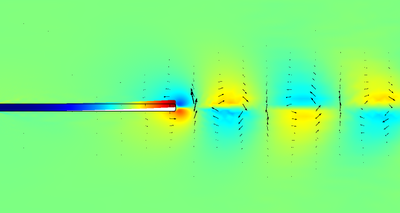
This is a small 2D demonstration model that couples the Linearized Navier-Stokes, Frequency Domain, Solid Mechanics, and Turbulent Flow (k-epsilon) physics interfaces to model the vibrations of a plate located in a 2D viscous parallel plate flow. This type of model is used to model fluid ... Read More
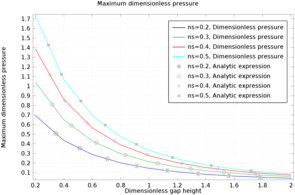
This benchmark model computes the load-carrying capacity of a one dimensional hydrodynamic step bearing. The results are compared with analytic expressions obtained by solving the Reynolds equations directly in this simple case. Read More

The NREL Phase VI wind turbine is a widely recognized standard test case in the study of wind turbine aerodynamics, and its wind tunnel test data have become an important benchmark for validating CFD numerical simulation methods. In this validation case, COMSOL Multiphysics is used to ... Read More


