
The Application Gallery features COMSOL Multiphysics® tutorial and demo app files pertinent to the electrical, structural, acoustics, fluid, heat, and chemical disciplines. You can use these examples as a starting point for your own simulation work by downloading the tutorial model or demo app file and its accompanying instructions.
Search for tutorials and apps relevant to your area of expertise via the Quick Search feature. Note that many of the examples featured here can also be accessed via the Application Libraries that are built into the COMSOL Multiphysics® software and available from the File menu.
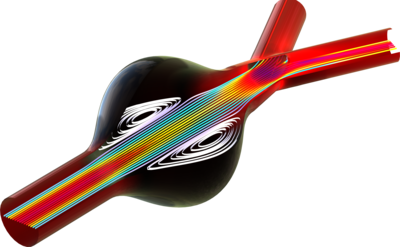
To understand the risk of coagulation and blood clot formation in an abdominal aortic aneurysm (AAA), modeling and simulation can be used to study the blood flow through the AAA. In this example, blood is modeled as an Oldroyd-B fluid. While this is a generic example, if instead using ... Read More

Rayleigh-Bénard's convection cells is a classic in fluid dynamics. We present here two different approaches for computing the critical Rayleigh number above which the cells form. Read More

Turbulent flow, SSG-LRR interface is used to analyze fully developed turbulent flow in an axially rotating pipe and in a swirling jet emanating from such a pipe. The resulting flow pattern in the pipe is characterized by slower-than-solid-body rotation. Axial velocity of the swirling jet ... Read More
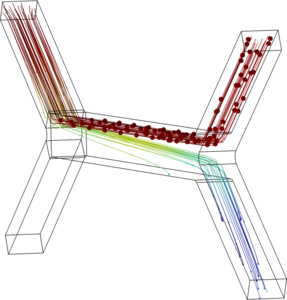
This model demonstrates continuous magnetophoretic separation of particles in a 3D microfluidic Y-channel using a permanent magnet. Separation is achieved through the balance between the magnetophoretic force and hydrodynamic drag. Read More
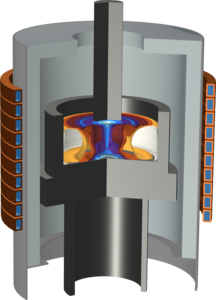
The TSSG process, namely Top-Seeded Solution Growth, is a method used to grow SiC single crystals. It has the advantages of lower growth temperature and high crystal quality. This model introduces the simulation method of the TSSG process, obtains the temperature distribution of the ... Read More
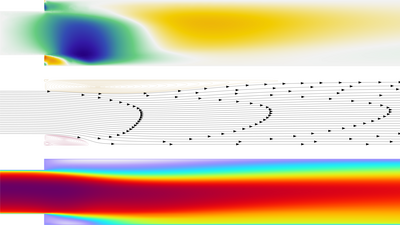
The Turbulent flow, Elliptic Blending R-ε interface is used to analyze fully developed turbulent flow in a spanwise rotating channel. Due to the influence of the Coriolis force on turbulence, profiles of the flow variables are skewed at moderate rotation rates. An asymmetry between the ... Read More
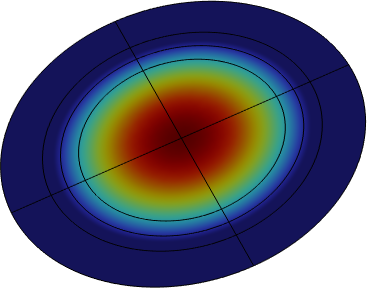
This model demonstrates the use of the Two-Phase Thin-Film Flow, Phase Field multiphysics coupling, which can be used to predict the evolution of an interface between two different, immiscible fluids in thin, narrow channels. The example here presents a free boundary lubrication ... Read More
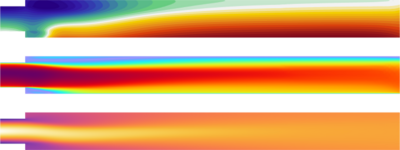
Turbulent flow, Elliptic Blending R-ε interface is used to analyze fully developed turbulent flow in a spanwise rotating channel. Due to the influence of Coriolis force on turbulence, profiles of the flow variables are skewed at moderate rotation rate. The asymmetry between cyclonic ... Read More
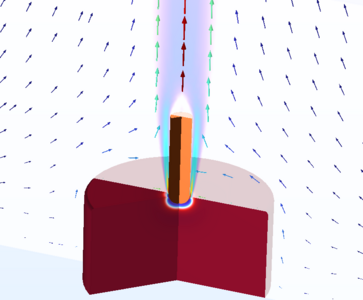
In electrosurgery, high-power AC current from a probe is driven into tissue in order to cut and coagulate it. The current causes rapid Joule heating near the tip, and as temperatures reach 100°C, water and blood vaporize and the tissue desiccates, enabling cutting or sealing. This ... Read More
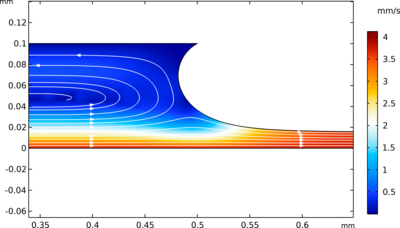
Free-surface calculations in the predefined flow interfaces are currently limited to time-dependent studies when using the built-in boundary conditions. Here, a stationary formulation following Romero et al. [1] is implemented using equation contributions. The attached slides describe ... Read More


