
The Application Gallery features COMSOL Multiphysics® tutorial and demo app files pertinent to the electrical, structural, acoustics, fluid, heat, and chemical disciplines. You can use these examples as a starting point for your own simulation work by downloading the tutorial model or demo app file and its accompanying instructions.
Search for tutorials and apps relevant to your area of expertise via the Quick Search feature. Note that many of the examples featured here can also be accessed via the Application Libraries that are built into the COMSOL Multiphysics® software and available from the File menu.
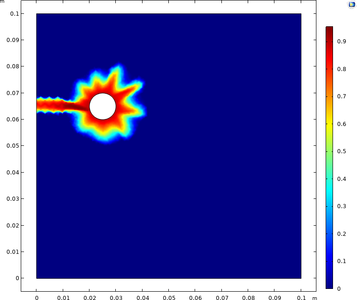
Oxide jacking is the process by which reinforced concrete cracks, due to the corrosion of the reinforcing rebar rods. The corrosion process causes growth of an oxide layer on the rebar, which in turn causes internal stresses in the concrete. If the corrosion process is allowed to ... Read More
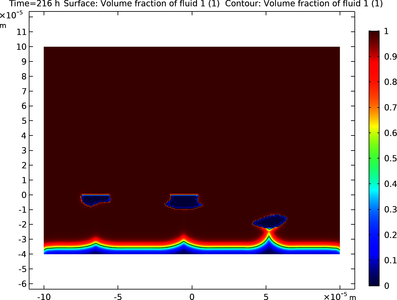
This example models galvanic corrosion between two different phases in a magnesium alloy for a representative cross-sectional microstructure configuration. The Level Set interface is used here to model dissolution of a constituent phase leading to topological changes. The electrode ... Read More
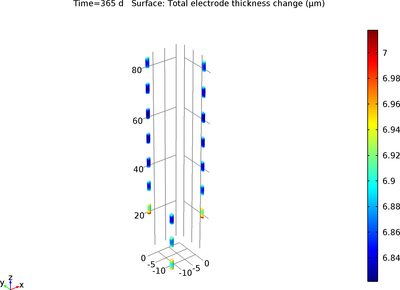
This model exemplifies how the rate of steel corrosion in an oil platform increases over time due to build-up of a resistive film on the sacrificial anodes, formed by reaction products. The model also includes secondary current distribution electrode kinetics on the protected steel ... Read More
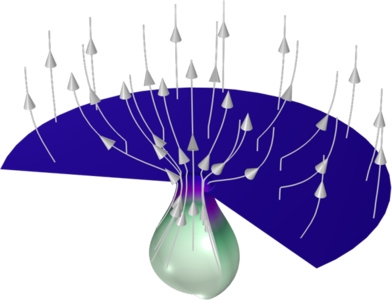
Pitting corrosion is a type of localized corrosion by which local cavities, pits, are formed on an initially smooth metal surface. A pit may be initialized by surface defects, such as an inhomogeneities in composition or shape, or mechanical abuse resulting in a small scratch or dent. ... Read More
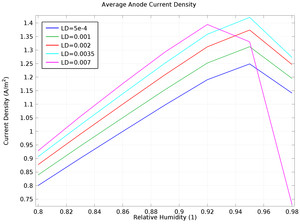
This model simulates atmospheric galvanic corrosion of an aluminum alloy in contact with steel. The electrolyte film thickness depends on the relative humidity of the surrounding air and the salt load density of NaCl crystals on the metal surface. Empirical expressions for the oxygen ... Read More
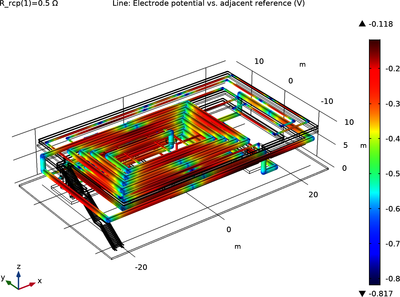
Highly alloyed stainless steel used in chlorinated seawater systems may be prone to corrosion under certain operating conditions. Conventional cathodic protection technique is less suitable for stainless steel due to unacceptable anode consumption rate and propensity to hydrogen ... Read More
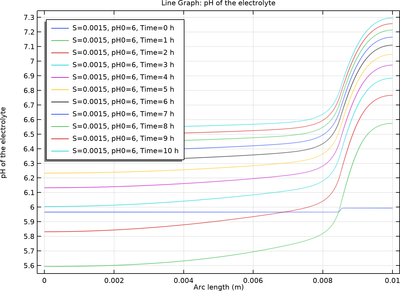
The model simulates atmospheric corrosion of a galvanic couple, comprising of an Al-Co-Ce metallic coating and an aluminum alloy, which is in contact with electrolyte film of 100 micrometer thickness. The corrosion inhibitors are released from the metallic coating and are transported ... Read More
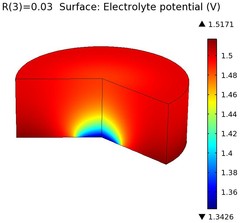
Magnesium alloys are attractive alternatives as lightweight materials in various fields of engineering. Magnesium is however relatively non-noble and may suffer considerable galvanic corrosion when being used in conjunction with other metals, for instance when mounting an Mg alloy ... Read More

An established method for benchmarking the atmospheric corrosion resistance of materials is the use of accelerated corrosion tests (ACT) performed in climate chambers. The main purpose of the ACTs is to make reliable and fast predictions of the long time behavior. The tests expose ... Read More
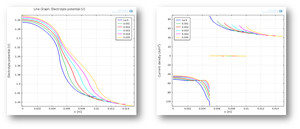
The use of Aluminum (Al) isolator is a commonly employed mitigation strategy for galvanic corrosion between magnesium alloy (Mg) and mild steel (MS). The present model demonstrates the effect of Al isolator thickness on galvanic corrosion severity using a parametric study. The electrode ... Read More


