
The Application Gallery features COMSOL Multiphysics® tutorial and demo app files pertinent to the electrical, structural, acoustics, fluid, heat, and chemical disciplines. You can use these examples as a starting point for your own simulation work by downloading the tutorial model or demo app file and its accompanying instructions.
Search for tutorials and apps relevant to your area of expertise via the Quick Search feature. Note that many of the examples featured here can also be accessed via the Application Libraries that are built into the COMSOL Multiphysics® software and available from the File menu.
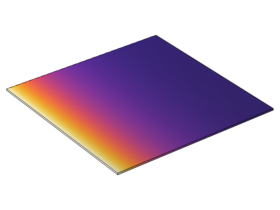
This example models heat transfer in a thin rectangular metal plate. Because the plate’s thickness is only 1/100 of its length and width, you can simulate the process using a 2D approximation. The plate has a fixed temperature at one end and is isolated at the other. A surrounding liquid ... Read More
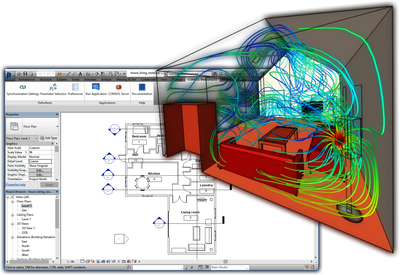
Prevent shaking windows and enhance the sound experience by careful positioning of the loudspeakers in your room. This tutorial analyzes the low frequency response of a living room to the woofer units of two loudspeakers, and solves for the eigenfrequencies of the room. The room geometry ... Read More

Homogeneous Charge Compression Ignition (HCCI) engines are being considered as an alternative to traditional spark- and compression-ignition engines. As the name implies, a homogeneous fuel/oxidant mixture is auto-ignited by compression with simultaneous combustion occurring throughout ... Read More
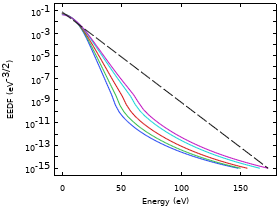
This tutorial models an ICP reactor by solving plasma fluid type equations fully coupled with the homogeneous and time-independent electron Boltzmann equation in the classical two-term approximation. The approximated Boltzmann equation is solved for each position of space and is coupled ... Read More
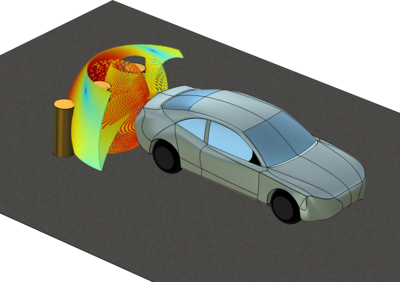
This tutorial demonstrates how to compute the response of an ultrasonic car parking sensor transducer coupling Pressure Acoustics, Frequency Domain, Solid Mechanics, and Piezoelectric Materials. The far-field radiation pattern of the transducer is then used as a source for a Ray ... Read More
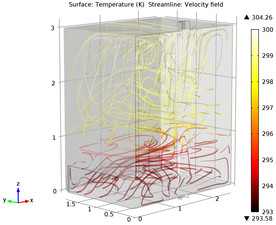
In general, there are two classes of ventilation: mixing ventilation and displacement ventilation. In displacement ventilation, air enters a room at the floor level and displaces warmer air to achieve the desired temperature. Heating sources in the room can include running electronic ... Read More
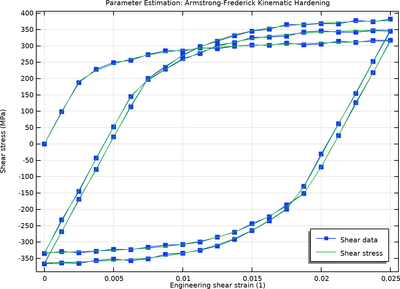
This tutorial model demonstrates how to estimate the material parameters of a combined hardening elastoplastic material model given cyclic shear data. Read More
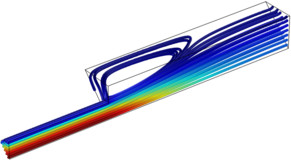
This tutorial model solves the incompressible Navier-Stokes equations in a backstep geometry using the Laminar Flow interface. A characteristic feature of fluid flow in geometries of this kind is the recirculation region that forms where the flow exits the narrow inlet region. The model ... Read More
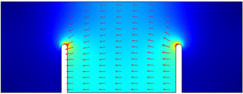
This example treats the modeling of electroosmotic flow in porous media. The system consists of a compartment of sintered porous material and two electrodes that generate an electric field. The cell combines pressure and electroosmotic driven flow. The equations that are solved are the ... Read More

Carbon dioxide in aqueous solution is highly corrosive and can cause significant damage to steel designs. Such conditions arise in pipes used in a variety of applications, especially within the petrochemical industry. In this tutorial example, turbulent flows consisting of carbon ... Read More


