
The Application Gallery features COMSOL Multiphysics® tutorial and demo app files pertinent to the electrical, structural, acoustics, fluid, heat, and chemical disciplines. You can use these examples as a starting point for your own simulation work by downloading the tutorial model or demo app file and its accompanying instructions.
Search for tutorials and apps relevant to your area of expertise via the Quick Search feature. Note that many of the examples featured here can also be accessed via the Application Libraries that are built into the COMSOL Multiphysics® software and available from the File menu.
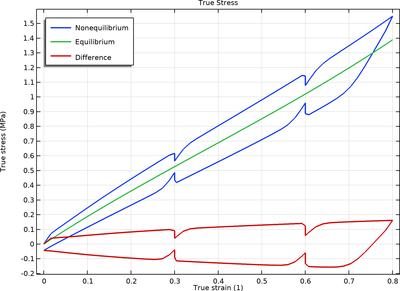
In this example, the Bergstrom–Boyce material model is used to capture the nonequilibrium behavior of carbon-black-filled chloroprene rubber under a strain history that alternates compression with relaxation. Results are verified against experimental and numerical results taken from the ... Read More
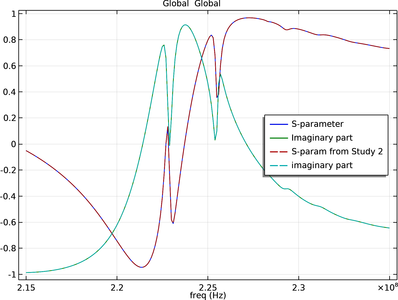
This model shows how to compute the S-parameter for a piezoelectric MEMS device by extending the tutorial Thin-Film BAW Composite Resonator. The measurement of S-parameter is commonly used to characterize such devices for RF applications. The terminal feature in the Electrostatics ... Read More
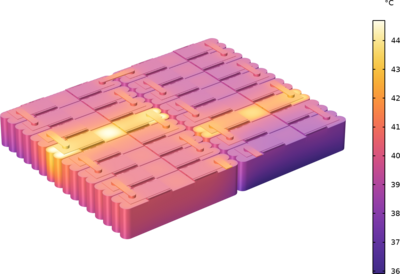
This example models the temperature profile in a liquid-cooled prismatic battery pack during a high-rate charge. The pack consists of 16 prismatic battery cells connected by busbars, placed on an aluminum plate containing four cooling channels. The battery pack is assumed to have two ... Read More
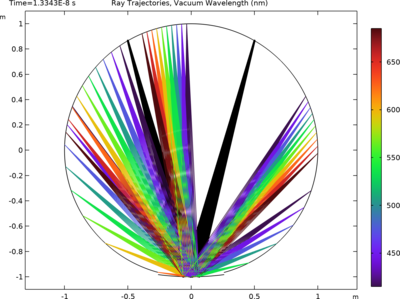
The Rowland circle is a circle of radius R that lies tangent to a concave curved diffraction grating of radius 2R. If the entrance slit of incoming light is positioned on this circle, then rays reflected by the grating will be focused at various points along the same circle based on ... Read More
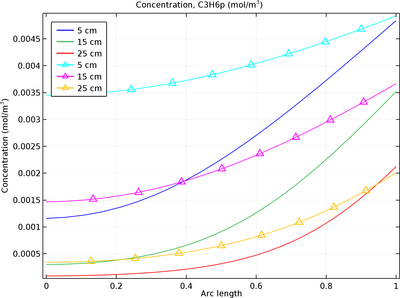
One of the most common reactors in the chemical industry, for use in heterogeneous catalytic processes, is the packed bed reactor. This type of reactor is used both in synthesis as well as in effluent treatment and catalytic combustion. The reactor consists in essence of a container ... Read More
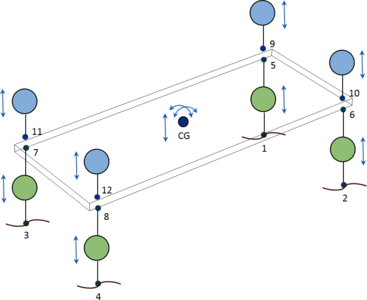
In this example, a lumped model of a vehicle suspension system having 11 degrees of freedom is analyzed. The Mass, Spring, and Damper nodes of the Lumped Mechanical System interface are used to model the wheels, including suspension system as well as the seats with a passenger. The ... Read More
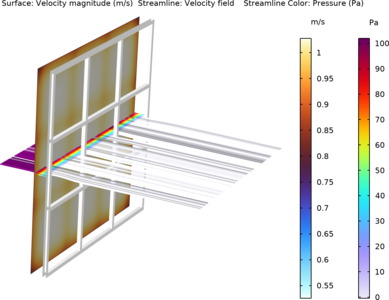
This example demonstrates simulation of a turbulent flow in a geometry with an air filter. Porous material of the filter induces an abrupt pressure drop and drastic increase of turbulence level inside the filter. Read More
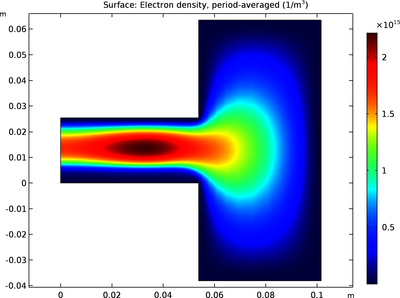
This model investigates the National Institute of Standards and Technology (NIST) Gaseous Electronics Conference (GEC) reference cell in two dimensions using the Plasma, Time Periodic interface. A 2D example helps in understanding the physics without excessive CPU time. The cell is ... Read More
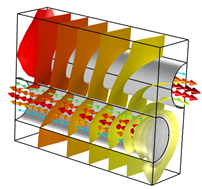
The example concerns a stainless-steel MEMS heat exchanger, which you can find in lab-on-a-chip devices in biotechnology and in microreactors such as for micro fuel cells. This model examines the heat exchanger in 3D, and it involves heat transfer through both convection and ... Read More
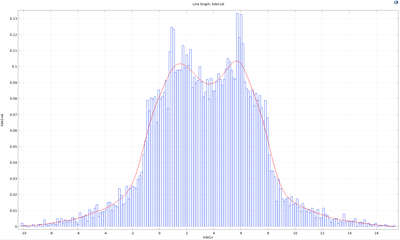
This example demonstrates how to perform uncertainty quantification analysis of the Ishigami function. This random function of three variables is a well-known benchmark used to test global sensitivity analysis and uncertainty quantification algorithms. The mean, standard deviation, ... Read More


