
The Application Gallery features COMSOL Multiphysics® tutorial and demo app files pertinent to the electrical, structural, acoustics, fluid, heat, and chemical disciplines. You can use these examples as a starting point for your own simulation work by downloading the tutorial model or demo app file and its accompanying instructions.
Search for tutorials and apps relevant to your area of expertise via the Quick Search feature. Note that many of the examples featured here can also be accessed via the Application Libraries that are built into the COMSOL Multiphysics® software and available from the File menu.
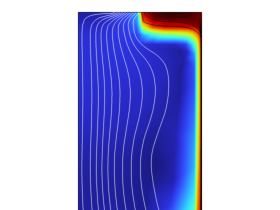
In this first half of a two-part example, a 2D model of a trench-gate IGBT is built, which will be extended to 3D in the second half. In general, it is the most efficient to start with a 2D model to make sure everything works as expected, before extending it to 3D. The Caughey&ndash ... Read More
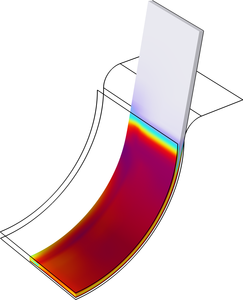
This example benchmarks a NAFEMS validation model of a friction contact problem with an elastoplastic material model. A thin metal sheet is forced into a die by a punch. Both the compressing displacement and the release of the punch are modeled in order to compute the forming angle (at ... Read More
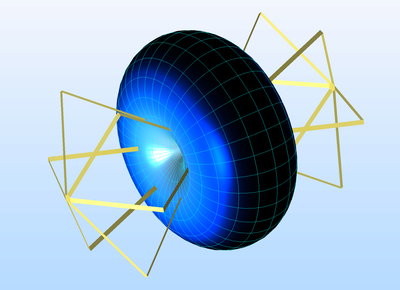
Biconical antennas are popular for very high frequency (VHF) measurement because they support a wide frequency range. They are also useful for electromagnetic compatibility (EMC) testing where the antenna can be used as an RF source in susceptibility or immunity test. This model ... Read More
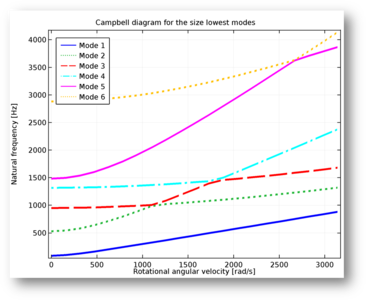
The eigenfrequencies of a rotating blade are studied in this benchmark. It shows how stress stiffening and spin softening affect the fundamental eigenfrequency. High rotational speeds in rotating machinery can result in centrifugal forces of considerable magnitude. The forces induced by ... Read More
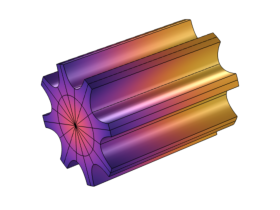
This example reproduces parts of the study of Ref. 1 on the thermal contact resistance at the interface between a heat sink and an electronic package. Eight cooling fins equip the cylindrical heat sink and contact is made at the radial boundaries of the package. The efficiency of the ... Read More
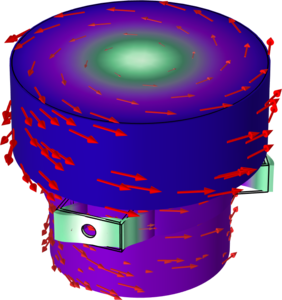
In many structural dynamics applications, some components are stiff compared to the supporting structure. Such a stiff part will only contribute to the dynamic properties of the structure through its mass and moment of inertia. It is then possible to reduce the model size significantly ... Read More
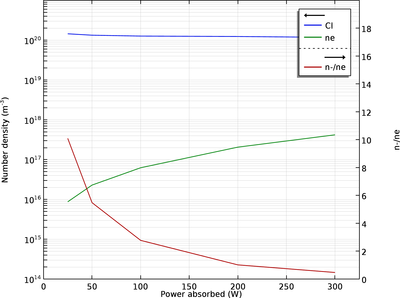
Plasma discharges containing chlorine are commonly used to etch semiconductors and metals in microelectronics fabrication. This tutorial model studies chlorine plasma discharges using a global (volume-averaged) diffusion model. Global diffusion models can run simulations in a fraction ... Read More
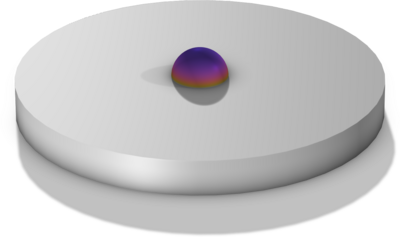
Droplet evaporation is ubiquitous in everyday life, and is essential in many industrial processes such as ink-jet printing, cleaning or coating of surfaces, and phase change heat transfer. In this model, a water droplet placed on a solid substrate evaporates in air. We solve the ... Read More

This tutorial model of the Joule heating effect in a busbar demonstrates how to synchronize an assembly between the PTC Creo Parametric™ software and the COMSOL Multiphysics® software, how to modify the geometry from COMSOL Multiphysics®, and how to run a ... Read More
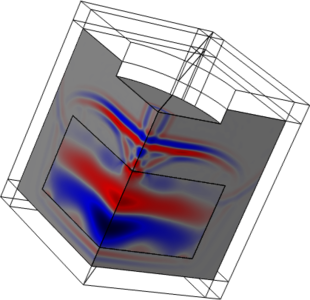
This tutorial showcases the principles of the immersion ultrasonic testing technique. A search unit placed in a water tank sends an ultrasonic pulse signal that scatters off a solid object. Part of the signal is reflected back to the search unit by the object and possible flaws in it. By ... Read More


