
The Application Gallery features COMSOL Multiphysics® tutorial and demo app files pertinent to the electrical, structural, acoustics, fluid, heat, and chemical disciplines. You can use these examples as a starting point for your own simulation work by downloading the tutorial model or demo app file and its accompanying instructions.
Search for tutorials and apps relevant to your area of expertise via the Quick Search feature. Note that many of the examples featured here can also be accessed via the Application Libraries that are built into the COMSOL Multiphysics® software and available from the File menu.
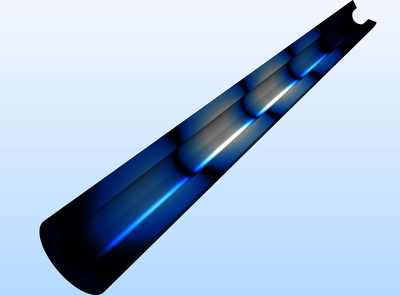
Simulation of Maxwell’s equations in the time domain is useful if the objective of the analysis is to observe a transient phenomenon, to find the time it takes a signal to propagate, or if the materials being modeled are non-linear with respect to the electric or magnetic field strength. ... Read More
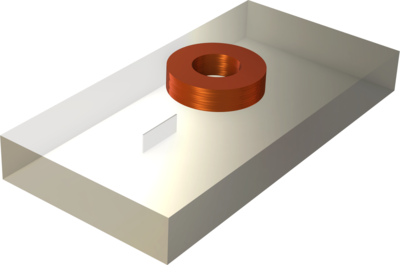
This model is a benchmark problem from TEAM workshop (problem 15 part I, see https://www.compumag.org/wp/team/). The model simulates the behavior of a coil as it scans a conductive plate containing a defect (a crack). The computed coil parameters, which include change in resistance and ... Read More

In this example, an SF6/argon plasma reactor at moderate pressure is studied using a global model. The heavy species heat equation is included. Parametric sweeps for input power and argon mole fraction are computed. Read More
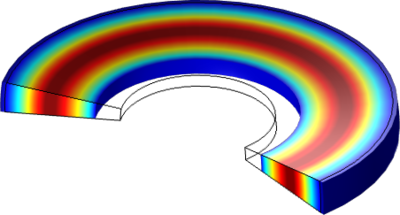
This example illustrates how to combine different Creep material models. Here a Norton–Bailey model (primary creep) is combined with a Norton model (secondary creep). This example is a continuation of the model thermally induced creep. Read More
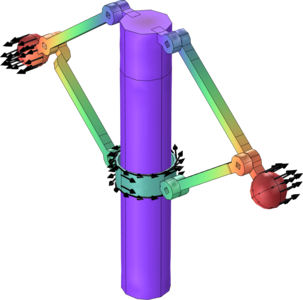
A centrifugal governor is used to control the speed of rotating machinery. One of the most common applications is in controlling the RPM of an engine by regulating the fuel supply. This model illustrates the functioning of a spring loaded centrifugal governor. The dynamics of the ... Read More
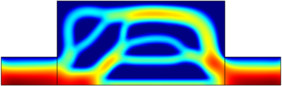
In this application, a solution is pumped through a catalytic bed where a solute species reacts as it gets in contact with the catalyst. The purpose of this example is to maximize the total reaction rate for a given total pressure difference across the bed by finding an optimal catalyst ... Read More
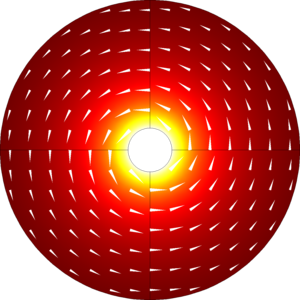
The coaxial cable (coax) is one of the most ubiquitous transmission line structures. It is composed of a central circular conductor, surrounded by an annular dielectric, and shielded by an outer conductor. This model computes the electric and magnetic field distribution inside of the ... Read More
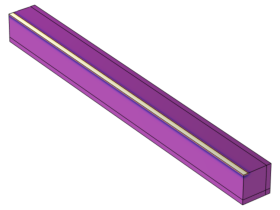
The model demonstrates the basics of the 3-omega method. The coupled electromagnetic heating problem is solved in a solid sample which is heated by a thin copper strip, deposited on the surface of a sample. Analyzing the frequency dependence of the voltage oscillation amplitude, we ... Read More
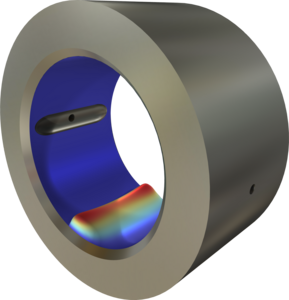
In this example, the importance of including elastic deformations when analyzing heavily loaded fluid-film bearings is investigated. The structural parts are modeled using the Solid Mechanics interface, while the pressure in the lubricant is determined by the means of the Hydrodynamic ... Read More
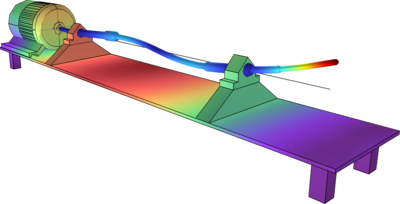
Active magnetic bearings are often used for controlling the vibration level in mechanical systems. In this example, a motor driven rotor system in which the speed of the system is gradually increased is considered. The system vibrates due to existing imbalances. As the rotor speed ... Read More


