
The Application Gallery features COMSOL Multiphysics® tutorial and demo app files pertinent to the electrical, structural, acoustics, fluid, heat, and chemical disciplines. You can use these examples as a starting point for your own simulation work by downloading the tutorial model or demo app file and its accompanying instructions.
Search for tutorials and apps relevant to your area of expertise via the Quick Search feature. Note that many of the examples featured here can also be accessed via the Application Libraries that are built into the COMSOL Multiphysics® software and available from the File menu.
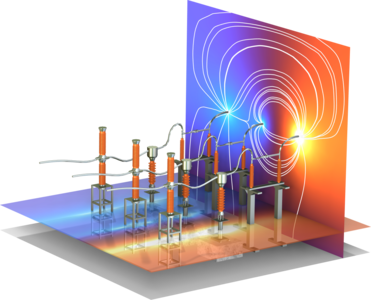
Breaker and disconnector devices are widely used in AC substations in power systems.In this model, the Electrostatics Interface is used to simulate the electric potential and electric field in a 110kV 3-phase high-voltage switchgear operating at 50 Hz. A surrogate model is also trained ... Read More
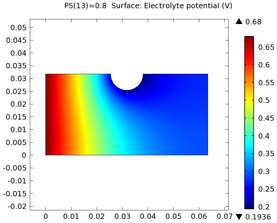
This example models cathodic protection of a steel reinforcing bar in concrete. Three different electrochemical reactions are considered on the steel surface. Charge and oxygen transport are modeled in the concrete domain, where the electrolyte conductivity and oxygen diffusivity depend ... Read More
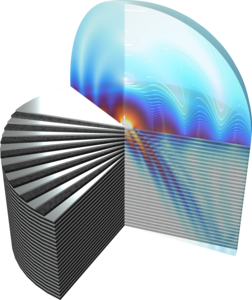
The modal dispersion in a metamaterial can be engineered by changing the type of material and dimension of the composing unit cells. For instance, a periodically organized subwavelength metal–dielectric layered metamaterial exhibits an anisotropic dispersion characteristic in the ... Read More
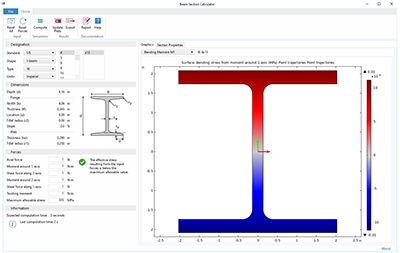
This app demonstrates: Light theme This app allows you to evaluate cross-section data for a wide range of American and European standard beams. Given a set of forces and moments acting on the section, you can also compute a detailed stress distribution. Calculated cross-section data ... Read More

This space-dependent model describes a stirred semibatch reactor used for producing antibody–drug conjugates. The reactor is set up in 3D and the conjugation reactions, turbulent flow, and concentration fields are simulated as functions of time. The resulting yield and drug-to-antibody ... Read More

This model solves the Boltzmann equation in two-term approximation for a mixture of nitrogen and oxygen representing a background gas of dry air. Electron transport coefficients and source terms are computed by suitable integration of the electron energy distribution function over ... Read More
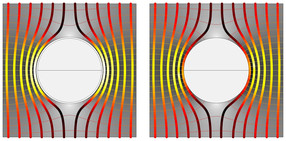
The contact impedance boundary condition is meant to approximate a thin layer of material that impedes the flow of current normal to the boundary, but does not introduce any additional conduction path tangential to the boundary. This example compares the contact impedance boundary ... Read More
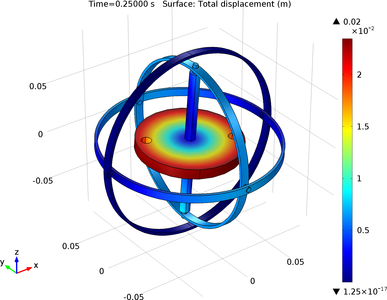
Gyroscopes are used to measure orientation or maintain the stability of vehicles such as airplanes, spacecraft, and submarines. They are also used as sensors in inertial guidance systems. This model demonstrates the modeling of a mechanical gyroscope. It analyzes the response of a ... Read More

This tutorial model presents a study showing the transient negative mobility and the negative differential conductivity effects in xenon. The stationary and time dependent Boltzmann equation in the two-term approximation is used to compute the electron energy distribution function. ... Read More
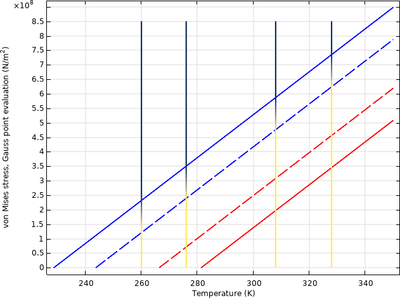
The model includes a compilation of benchmark examples included in the text book: Shape Memory Alloys: Modeling and Engineering Applications. D. Lagoudas Ed. Springer 2008. The model uses the Souza–Auricchio model and shows the thermomechanical properties of a NiTi alloy sample ... Read More


