
The Application Gallery features COMSOL Multiphysics® tutorial and demo app files pertinent to the electrical, structural, acoustics, fluid, heat, and chemical disciplines. You can use these examples as a starting point for your own simulation work by downloading the tutorial model or demo app file and its accompanying instructions.
Search for tutorials and apps relevant to your area of expertise via the Quick Search feature. Note that many of the examples featured here can also be accessed via the Application Libraries that are built into the COMSOL Multiphysics® software and available from the File menu.
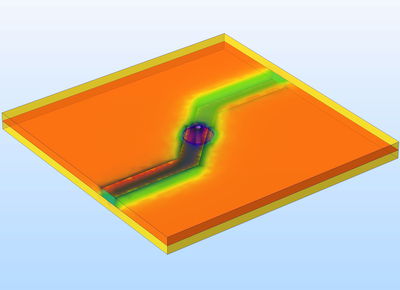
In signal integrity (SI) applications, time-domain reflectometry (TDR) is a useful technique for analyzing the discontinuity in a signal path by observing the reflected signal strength. The reflected signal distorts the input pulse mainly by impedance mismatch if there is no external ... Read More
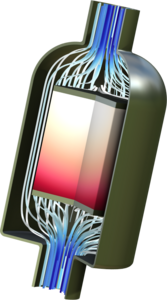
Chemical vapor deposition (CVD) is an important step in the process of manufacturing microchips. One common application is the deposition of silicon on wafers in low pressure reactors to obtain uniform deposition thicknesses. This example models the coupled reaction kinetics, fluid ... Read More
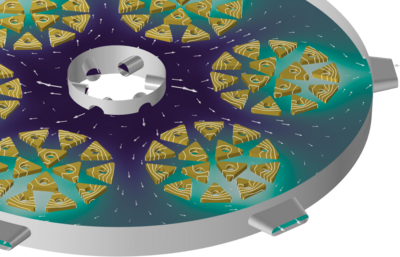
Chemical vapor deposition (CVD) is a process used to grow thin films on substrates. In this CVD example, metal inserts for machining tools are coated with titanium nitride (TiN). The titanium nitride layer improves the wear resistance of the metal inserts by increasing the hardness, ... Read More

A hinge between two mechanical components is modeled by coupling two rigid connectors. This method can be used for simulating many types of mechanisms. In mechanical assemblies, parts are sometimes connected so that they are free to move relative to each other in one or more degrees of ... Read More
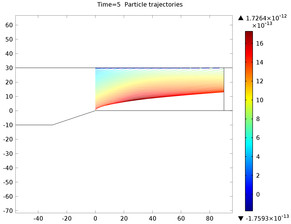
When a temperature gradient in a gas exists, suspended particles will tend to move from regions of high temperature to low. The force which produces this effect is called the thermophoretic force. Gas molecules colliding with a particle from the hot side have a higher velocity than the ... Read More
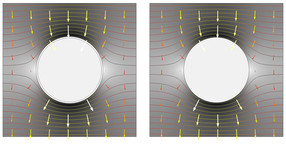
The electric shielding boundary condition is meant to approximate a thin layer of highly conductive material that provides an additional current path tangential to a boundary. This example compares the electric shielding boundary condition to a full-fidelity model and discusses the range ... Read More
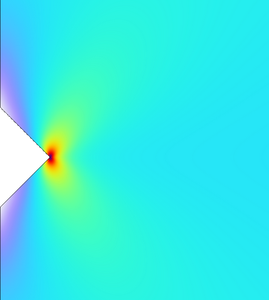
A detailed description of these models can be found in our blog post “How Should I Evaluate Singular Stress Fields?”. The models are: notchedStrip.mph – Model for the initial studies of the stress field properties. singularityPower.mph – Small model solving the transcendental equation ... Read More
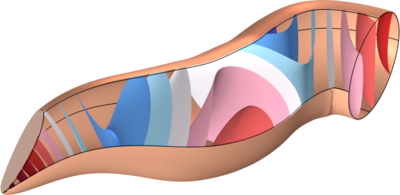
In this tutorial model, the acoustics of the human ear canal are investigated. The output includes the input impedance and the transfer impedance, as well as the level transformation from the entrance to the ear drum. The geometry of the ear canal used is based on measurements from test ... Read More
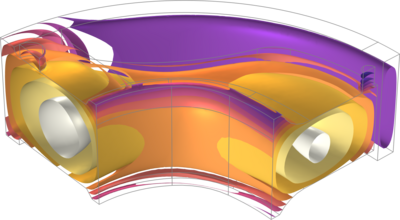
Modeling curing is important in a wide variety of applications such as for devices utilizing polymer materials, rubber materials, plastics, and concrete. Curing is usually an exothermic reaction. In the current example, curing of butyl rubber is studied in a 3D mold for an automotive ... Read More
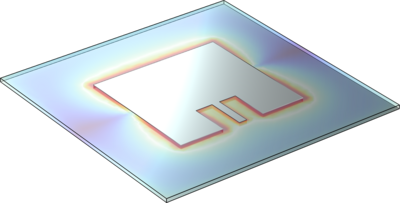
In this tutorial, an uncertainty quantification analysis is performed on the Microstrip Patch Antenna model from the RF Module Application Library to explore how variations in input parameters, such as material properties or geometric variations, impact the antenna’s performance in terms ... Read More


