
The Application Gallery features COMSOL Multiphysics® tutorial and demo app files pertinent to the electrical, structural, acoustics, fluid, heat, and chemical disciplines. You can use these examples as a starting point for your own simulation work by downloading the tutorial model or demo app file and its accompanying instructions.
Search for tutorials and apps relevant to your area of expertise via the Quick Search feature. Note that many of the examples featured here can also be accessed via the Application Libraries that are built into the COMSOL Multiphysics® software and available from the File menu.

A Hall effect sensor is a semiconductive material with an anisotropic conductivity that is a function of the magnetic field. A magnet, mounted on a wheel, is rotated around nearby the sensor and the variation in the electric potential across the sensor is modeled. For complete ... Read More
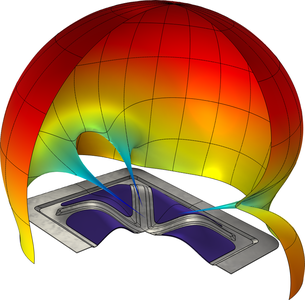
This model presents a method to analyze acoustic damping pads. These pads use a constrained layer of viscoelastic material to dissipate energy and thus reduce the energy radiated as noise. Damping pads are used in many different industries to reduce the noise generated by vibrating ... Read More
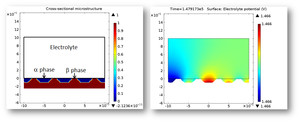
Galvanic corrosion between two different phases (alpha and beta phases) in a metallic (magnesium) alloy is simulated for a representative cross-sectional microstructure configuration. A key feature in the model formulation is the implementation of both anodic and cathodic regions at ... Read More
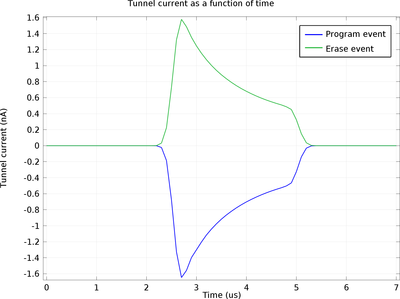
This model calculates the current and charge characteristics of a floating gate Electrically Erasable Programmable Read-Only Memory (EEPROM) device. A stationary study demonstrates the effects of varying the charge stored on the floating gate by computing Current-Voltage curves as a ... Read More
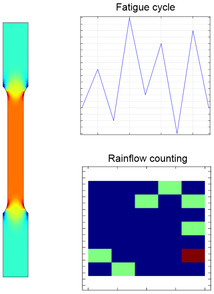
A benchmark model of the Rainflow counting algorithm compares results between ASTM and COMSOL fatigue module using a flat tensile test specimen. An extension is made for the cumulative damage calculation following the Palmgren-Miner model and results are compared with analytical ... Read More
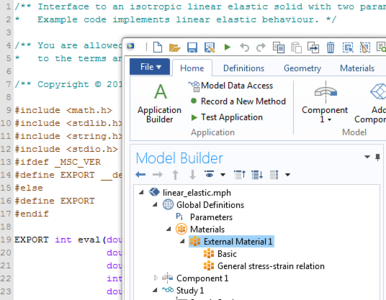
The External Material functionality makes it possible to program your own material models for cases when the built-in material models are not sufficient. For structural mechanics, you have the possibility to either completely define the material model in a domain, or to add an inelastic ... Read More
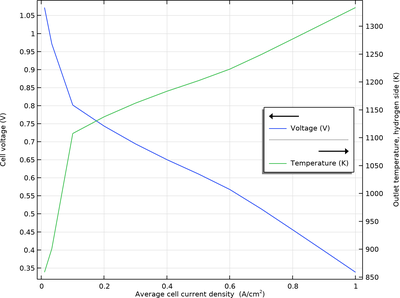
In this model of an ammonia-fed solid oxide fuel cell, the required hydrogen is supplied through endothermic thermal decomposition of ammonia. The model includes the full coupling between the mass balances and gas flow in the H2 and O2 gas diffusion electrodes, the momentum balances in ... Read More
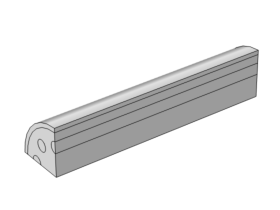
In this tutorial you will learn how to use selections when creating the parametric geometry for the analysis of a steam reformer, and set up the selections needed for the physics definitions. The multiphysics analysis of the steam reformer is described in the model Steam Reformer found ... Read More
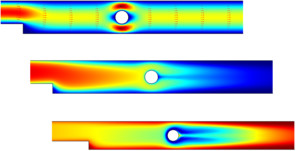
In this tutorial, the heat and mass transport equations are coupled to laminar flow in order to model exothermic reactions in a parallel plate reactor. It exemplifies how you can use COMSOL Multiphysics to systematically set up and solve increasingly sophisticated models using predefined ... Read More
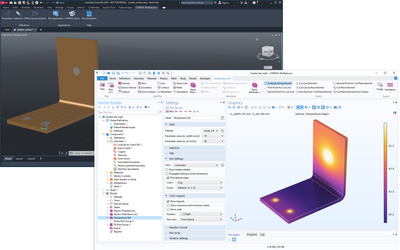
This tutorial model of the Joule heating effect in a busbar demonstrates how to synchronize geometry between the AutoCAD® software and the COMSOL Multiphysics® software, how to modify the geometry from COMSOL Multiphysics®, and how to run a geometric parametric ... Read More


