
The Application Gallery features COMSOL Multiphysics® tutorial and demo app files pertinent to the electrical, structural, acoustics, fluid, heat, and chemical disciplines. You can use these examples as a starting point for your own simulation work by downloading the tutorial model or demo app file and its accompanying instructions.
Search for tutorials and apps relevant to your area of expertise via the Quick Search feature. Note that many of the examples featured here can also be accessed via the Application Libraries that are built into the COMSOL Multiphysics® software and available from the File menu.
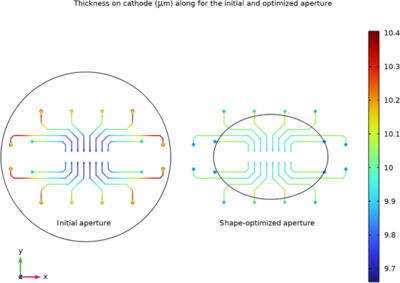
An aperture is often used in electroplating baths in order to improve the uniformity of the deposited metal layer. This example simulates electroplating of a printed circuit board (PCB) in 3D using a secondary current distribution. The size and aspect ratio of the aperture is optimized ... Read More
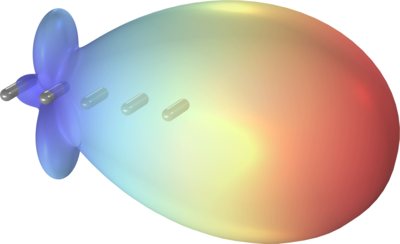
This model demonstrates the use of boundary element method in the Electromagnetic Waves, Boundary Element interface to model an optical Yagi-Uda antenna. The antenna is driven by an electrical point dipole, which is implemented through the background field. The field distribution around ... Read More
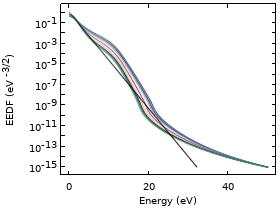
In this example, a hydrogen plasma reactor at moderate pressure is studied using a global model. The heavy species heat equation is included. In the first part of the study, a Maxwellian electron energy distribution function is used. In the second part, the global model is solved self ... Read More
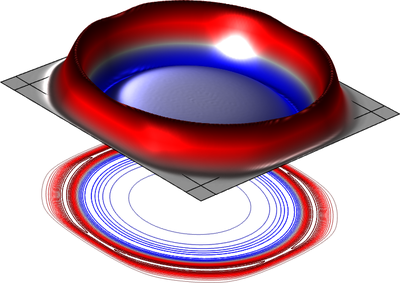
This tutorial simulates a standard test and benchmark model for perfectly matched layers (PMLs) as absorbing boundary conditions in the time domain. It involves the propagation of a transient Gaussian pulse with no flow. The Pressure Acoustics, Transient interface is used together with ... Read More
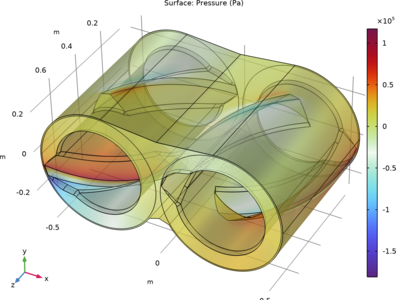
Non-isothermal non-Newtonian flow in an internal mixer for rubbers and polymers. The Carreau model is used including thermal effects for the viscosity. Read More
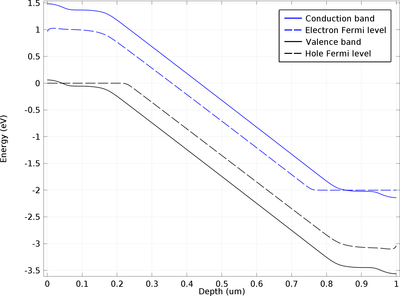
This simple model demonstrates how to use the Semiconductor Optoelectronics interfaces to model a simple GaAs PIN diode structure. Both the stimulated and spontaneous emission in the semiconductor are accounted for. The corresponding absorption of the light and the associated change in ... Read More
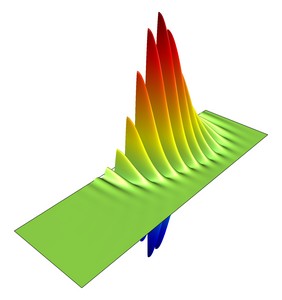
It is possible to generate harmonics that are multiples of the frequency of laser light by using nonlinear optical materials. This model demonstrates second harmonic generation using transient wave simulation and nonlinear material properties. A YAG (lambda=1.06 micron) laser beam is ... Read More
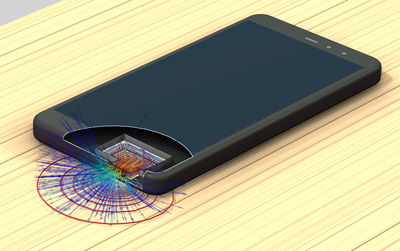
This tutorial model shows how to model a microspeaker located in a smart phone including the radiation through and interaction with the acoustic port that connects to the exterior. The model demonstrates a linear frequency domain analysis as well as a nonlinear time domain analysis. A ... Read More
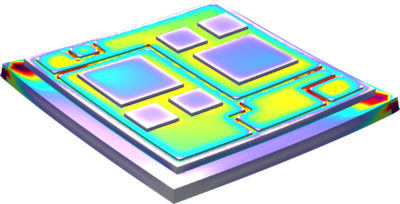
The Highly Accelerated Stress Test (HAST) is a testing technique to precipitate failure of electronic devices under elevated temperature and high humidity environment. This model demonstrates the structural analysis of a plastic encapsulated IGBT module under the HAST testing condition. ... Read More
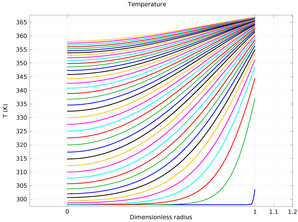
This model approximates 3D spherical transport using a 1D model. Many models of industrial-transport problems allow the assumption that the problem is spherically symmetric. This assumption is of great importance because it eliminates two space coordinates to result in a 1D problem that ... Read More


