
The Application Gallery features COMSOL Multiphysics® tutorial and demo app files pertinent to the electrical, structural, acoustics, fluid, heat, and chemical disciplines. You can use these examples as a starting point for your own simulation work by downloading the tutorial model or demo app file and its accompanying instructions.
Search for tutorials and apps relevant to your area of expertise via the Quick Search feature. Note that many of the examples featured here can also be accessed via the Application Libraries that are built into the COMSOL Multiphysics® software and available from the File menu.
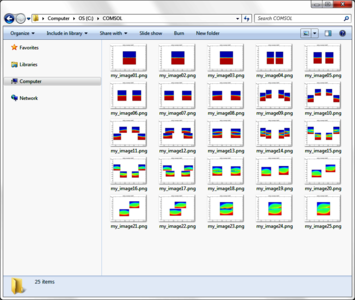
This example demonstrates how to use a parameterized slice plot and animation functionality to export a sequence of images. In addition, the example shows how to use a job sequence to perform a programmatic sequence of operations where the model is first solved and then the image ... Read More
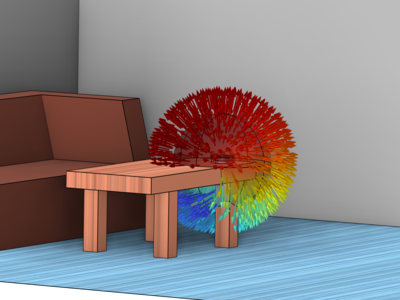
This model combines pressure acoustics and ray acoustics to perform a full frequency range analysis of the room impulse response of a small smart speaker. The source characterization in the ray tracing model is based on a full multiphysics model of the transducer and compares two source ... Read More
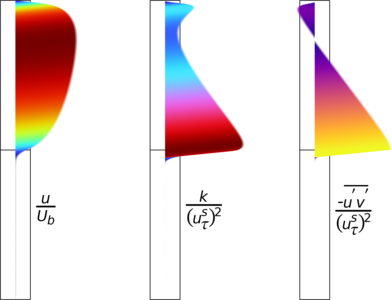
This setup demonstrates how the characteristics of turbulent flow in a channel are modified by the presence of an adjacent porous region. Asymmetric velocity profiles, higher turbulence levels, and higher friction coefficients both at the solid wall and the fluid-porous interface are ... Read More

This model solves the Boltzmann equation in the two-term approximation for a background of molecular and atomic hydrogen. Electron mobility and source terms are computed by suitable integration of the electron energy distribution function over electron impact cross sections. Read More
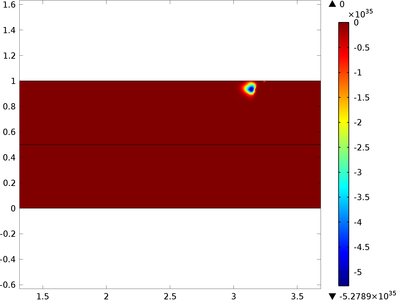
MOSFETs typically operate in three regimes depending on the drain-source voltage for a given gate voltage. Initially the current-voltage relation is linear, this is the Ohmic region. As the drain-source voltage increases the extracted current begins to saturate, this is the saturation ... Read More
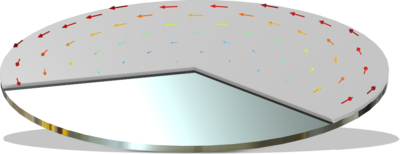
In the semiconductor manufacturing process, photoresist coating is an important process and the thickness of the photoresist layer needs to be precisely controlled. Usually, the photoresist layer is thinned by spin coating. The specific principle is to use centrifugal force to throw ... Read More
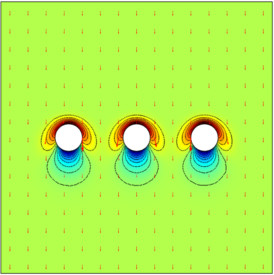
This example utilizes the Richards’ Equation interface to assess how well geophysical irrigation sensors see the true level of fluid saturation in variably saturated soils. The challenge to characterizing fluid movement in variably saturated porous media lies primarily in the need to ... Read More
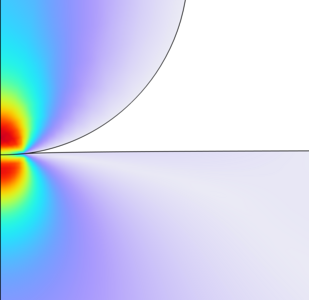
Consider an infinitely long steel cylinder resting on a flat aluminum foundation, where both structures are elastic. The cylinder is subjected to a point load at its top. The objective of this study is to determine the contact pressure distribution and the contact length between the ... Read More
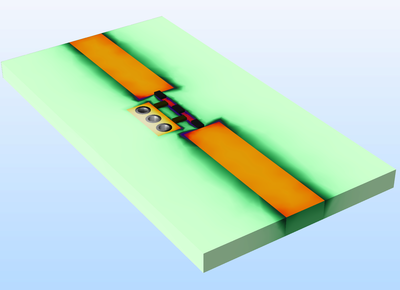
Passive devices can be designed using lumped element features if both the operating frequency of the device and the insertion loss of lumped elements are low. This example simulates two types of lumped element filters that are similar to lumped ports, except that they are strictly ... Read More
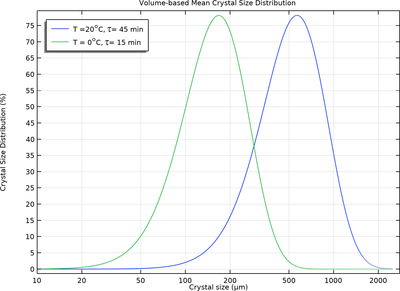
Crystallization is a key separation process in e.g. pharmaceuticals production. It is the process by which a chemical species is separated from solution by forming a crystal. To achieve the required product properties, control over the crystal particle size distribution is necessary. ... Read More


