
The Application Gallery features COMSOL Multiphysics® tutorial and demo app files pertinent to the electrical, structural, acoustics, fluid, heat, and chemical disciplines. You can use these examples as a starting point for your own simulation work by downloading the tutorial model or demo app file and its accompanying instructions.
Search for tutorials and apps relevant to your area of expertise via the Quick Search feature. Note that many of the examples featured here can also be accessed via the Application Libraries that are built into the COMSOL Multiphysics® software and available from the File menu.
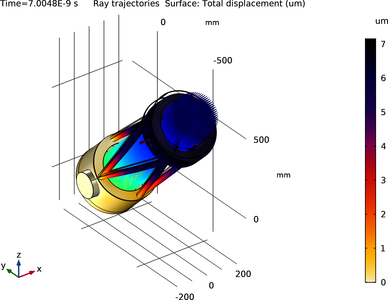
This tutorial demonstrates a structural analysis of a simple telescope. The deformation of the telescope structure under gravity is examined and the effect on image quality is demonstrated. Read More
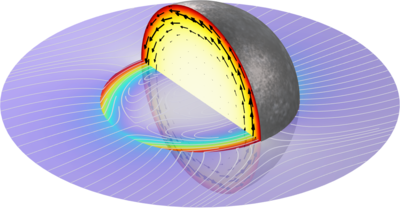
An iron sphere in a magnetic field is an excellent textbook example to demonstrate the effects of a magnetic field interacting with a permeable material. This tutorial series is designed as an introduction to numerically modeling electromagnetic effects with COMSOL. This series ... Read More

This type is one of the most popular laser cavities. In particular, it is often used for the Ti-doped sapphire femto-second laser. The stability of the laser cavity is analyzed by releasing a ray inside the cavity and is traced for a predefined time period that is sufficiently long. ... Read More
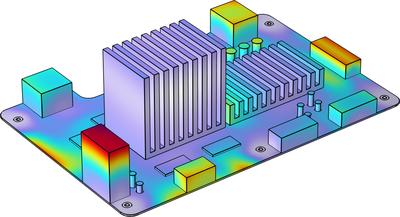
In this example, a random vibration test of electronic equipment is simulated. Three analyses are performed, one for acceleration in each global direction. Accelerations in the components and forces in clamping bolts are evaluated. Read More
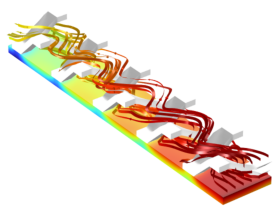
This tutorial models the intercoupled electrochemical reactions, charge and species transport as well as heat transfer in a polymer electrolyte membrane (PEM) fuel cell. For the gas flow fields, straight channels are used on the hydrogen anode side, whereas a mesh structure is used on ... Read More
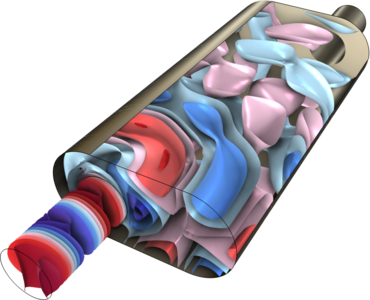
This example describes the pressure wave propagation in a muffler for an internal combustion engine. This example shows how to analyze both inductive and resistive damping in a muffler as well as the use of port boundary conditions. Read More
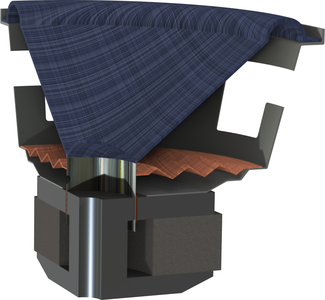
This tutorial shows how to best solve full 3D vibro-electroacoustic multiphysics models of loudspeakers. The model is based on a 3D representation of the existing 2D axisymmetric Application Library model loudspeaker_driver found in the software. The setup of the physics is essentially ... Read More

As an example of a magnetostatic problem, consider how to model a horseshoe-shaped permanent magnet. One way is to treat the entire magnet as a ferromagnetic material, where the two end sections are defined as being pre-magnetized in different and opposite directions. Read More


