
The Application Gallery features COMSOL Multiphysics® tutorial and demo app files pertinent to the electrical, structural, acoustics, fluid, heat, and chemical disciplines. You can use these examples as a starting point for your own simulation work by downloading the tutorial model or demo app file and its accompanying instructions.
Search for tutorials and apps relevant to your area of expertise via the Quick Search feature. Note that many of the examples featured here can also be accessed via the Application Libraries that are built into the COMSOL Multiphysics® software and available from the File menu.
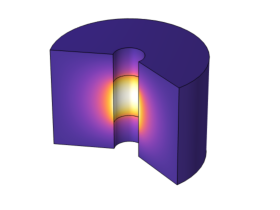
This model how to build and solve a conductive heat transfer problem using the Heat Transfer interface. The model, taken from a NAFEMS benchmark collection, shows an axisymmetric steady-state thermal analysis. As opposed to the NAFEMS benchmark model, we use the temperature unit kelvin ... Read More
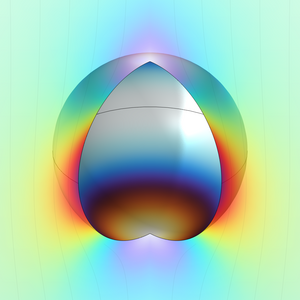
Electroporation is a technique where a localized electric field is used to generate nanometric pores in cell membranes, improving the cell permeability for ions and pharmaceuticals. This model shows the electroporation of a spherical cell by means of a nanosecond electric pulse. The ... Read More

This example compares moisture transport within two types of anisotropic porous medium. The first component defines a layered structure. The structure alternates between layers with high and low moisture diffusivity. So the moisture spreads more easily along the layers than transversely. ... Read More
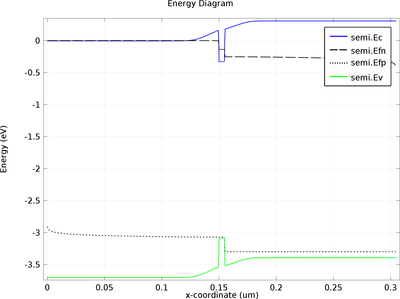
This model simulates a GaN based light emitting diode. The emission intensity, spectrum, and quantum efficiency are calculated as a function of the driving current. Direct radiative recombination across the band gap is modeled, as well as non-radiative Auger and trap-assisted ... Read More
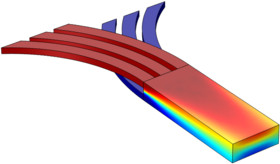
At the macroscopic level, systems usually mix fluids using mechanical actuators or turbulent 3D flow. At the microscale level, however, neither of these approaches is practical or even possible. This model demonstrates the mixing of fluids using laminar-layered flow in a MEMS mixer. This ... Read More
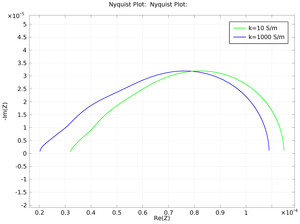
A fuel cell unit cell is modeled using the full Butler-Volmer expression for the anodic and cathodic charge transfer reactions. The anodic and cathodic overpotentials depend on the local ionic and electronic potentials, which are obtained from the charge balance equations for ionic and ... Read More
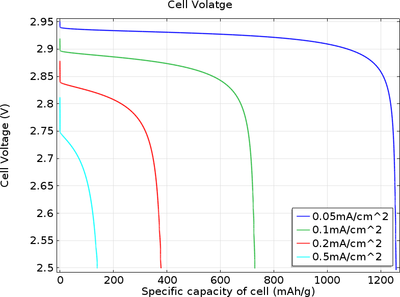
Rechargeable lithium-air batteries have recently attracted great interest mainly due to their high energy density. The theoretical value is about 11400 Wh/kg which is around 10 times greater than the lithium-ion batteries. In this tutorial, discharge of a lithium-air battery is ... Read More
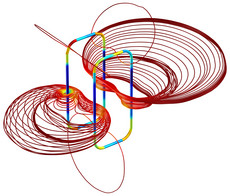
RFIDs are used in a multitude of applications such as tracking or identifying consumer products and their packaging. An RFID system consists of two main parts: A tag or transponder with a printed circuit-board (PCB) antenna A reader unit with a larger RF antennaThe reader antenna ... Read More
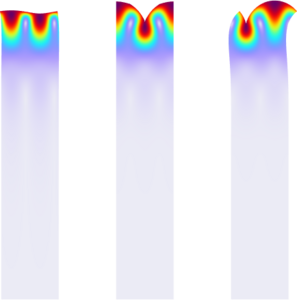
FEM simulation can be used to obtain a SAW velocity and some related parameters (squared electromechanical coupling coefficient, reflectivity, etc.) for different typical configurations. Such parameters are input data for various analytical and semi-analytical methods of SAW device ... Read More
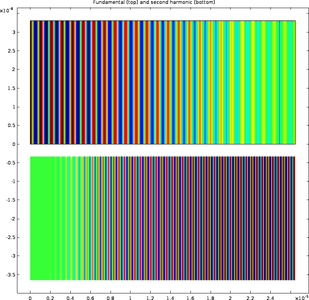
It is more difficult to generate laser emissions in the short-wavelength part of the visible and near visible part of the electromagnetic spectrum than in the long-wavelength part. Nonlinear frequency mixing makes it easier to generate new short wavelengths from existing laser ... Read More


