
The Application Gallery features COMSOL Multiphysics® tutorial and demo app files pertinent to the electrical, structural, acoustics, fluid, heat, and chemical disciplines. You can use these examples as a starting point for your own simulation work by downloading the tutorial model or demo app file and its accompanying instructions.
Search for tutorials and apps relevant to your area of expertise via the Quick Search feature. Note that many of the examples featured here can also be accessed via the Application Libraries that are built into the COMSOL Multiphysics® software and available from the File menu.
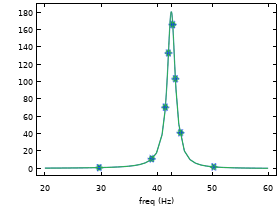
In this verification example, forced random vibrations of a simply-supported deep beam are studied. The beam is loaded by a distributed force with a uniform power spectral density (PSD). The output PSD is computed for the displacement and bending stress response. The computed values are ... Read More
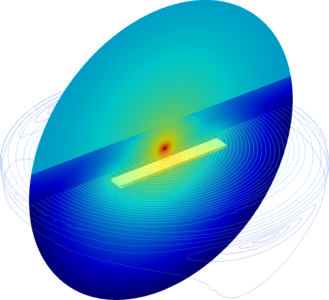
The marine controlled source electromagnetics method (CSEM) for oil prospecting has emerged as a promising technique during recent years. This model demonstrates one variant of it. It uses a mobile horizontal 1 Hz electric dipole antenna that is towed 150 m above the sea floor. An array ... Read More
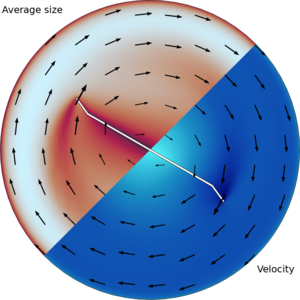
Nanoparticles have become widely used in a range of applications. For example, in pharmaceuticals, particles on the nanoscale, such as nanocrystals, are often used as an effective means of drug delivery. Meanwhile in material sciences, nanoparticle coating is an increasingly common way ... Read More
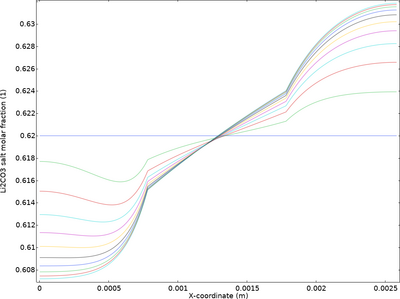
This tutorial shows how to model transport of the individual ions in a salt melt comprising two binary salts, where the transport equations are defined using concentrated solution theory. The example model defines a molten carbonate fuel cell (or electrolyzer), with a 1D-model geometry ... Read More
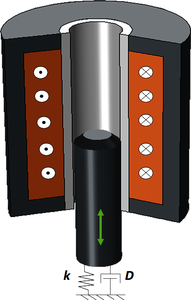
This is a transient model of an electromagnetic plunger consisting of a magnetic core, nonmagnetic guider, multi-turn coil, and magnetic plunger attached to the spring and damper at the far end. The electromagnetic force on the plunger due to the transient current in the coil is ... Read More
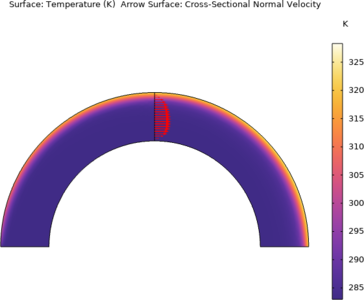
This tutorial illustrates how to use built-in variables and operators, for the evaluation of the bulk temperature along a geometry like a channel, a pipe or a chimney, in a nonisothermal flow in 2D and 3D. The bulk temperature may be needed to compute the heat transfer coefficient for an ... Read More

This model studies the natural frequencies of a pre-tensioned string using the 2D Wire interface. This is an example of “stress stiffening”; in fact the transverse stiffness of wire elements is directly proportional to the tensile force. Strings made of piano wire have an extremely high ... Read More

These two models show how to set up a magnetohydrodynamics model using either a fully coupled approach, or a one-way coupled approach. A more detailed description of these models can be seen in the blog post "Building a Magnetohydrodynamic Multiphysics Model in COMSOL®". Read More

This example involves a static 2D axisymmetric analysis of a piezoelectric actuator using the Piezoelectric Devices physics interface. It models a radially polarized piezoelectric tube, as described by S. Peelamedu and co-authors. An application area where radially polarized tubes are ... Read More

This model example shows how to model nonlinear propagation of a cylindrical wave using the Nonlinear Pressure Acoustics, Time Explicit physics interface available in Acoustics Module of COMSOL Multiphysics. The interface implements the system of nonlinear acoustic equations in the form ... Read More


