
The Application Gallery features COMSOL Multiphysics® tutorial and demo app files pertinent to the electrical, structural, acoustics, fluid, heat, and chemical disciplines. You can use these examples as a starting point for your own simulation work by downloading the tutorial model or demo app file and its accompanying instructions.
Search for tutorials and apps relevant to your area of expertise via the Quick Search feature. Note that many of the examples featured here can also be accessed via the Application Libraries that are built into the COMSOL Multiphysics® software and available from the File menu.
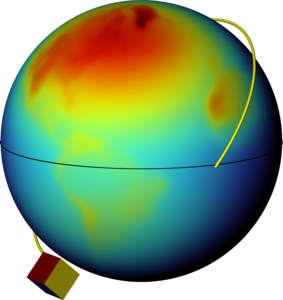
This model demonstrates how to define Earth properties that are spatially varying on the planet. A satellite in orbit experiences solar, albedo, and planetary infrared (IR) loads, where albedo and planetary IR can vary with latitude and longitude. In this example, these inputs are read ... Read More
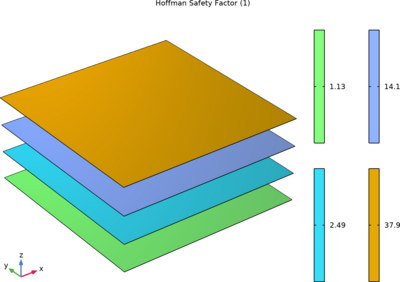
Laminated shells made of carbon-fiber-reinforced polymer (CFRP) are common in a wide variety of applications due to their high strength-to-weight ratio. Laminated shells are widely used in the aerospace, marine, automotive, and manufacturing industries. To ensure reliable designs, it is ... Read More
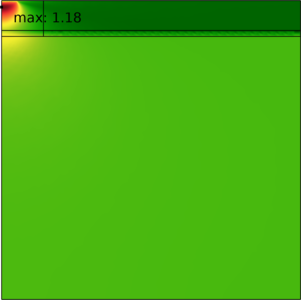
A standing contact fatigue test is a procedure used for testing crack growth on the subsurface level. In such a test, a spherical object is pressed against the tested materials and cycled between a high and low compressive load. No translational movement between the two occurs. After a ... Read More

The underlying physics of a capacitively coupled plasma is rather complicated, even for rather simple geometric configurations and plasma chemistries. This model benchmarks the Capacitively Coupled Plasma physics interface against many different codes. Read More
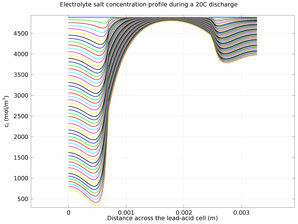
Lead-acid batteries are widely used as starting batteries for various traction applications such as cars and trucks and so forth. The reason for this is the fairly low cost in combination with the performance robustness for a broad range of operating conditions. However, one drawback of ... Read More
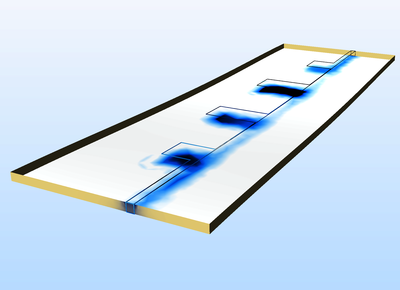
Microstrip filters can be fabricated directly on a printed circuit board (PCB) with a microstrip line going from the input to the output. Along the microstrip line there are a number of stubs of certain lengths and widths. The design of the filter involves choosing the impedance of the ... Read More
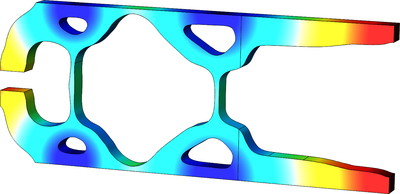
Compliant mechanisms are attractive due to their simplicity, owing to their lack of hinges. In this model we show how to design a set of compliant pliers using topology optimization. The resulting design is post-processed using shape optimization, where the maximum stress is constrained ... Read More
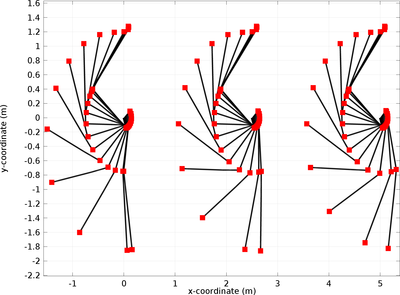
How well you can strike a golf ball is not only determined by your muscle strength, but more importantly it is influenced by the mechanics of golf swing. The outcome of golf stroke is basically determined by the movement of the club head just prior to the impact with the ball. In this ... Read More
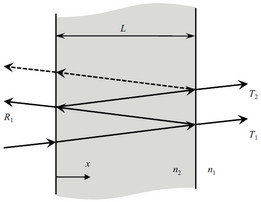
This is an example of a Fabry-Perot cavity, the simplest optical resonator structure. It is a classical problem in optics and photonics. Two methods are shown for computing the Q-factor. The losses in this model are purely via radiation away from the resonator. Read More
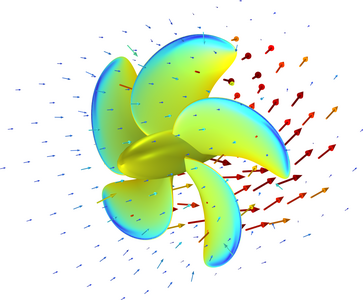
A propeller is the propulsion device of a ship. This model studies the open water performance of the KP505 propeller[1]using the frozen rotor method with RANS turbulence model. Thrust and torque coefficient, and open water efficiency of the propeller at different advance coefficients ... Read More


