
The Application Gallery features COMSOL Multiphysics® tutorial and demo app files pertinent to the electrical, structural, acoustics, fluid, heat, and chemical disciplines. You can use these examples as a starting point for your own simulation work by downloading the tutorial model or demo app file and its accompanying instructions.
Search for tutorials and apps relevant to your area of expertise via the Quick Search feature. Note that many of the examples featured here can also be accessed via the Application Libraries that are built into the COMSOL Multiphysics® software and available from the File menu.
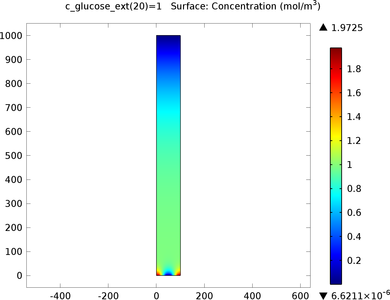
Electrochemical glucose sensors use amperometric methods to measure the concentration of glucose in a sample. This example models the diffusion of glucose and ferri/ferrocyanide redox mediators in a unit cell of electrolyte above an interdigitated electrode. The sensor gives a linear ... Read More
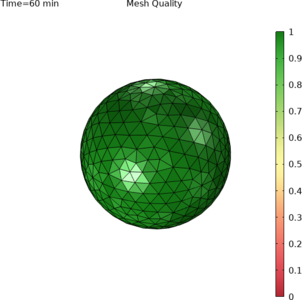
Droplet evaporation is ubiquitous in everyday life and is essential in many industrial processes, such as inkjet printing, cleaning/coating of surfaces, and phase change heat transfer. This model demonstrates how to model phase transition by a moving exterior boundary condition using ... Read More

This model demonstrates how to simulate a piezoelectric transducer as both a sound transmitter and a receiver in a well logging setup. Other applications of this setup are, for example, in the field of nondestructive testing. A transmitting transducer is connected to an electrical ... Read More
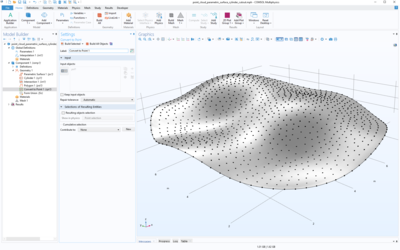
Not all analysis projects start with a CAD model. Sometimes the only data you have available is a set of points, also known as a point cloud. The examples files available here illustrate how point cloud data can be converted to geometry models that can be used for simulation in the ... Read More
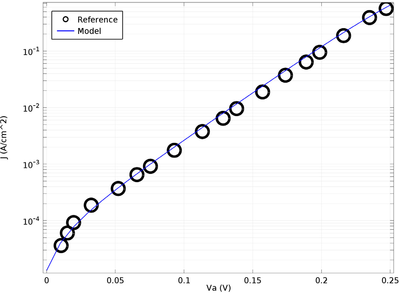
Schottky Contact This benchmark simulates the behavior of an ideal Schottky barrier diode made of a tungsten contact deposited on a silicon wafer. The resulting J-V (current density vs. applied voltage) curve obtained from the model under forward bias is compared with experimental ... Read More
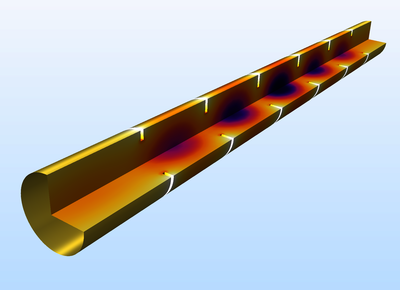
A circular waveguide filter is designed using a 2D axisymmetric model. Six annular rings added to the waveguide form circular cavities connected in series, and each cavity cutoff frequency is close to the center frequency of the filter. The simulated S-parameters show a bandpass ... Read More
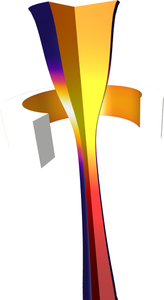
This example is about the modeling of the fiber drawing process. Thermal fiber drawing is a process in which a comparatively thicker structure is heated and drawn into extended lengths of microstructured fiber. This process is done by passing them through the furnace and pulling them ... Read More
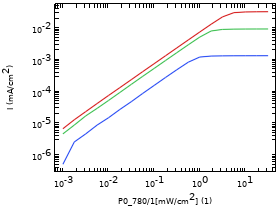
This example shows an approximate approach to model a dot-in-well solar cell as described by Asahi et al. in the reference paper. The quantum wells and the layers of quantum dots are each treated as lumped energy levels in the band gap. The authors specify transitions between the dot ... Read More

This model shows how to simulate the time-dependent adsorption and desorption of water in a vacuum system at low pressures. The water is introduced into the system when a gate valve to a load lock is opened and the subsequent migration and pumping of the water is modeled. Read More
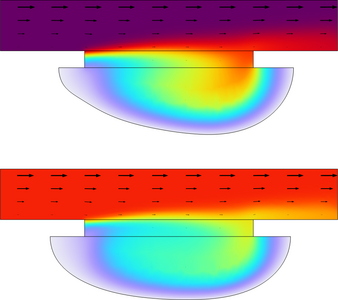
This model illustrates how to improve the symmetry of a wet chemical etching process by varying the convection and chemical concentration as a function time. Read More


