
The Application Gallery features COMSOL Multiphysics® tutorial and demo app files pertinent to the electrical, structural, acoustics, fluid, heat, and chemical disciplines. You can use these examples as a starting point for your own simulation work by downloading the tutorial model or demo app file and its accompanying instructions.
Search for tutorials and apps relevant to your area of expertise via the Quick Search feature. Note that many of the examples featured here can also be accessed via the Application Libraries that are built into the COMSOL Multiphysics® software and available from the File menu.
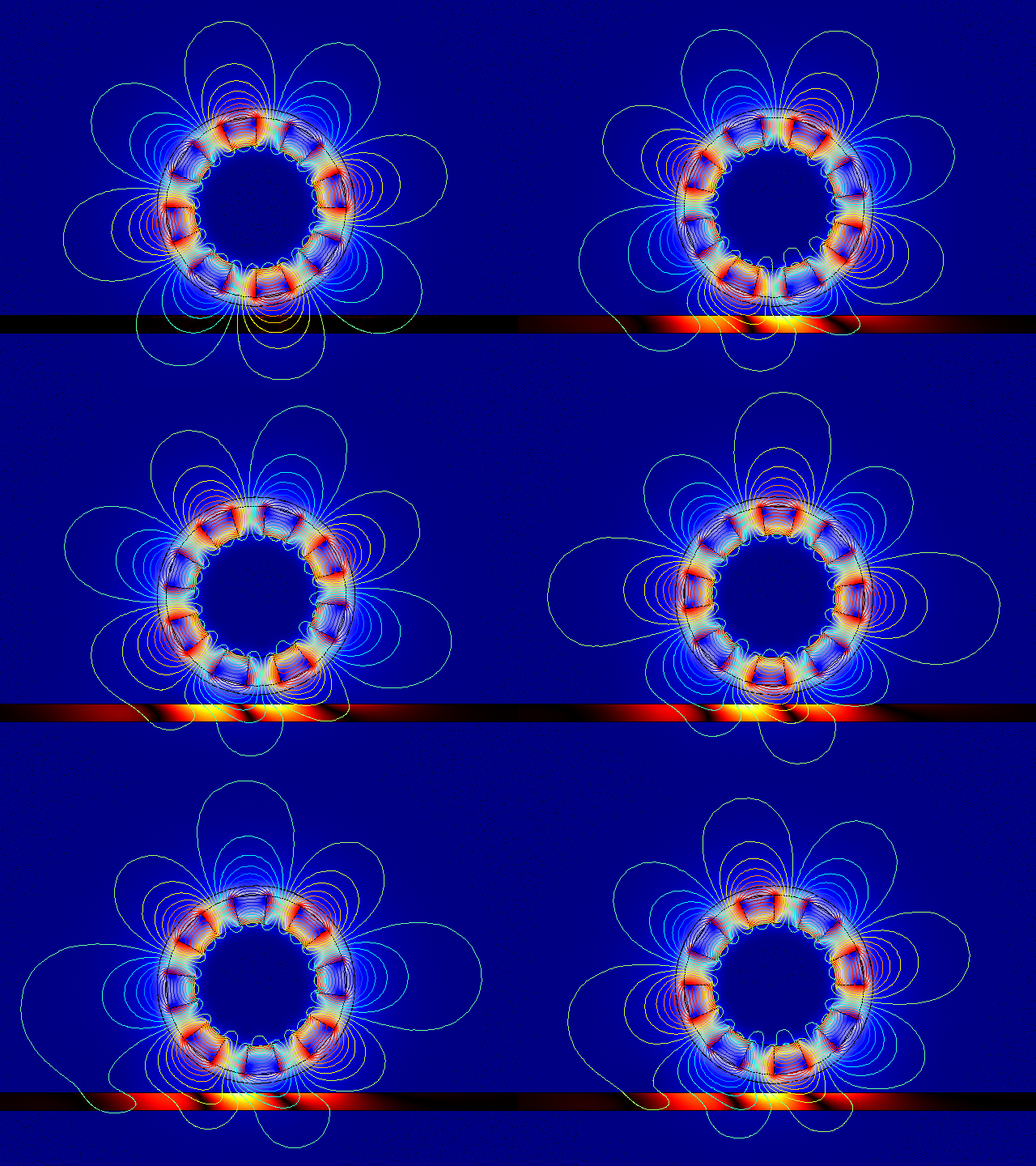
This model illustrates the working principle of an electrodynamic wheel (EDW) magnetic levitation system. EDW magnetic levitation system consists of rotating and/or translationally moving permanent magnet Halbach rotor above a passive conducting guideway/track. Eddy current is ... Read More

This example shows how to implement a stress dependent material model. The Young's modulus changes based on the stress value. Read More
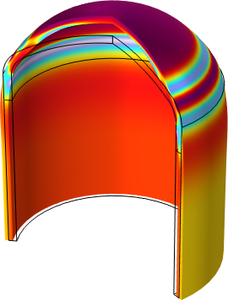
A thin-walled container made of rolled steel is subjected to an internal overpressure. As an effect of the manufacturing method, one of the three material principal directions — the out-of- plane direction — has a higher yield stress than the other two. Hill’s orthotropic plasticity is ... Read More
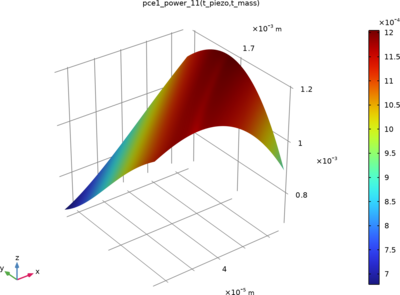
Uncertainty Quantification (UQ) is used to study the effect of manufacturing variation on the performance of Piezoelectric Energy Harvester. This tutorial shows how UQ studies are specified for a frequency domain study that calculates the energy harvester's power output. Read More
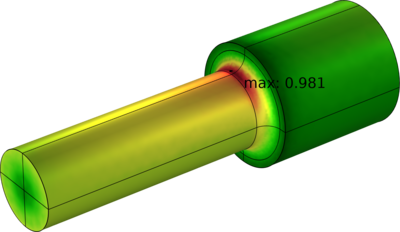
This example shows how to perform a High Cycle Fatigue (HCF) analysis with a non-proportional load history caused by a transversal force and a torque which are applied in different combinations. Three different fatigue models (Findley, Matake, and Dang Van) are compared. Read More
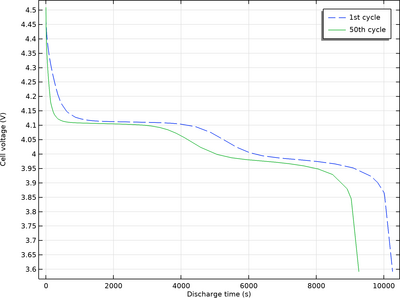
Some positive electrode materials are known to deteriorate in overcharged lithium-ion battery cells. Predominantly, manganese containing electrode materials such as LMO and NMC can loose capacity due to manganese dissolving from the materials at overcharge. This decomposition is a ... Read More
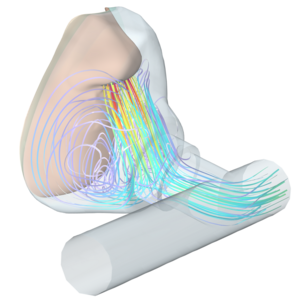
When designing oxygen masks for delivering respiratory support to patients via BiPAP and CPAP, multiphysics modeling helps visualize the flow pattern inside the mask for a given design. From there, it is possible to estimate oxygen consumption, carbon dioxide accumulation, and ... Read More
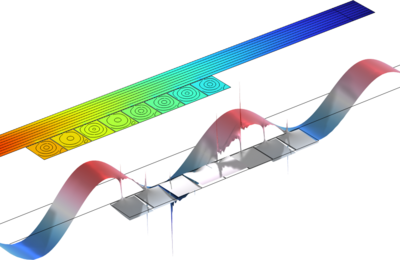
This model demonstrates how to compute the acoustic properties of an acoustic liner with a grazing flow. The liner consists of eight resonators with thin slits. The background grazing flow is at Mach number 0.3. The sound pressure level above the liner is computed and can be compared to ... Read More
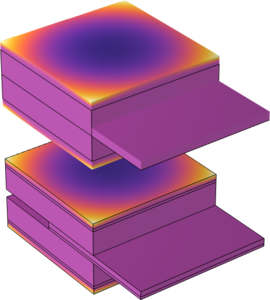
This tutorial model demonstrates the use of the multiphysics coupling feature Thermal Connection, Layered Shell, Surfaces. In this model, three layered shells are connected to heat domains by interior and exterior boundaries. The results obtained with the Heat Transfer in Shells ... Read More
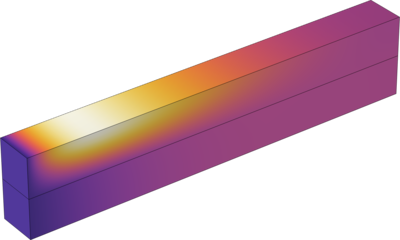
This example models heat generation in a beam-like structure subjected to small amplitude vibrations. The model computes the linear elastic response in the frequency domain. The transient heat-transfer analysis simulates the slow-rising temperature in the beam using the heat generated ... Read More


