
The Application Gallery features COMSOL Multiphysics® tutorial and demo app files pertinent to the electrical, structural, acoustics, fluid, heat, and chemical disciplines. You can use these examples as a starting point for your own simulation work by downloading the tutorial model or demo app file and its accompanying instructions.
Search for tutorials and apps relevant to your area of expertise via the Quick Search feature. Note that many of the examples featured here can also be accessed via the Application Libraries that are built into the COMSOL Multiphysics® software and available from the File menu.
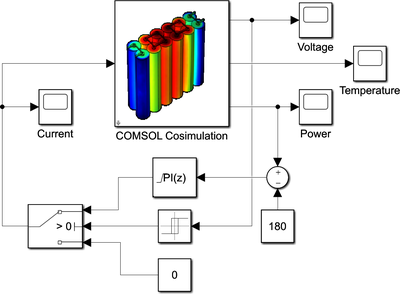
This model computes the temperature distribution in a battery pack that is in use at a specified power. The current is controlled in Simulink® to ensure constant power during usage. Read More
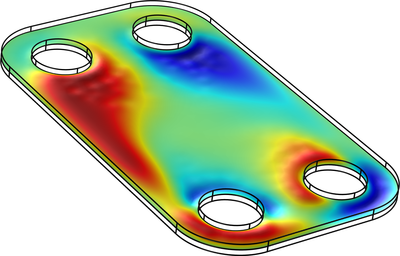
This model demonstrates how to use the built-in shape optimization functionality to improve the performance of a plate heat exchanger. The optimization reduces the path immediately in front of the inlets and outlets to increase the length of typical streamlines. This leads to a improved ... Read More
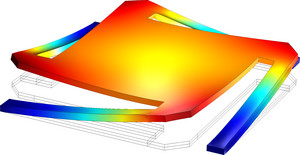
One method of creating spring-like structures or inducing curvature in thin structures is to plate them to substrates that are under the influence of residual stresses. The plating process can control this stress even for similar materials. One such device is the electrostatically ... Read More
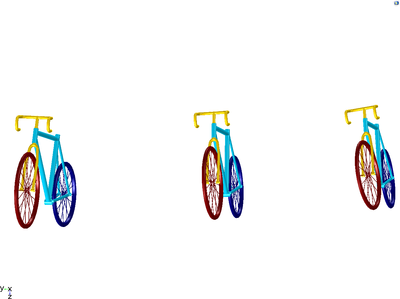
This model demonstrates the motion of a bicycle with a hands-free rider when given an initial forward velocity and perturbed with a lean about the forward axis. This is implemented through the Multibody Dynamics module in COMSOL. The wheels of the bicycle have been modelled assuming ... Read More
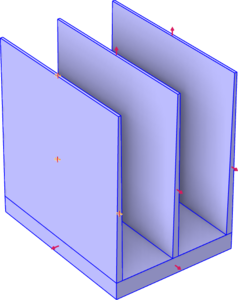
These tutorial models show how to use the tools to assist with defining surface-to-surface radiation models. In the first model, radiation direction symbols are used to find an unexpected configuration where the opacity is not correctly defined. In the other, the topology check ... Read More
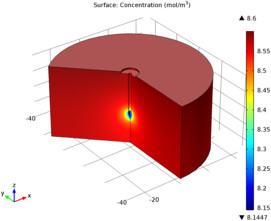
This tutorial example serves as an introduction to the Corrosion Module and models the metal oxidation and oxygen reduction current densities on the surface of a galvanized nail, surrounded by a piece of wet wood, which acts as electrolyte. The protecting zinc layer on the nail is not ... Read More

In this example, the natural frequencies of a double hat beam are studied. The beam is made of two thin steel plates, joined together by spot welds along the flanges. The Spot Welds feature sets up multiple mesh-independent connections between the shells. Read More
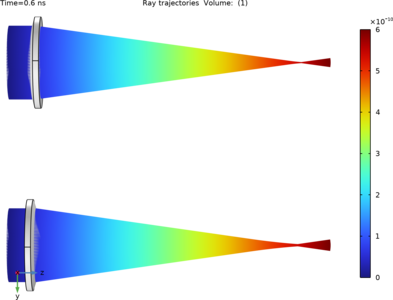
Light collimation or focusing is a basic task often needed when working with lasers in the lab where singlets are used due to their simplicity. If a plano-convex lens is used for the task, there is a correct lens orientation that minimizes aberrations. A useful rule-of-thumb is to ... Read More
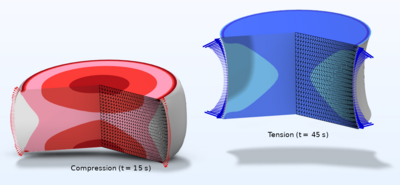
This model demonstrates how to set up a fully coupled poroviscoelastic model of biological tissues. The model is benchmarked by simulating a cyclic uniaxial tension–compression test on human brain tissue. Read More
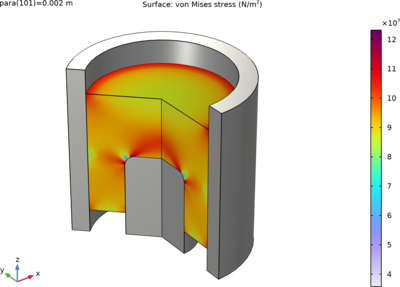
The fabrication of a cup through powder compaction is simulated in this tutorial model. The powder compaction process is becoming common in the manufacturing industry, due to its potential for producing components of complex shape and high strength. Combining the Fleck–Kuhn–McMeeking ... Read More


