
The Application Gallery features COMSOL Multiphysics® tutorial and demo app files pertinent to the electrical, structural, acoustics, fluid, heat, and chemical disciplines. You can use these examples as a starting point for your own simulation work by downloading the tutorial model or demo app file and its accompanying instructions.
Search for tutorials and apps relevant to your area of expertise via the Quick Search feature. Note that many of the examples featured here can also be accessed via the Application Libraries that are built into the COMSOL Multiphysics® software and available from the File menu.
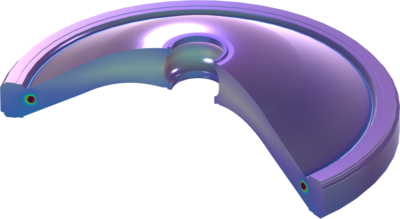
Basin-type insulators are essential components in Gas-Insulated Metal-Enclosed Switchgear (GIS). During manufacturing, the epoxy resin curing process can generate residual stresses that may lead to crack formation. Over time, such cracks can trigger partial discharges, degrading the ... Read More
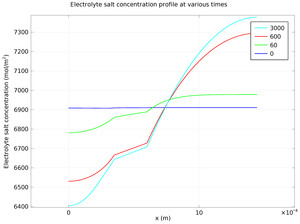
This model simulates the discharge of a Nickel-Metal Hydride (NiMH) battery using the Battery with Binary Electrolyte interface. The geometry is in one dimension and the model is isothermal. The model serves as an introduction to NiMH modeling, and can be further extended to include ... Read More

This application demonstrates how you can access and include external thermodynamic and physical property calculations in your simulation, using the Thermodynamics feature. The example shows how you can easily modify the predefined Plug-flow reactor type in the Reaction Engineering ... Read More
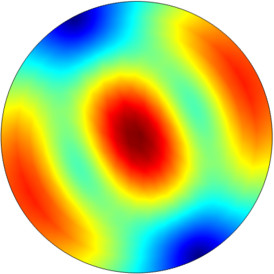
In mode analysis it is usually the primary goal to find a propagation constant. This quantity is often, but not always, real valued; if the analysis involves some lossy part, such as a nonzero conductivity or an open boundary, the eigenvalue is complex. In such situations, the real and ... Read More
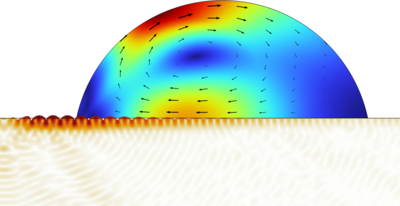
When a droplet is placed on a substrate on which surface acoustic waves (SAWs) are traveling, the energy of the SAWs is transferred into the droplet to form an acoustic field. The transferred energy is attenuated and generates a streaming flow. This type of streaming enables contactless ... Read More
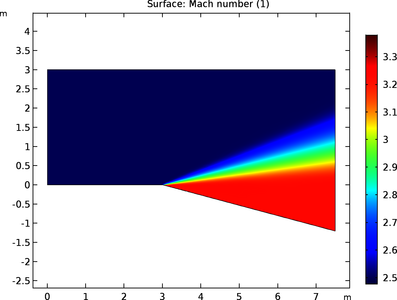
An important and interesting phenomenon with supersonic flows are expansion fans, which take place when the flow encounters a convex or expansion corner. The direction of the flow changes smoothly across the fan, while the Mach number increases. This 2D example models an expansion fan ... Read More

The common electroanalytical method of exhaustive amperometric detection in a microscopic thin layer is modelled as a 1D-symmetric diffusion problem. The simulated result agrees with the analytical Cottrell equation at short times, and deviates as expected at long times when the ... Read More

This tutorial drives a capacitively coupled plasma with an L-type matching network at high and low powers. At low power, where the harmonics in the current are low, prefect matching is obtained at the chosen power value. Sweeps over power, frequency, and pressure are performed and their ... Read More
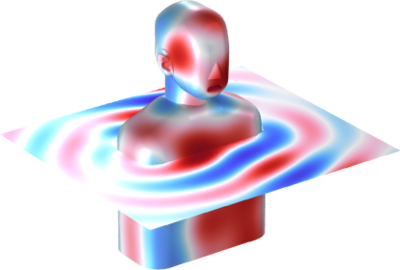
In this model, we use the Pressure Acoustics, Boundary Elements physics interface to analyze the acoustics of a generic head and torso simulator. This is a manikin head used to do standardized measurements for hearing aids, mobile phones, and headphones. The model showcases some ... Read More

The Whirling of a Uniform Shaft tutorial model demonstrates how to perform a transient analysis of a uniform shaft under gravity. The shaft is supported by two hydrodynamic bearings at its ends. The gyroscopic effect causes the rotor to whirl about its initial axis, until it eventually ... Read More


