
The Application Gallery features COMSOL Multiphysics® tutorial and demo app files pertinent to the electrical, structural, acoustics, fluid, heat, and chemical disciplines. You can use these examples as a starting point for your own simulation work by downloading the tutorial model or demo app file and its accompanying instructions.
Search for tutorials and apps relevant to your area of expertise via the Quick Search feature. Note that many of the examples featured here can also be accessed via the Application Libraries that are built into the COMSOL Multiphysics® software and available from the File menu.
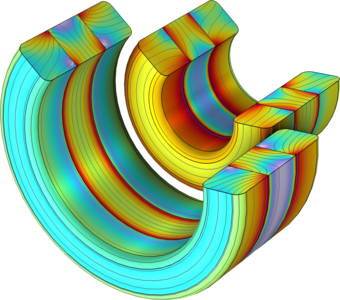
The model compare the electromagnetic force calculated by virtual work and maxwell stress tensor methods on the axial magnetic bearing. The forces is evaluated by studying the effect of a small displacement on the electromagnetic energy of the system. This is done by using the Magnetic ... Read More
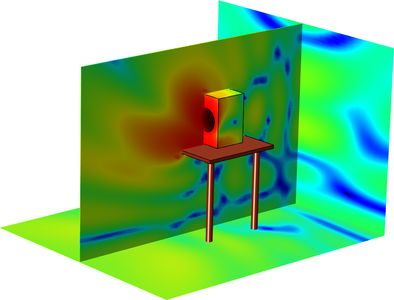
In this tutorial, the acoustic radiation pattern from a small generic loudspeaker is analyzed using the boundary element method (BEM). The loudspeaker is located on a small table above the floor and at a given distance from a wall. The model is set up using the Pressure Acoustics, ... Read More
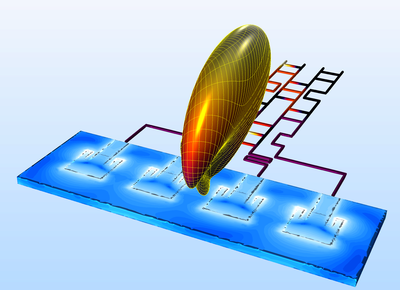
A Butler matrix is a passive beamforming feed network. It is a cost-effective feed network for phased array antennas because the circuit can be fabricated in the form of microstrip lines and is a viable solution for performing beam scanning without deploying expensive active devices. ... Read More
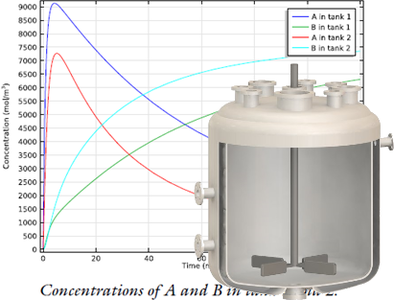
In the chemical and biochemical industries, for instance in fermentation processes, reactors having well-mixed conditions and liquid level control are common. This example shows modeling of a 0D ideal system of tank reactors in series with controlled feed inlet and product outlet ... Read More
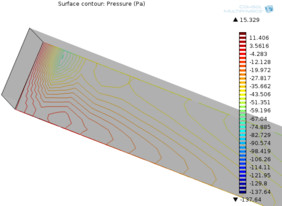
A lab-on-a-chip platform can be realized on a rotating disc by designing channels and other features to use the Coriolis or centrifugal forces to manipulate the flow. These forces are controlled by changing the angular velocity of the disc, so the platform is programmed by using a ... Read More
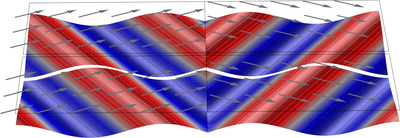
It is possible to engineer the structure of materials such that both the permittivity and permeability are negative. Such materials are realized by engineering a periodic structure with features comparable in scale to the wavelength. It is possible to model both the individual unit cells ... Read More
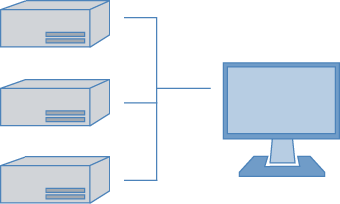
Use this app to validate that the default settings correctly submit jobs to a cluster. These default settings are taken from the preferences. The app allows you to override the default cluster settings, test modifications to the current setup, and test different settings for connecting ... Read More
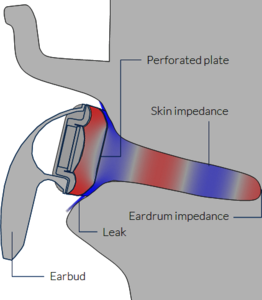
This conceptual model analyzes the influence of leaks on the acoustic response of an earbud speaker placed in an ear-canal-like geometry. Built-in impedance models are used to capture the effects of a perforated plate in front of the speaker, skin impedance, and ear drum impedance. The ... Read More
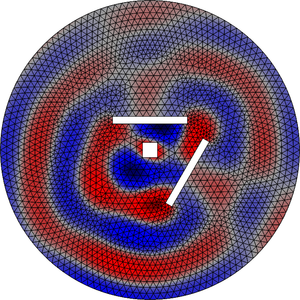
This simple tutorial model shows how to set up a parametric sweep over a number of frequency bands (octaves or 1/3 octaves) and remesh once per band. A frequency sweep is performed within each band, which now has an adequate mesh resolution. This approach saves some computational effort ... Read More
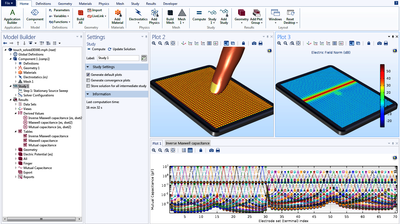
Intended as a tool for early proof of concept in capacitive touchscreen device development, the Touchscreen Simulator app evaluates a simulated capacitance matrix as well as the electric field norm. The app computes the capacitance matrix of a touchscreen in the presence of a human ... Read More


