
The Application Gallery features COMSOL Multiphysics® tutorial and demo app files pertinent to the electrical, structural, acoustics, fluid, heat, and chemical disciplines. You can use these examples as a starting point for your own simulation work by downloading the tutorial model or demo app file and its accompanying instructions.
Search for tutorials and apps relevant to your area of expertise via the Quick Search feature. Note that many of the examples featured here can also be accessed via the Application Libraries that are built into the COMSOL Multiphysics® software and available from the File menu.
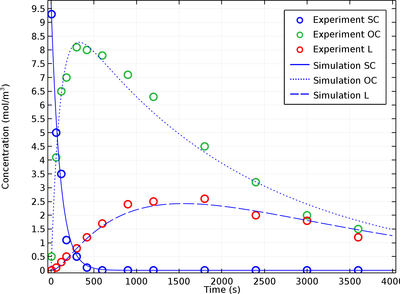
Biotechnology is a rapidly growing area in the pharmaceutical sciences. One example of a clinical application is gene therapy, where it is possible to produce proteins in vivo, using the body’s own mechanisms for protein production. Major issues in gene delivery involve the transport of ... Read More
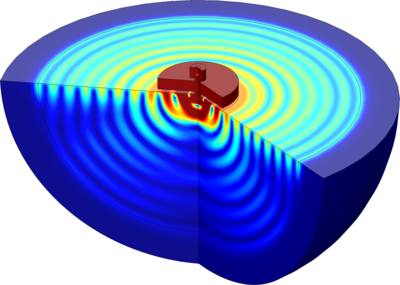
This model shows how to compute the anchor loss limited quality factor of a diamond disc resonator. The resonator is anchored to the substrate by a polysilicon post and power is transmitted to the substrate through the post. A perfectly matched layer is used to represent the essentially ... Read More
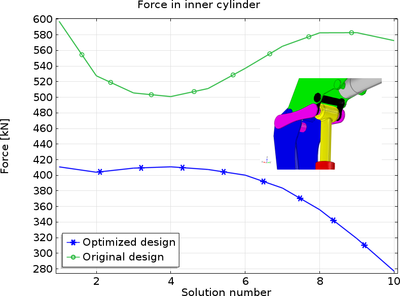
In complex mechanical systems, it can be challenging to find an optimal (or even good enough) solution only through engineering insight or trial-and-error procedures. Using mathematical optimization methods can then be an efficient path to a better design. In this example, a link ... Read More
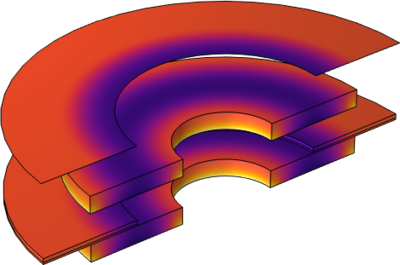
This tutorial model demonstrates the use of the multiphysics coupling feature Thermal Connection, Layered Shell, Surfaces. In this model, one layered shell is connected to heat domains by a facing boundary. The results obtained with the Heat Transfer in Shells interface are compared with ... Read More
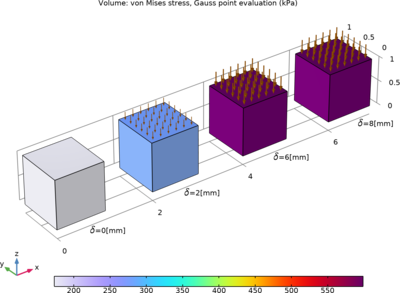
This model shows how to set up a uniaxial compression test on a prestressed soil sample. Due to uniaxial compression and simple initial stress values, it is possible to determine the vertical yield stress analytically. The soil sample is modeled with soil plasticity and the Mohr–Coulomb ... Read More
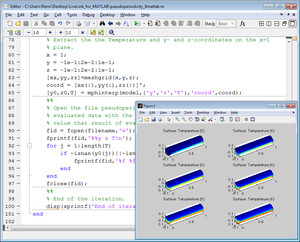
This model simulates convective heat transfer in a channel filled with water. To reduce memory requirements, the model is solved repeatedly on a pseudo-periodic section of the channel. Each solution corresponds to a different section, and before each solution step the temperature at the ... Read More
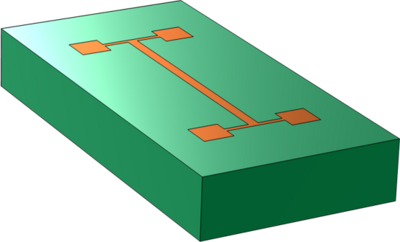
This model shows how to define a frequency-domain analysis of heat transfer. The 3-omega method uses the Cahill's equation to approximate the thermal conductivity of a sample from the measured temperature of a metal strip placed on top of it and subject to oscillating heating. The 2D ... Read More
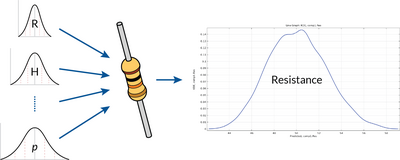
This example demonstrates how to apply the Uncertainty Quantification (UQ) Module in COMSOL Multiphysics to analyze the performance and reliability of a simple resistor. Small variations in material properties, geometry, and manufacturing processes can significantly impact the resistance ... Read More
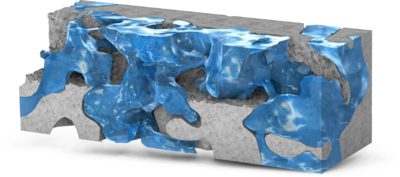
Digital Rock technology utilizes high-resolution imaging techniques, such as SEM and X-ray CT, to characterize the pore structures of rock cores. This approach enables pore-scale modeling of reservoir rocks, offering valuable insights into pore morphology, connectivity, and fluid ... Read More
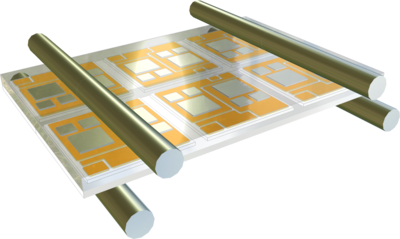
The four-point bending test is a conventional test method used to test the mechanical properties of materials subjected to bending. It is a reliability test used for semiconductor packaging and assembly. This model demonstrates the stress analysis of an IGBT module subjected to a four ... Read More


