
The Application Gallery features COMSOL Multiphysics® tutorial and demo app files pertinent to the electrical, structural, acoustics, fluid, heat, and chemical disciplines. You can use these examples as a starting point for your own simulation work by downloading the tutorial model or demo app file and its accompanying instructions.
Search for tutorials and apps relevant to your area of expertise via the Quick Search feature. Note that many of the examples featured here can also be accessed via the Application Libraries that are built into the COMSOL Multiphysics® software and available from the File menu.

In this example, a heat transfer model of a fiber composite's unit cell is analyzed with the Cell Periodicity feature. The homogenized thermal conductivity, density and heat capacity of a composite material are computed based on the individual properties of fiber and matrix. A comparison ... Read More
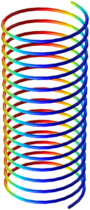
This model computes the trajectory of an ion in a uniform magnetic field using the Newtonian, Lagrangian and Hamiltonian formulations available in the Mathematical Particle Tracing interface. Read More
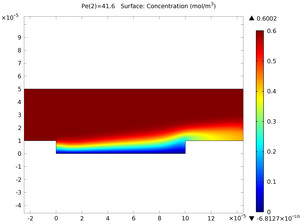
This model demonstrates the impact of convection and diffusion on the transport-limited electrodeposition of a copper microconnector bump (metal post). Microconnector bumps are used in various types of electronic applications for interconnecting components, for instance liquid crystal ... Read More
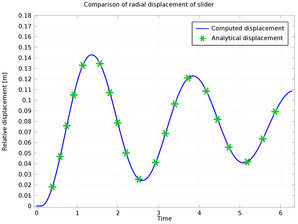
This model illustrates the modeling of slider motion caused by a base rotation. The motion of the slider is analyzed under various forces such as inertia force, centrifugal force, spring force and damping force. The prismatic joint, which is used to connect the two components, is spring ... Read More
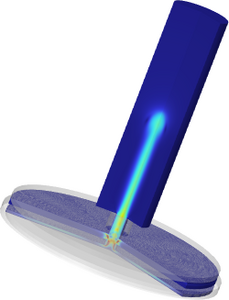
Piezoelectric microblowers are compact, lightweight air pumps with varying applications including electronics cooling and airflow related medical devices. The device consists of a PZT-brass diaphragm and a specially designed housing including a pumping chamber, air inlet and outlet ... Read More
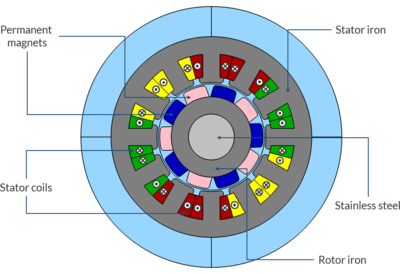
This is a primer model of a permanent magnet machine. It is a generic model that can be modified to simulate a motor or generator. It demonstrates different capabilities of COMSOL Multiphysics® to examine aspects of machine design, such as air gap magnetomotive force (MMF), ... Read More
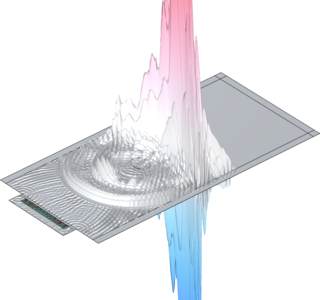
This tutorial demonstrates how to model ultrasound imaging in human tissue using an imaging probe composed of piezoelectric arrays that generate steered and focused beams. Simulating this process requires a transient multiphysics model to accurately capture sound generation, propagation, ... Read More
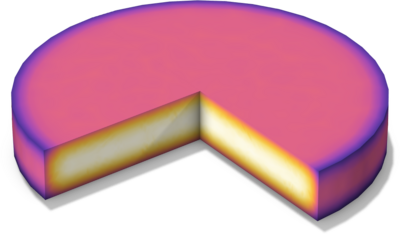
The purpose of this model is to introduce the Semitransparent Surface Feature from the Radiation in Participating Media Interface. It is a variation of the Radiative Cooling of a Glass Plate model with the DOM method. In this version a semitransparent surface is defined on external ... Read More
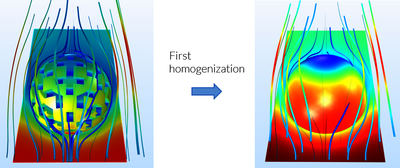
A catalyst particle with a hypothetical microstructure is described in detail. The heterogeneous description is approximated in a second model with a homogeneous particle and the results from the two approaches are compared. See: https://www.comsol.se/blogs/modeling-approaches-in ... Read More
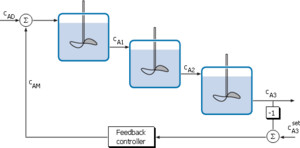
This example illustrates how to set up and solve a tank-in-series model in 0D using the Reaction Engineering interface. The model treats a series of three consecutive tank reactors. A feedback loop continuously adjusts the inlet concentration of the first tank to keep the concentration ... Read More


