
The Application Gallery features COMSOL Multiphysics® tutorial and demo app files pertinent to the electrical, structural, acoustics, fluid, heat, and chemical disciplines. You can use these examples as a starting point for your own simulation work by downloading the tutorial model or demo app file and its accompanying instructions.
Search for tutorials and apps relevant to your area of expertise via the Quick Search feature. Note that many of the examples featured here can also be accessed via the Application Libraries that are built into the COMSOL Multiphysics® software and available from the File menu.
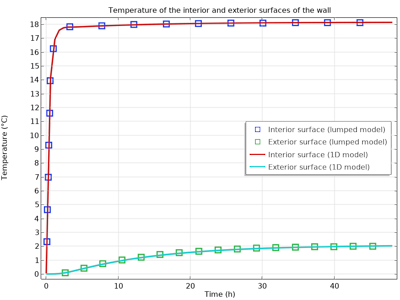
This model performs a transient analysis of the temperature through a house wall. The wall is formed of different layers corresponding to the structure, insulation and plaster. On the exterior and the interior, the wall is exposed to thermal radiation and convective cooling. The results ... Read More
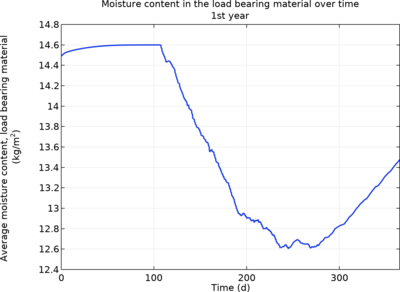
This tutorial demonstrates how to simulate coupled heat and moisture transport in an insulated roof structure composed of a load-bearing layer and an insulation layer. The thermal insulation faces the interior, while a moisture barrier is placed on the exterior side. The load-bearing ... Read More
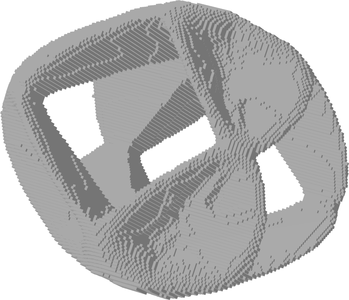
Topology optimization is associated with extreme design freedom which can yield extreme performance. The designs can be easier to manufacture by using milling constraints, at some cost to the performance. This example considers the case of a torsion sphere which is known to feature a ... Read More
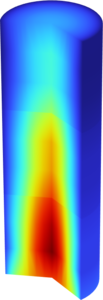
This model simulates a cylindrical furnace with isotropic scattering. It validates the use of the Discrete Ordinates Method for 2D axisymmetric cases, comparing the results with the highly accurate Monte Carlo method. The setup and reference Monte Carlo values are given in: R .P. Gupta, ... Read More
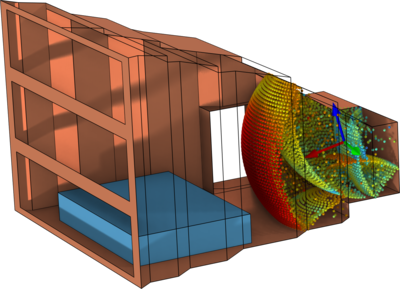
These models introduce how to perform convolution via the convolution integral, discrete convolution, and convolution theorem. Specifically, they show how to implement convolution by applying these methods to the low-pass filtering of a room impulse response (IR) and the auralization of ... Read More
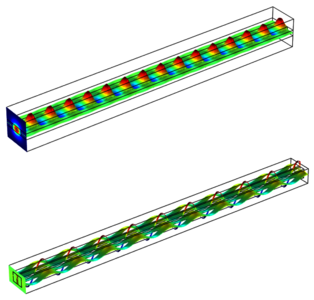
A 3D silicon waveguide is set up with rib and slot configurations. The meshing includes physics-controlled mesh, with the number of longitudinal mesh elements set to 50 to visualize the wave oscillation. The detailed discussion of the model setup is discussed in the blog post: "Silicon ... Read More
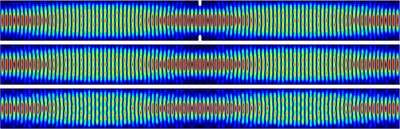
This model demonstrates three different ways to find the eigenfrequencies of a rectangular metallic cavity. The first method uses an eigenfrequency study step together with the Electromagnetic Waves, Beam Envelopes interface. Here, it is important to define a wave vector for the physics ... Read More
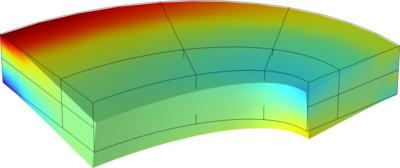
A benchmark model where a thick plate exposed to pressure on the top surface is analyzed. The solution is compared with a NAFEMS benchmark solution. Read More

This tutorial model explores the behavior of a microwave plasma torch. The plasma is generated within a dielectric tube inserted in a rectangular waveguide. The simulation solves the coupled equations for plasma transport and heating, microwave electromagnetic fields, fluid flow, and ... Read More
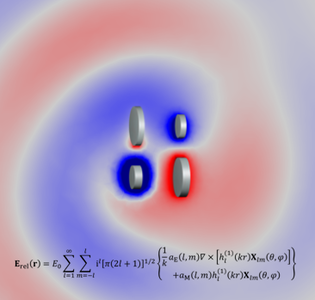
The multipole expansion is a powerful tool for analyzing electromagnetic waves scattered by small objects. In the expansion, the scattered field is represented as a superposition of the fields created by a finite set of point multipoles. Each point multipole is connected to a unique ... Read More


