
The Application Gallery features COMSOL Multiphysics® tutorial and demo app files pertinent to the electrical, structural, acoustics, fluid, heat, and chemical disciplines. You can use these examples as a starting point for your own simulation work by downloading the tutorial model or demo app file and its accompanying instructions.
Search for tutorials and apps relevant to your area of expertise via the Quick Search feature. Note that many of the examples featured here can also be accessed via the Application Libraries that are built into the COMSOL Multiphysics® software and available from the File menu.
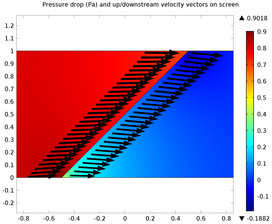
This model simulates the flow through a uniform inclined screen using the Screen feature in Single-Phase Flow physics and compares the results with an analytic solution. Read More
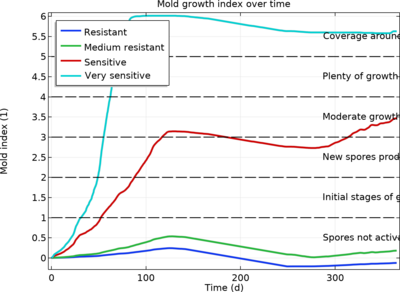
This tutorial demonstrates how to use the temperature and relative humidity computed from a heat and moisture transport simulation of an insulated roof as inputs for a mold prediction model. The VTT model for mold growth and decline prediction calculates a mold index M by solving an ... Read More
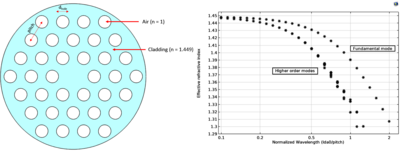
This model represents index guided photonic crystal fiber as discussed in the J. D. Joannopoulus book. The dispersion diagram of the fundamental and higher order modes matches well with Chapter 9, Figure 4. The hole radius is varied from 0.23[um] to 4.69[um]. J.D. Joannopoulus, R.D. ... Read More
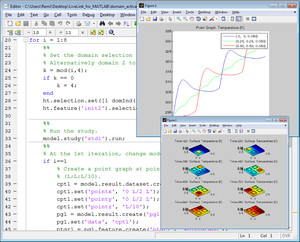
Heating of an object from alternating regions is one example where the modeling technique of activating and deactivating physics on domains can be useful. This model demonstrates how you can apply this technique using LiveLink™ for MATLAB®. Read More
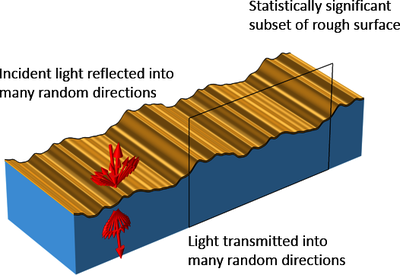
These examples demonstrate how to compute the total reflection, transmission, and absorption of light when a plane wave, at optical wavelengths, is incident upon a dielectric slab with a thin metal coating. Three examples are included that show: An optically flat slab A slab with a ... Read More
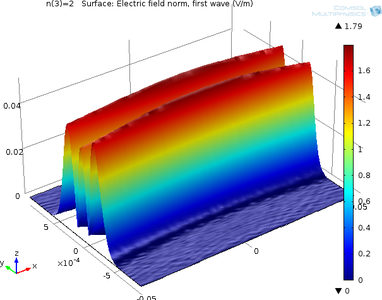
This model demonstrates how a nonlinear equation system can be setup to solve for the eigenfrequencies of a symmetric laser cavity. The model uses the bidirectional formulation of the Electromagnetic Waves, Beam Envelopes physics interface. The computed eigenfrequencies are verified with ... Read More
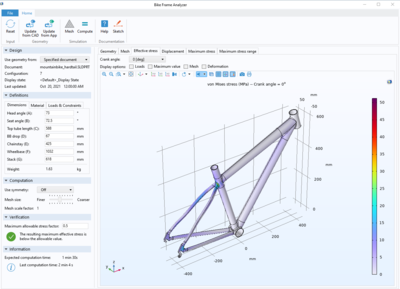
The reliability of a bike frame can be estimated by analyzing the structural stress subjected to different load cases. This app leverages LiveLink™ for SOLIDWORKS® to interactively update the geometry while computing stress analyses. Using this app, you can easily test different ... Read More
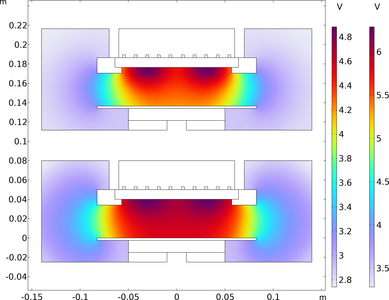
Electron transport in low-temperature plasmas depends strongly on the electron energy distribution function (EEDF), which is often approximated as Maxwellian but is frequently nonequilibrium in reality. Incorporating nonequilibrium EEDF behavior into spatially dependent models often ... Read More
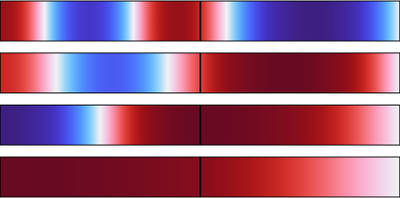
This tutorial demonstrates how to model the interaction between an acoustic field and the heat release from a flame, using the Flame Model domain feature. Modeling this interaction is important in order to understand and predict unstable acoustic modes in gas turbines and jet engines. ... Read More
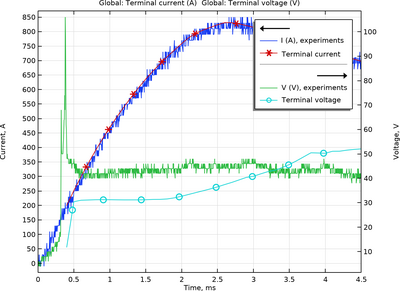
This model presents a 2D simulation of transient arc discharge movement along guided copper rails. While accurately modeling transient arcs typically requires a 3D simulation, the 2D approach offers greater efficiency and remains valuable for initial investigations and demonstration ... Read More


