
The Application Gallery features COMSOL Multiphysics® tutorial and demo app files pertinent to the electrical, structural, acoustics, fluid, heat, and chemical disciplines. You can use these examples as a starting point for your own simulation work by downloading the tutorial model or demo app file and its accompanying instructions.
Search for tutorials and apps relevant to your area of expertise via the Quick Search feature. Note that many of the examples featured here can also be accessed via the Application Libraries that are built into the COMSOL Multiphysics® software and available from the File menu.
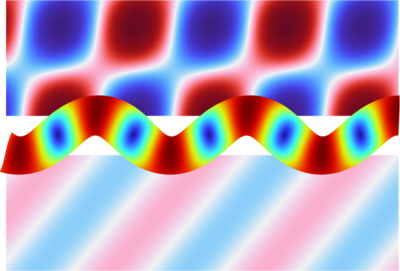
In this model, two fluids are separated by a solid elastic structure. An acoustic pressure wave impacts the structure resulting in a reflected wave and a wave transmitted with a loss through the structure. This model investigates the transmission loss through the structure. The effects ... Read More
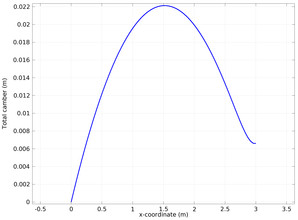
In this example you will build and solve a 3D beam model using the 3D Beam interface. This model shows how a thermally induced deformation of a beam is modeled. Temperature differences are applied across the top and bottom surfaces as well as the left and right surfaces of the beam. ... Read More

The Helmholtz filter is a popular technique for imposing a minimum length scale in structural topology optimization, but certain applications also call for a maximum length scale. This model demonstrates how to achieve this using an extra PDE filter. Read More
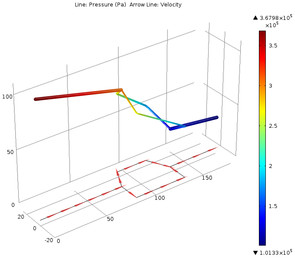
The Pipe Flow interface allows you to simulate non-Newtonian fluids flowing in pipes. This example models a coal slurry being transported in a pipe system where the pipe diameter changes in different sections. The slurry behaves as a non-Newtonian fluid described by the power law model. ... Read More
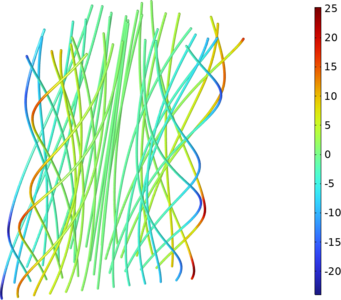
Turbulent flow, SSG-LRR interface is employed to investigate turbulent flow in a straight semicircular duct. The resulting flow pattern is characterized by slow secondary motions in the plane normal to the duct axis. The order of magnitude of velocity of those motions is 1% of the ... Read More
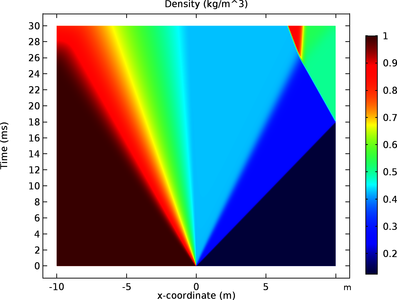
The compressible Euler equations are implemented in the Wave Form PDE interface with nodal discontinuous Lagrange shape functions to compute the flow in a shock tube. The purpose of this application is to simulate the flow in the tube and estimate the distributions of pressure, density, ... Read More
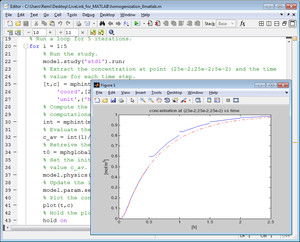
This model illustrates how to simulate a periodic homogenization process in a space dependent chemical reactor model. This homogenization removes concentration gradients in the reactor at a set time interval. The model demonstrates a technique by which you can first stop the time ... Read More
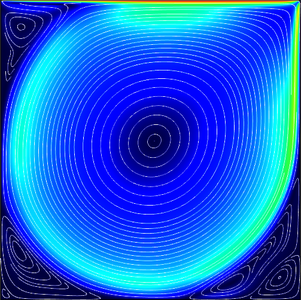
This example demonstrates how to define the lid-driven cavity benchmark in the field of computational fluid dynamics. In the model setup, a 2D square cavity has a tangentially moving wall that induces a large vortex in the center of the cavity, and small vortices in the corners. The ... Read More
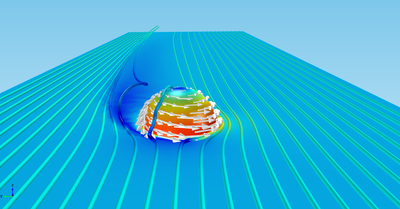
The Magnus effect explains the curl that soccer players can give the ball, resulting in the enjoyable goals that we can see in every FIFA World Cup™. This model looks at the Magnus effect in the laminar and turbulent flow regimes for transient and stationary flows. It also discusses ... Read More
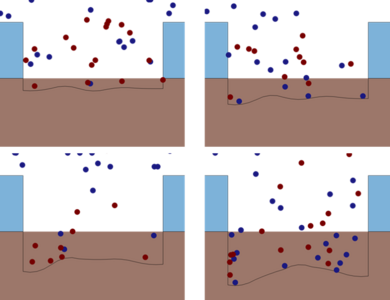
Ion beam etching is a critical technique widely used in semiconductor manufacturing, materials science, and microelectromechanical systems (MEMS). This proof-of-concept model simulates argon ion sputtering of a silicon surface using the Charged Particle Tracing interface. A Deformed ... Read More


