
The Application Gallery features COMSOL Multiphysics® tutorial and demo app files pertinent to the electrical, structural, acoustics, fluid, heat, and chemical disciplines. You can use these examples as a starting point for your own simulation work by downloading the tutorial model or demo app file and its accompanying instructions.
Search for tutorials and apps relevant to your area of expertise via the Quick Search feature. Note that many of the examples featured here can also be accessed via the Application Libraries that are built into the COMSOL Multiphysics® software and available from the File menu.
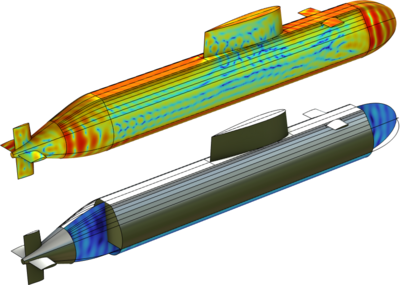
This tutorial shows an approach to model the acoustic scattering off a submarine including the outer hull. The flooded volumes between the outer hull and the pressure hull are modeled with Pressure Acoustics, Frequency Domain (FEM) and the outside water domains with Pressure Acoustics, ... Read More
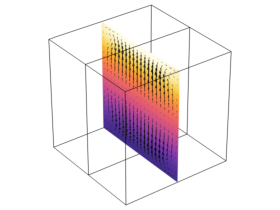
This example studies the stationary state of free convection in a cavity filled with water and bounded by two vertical plates. To generate the buoyancy flow, the plates are heated at different temperatures, bringing the regime close to the transition between laminar and turbulent. To ... Read More
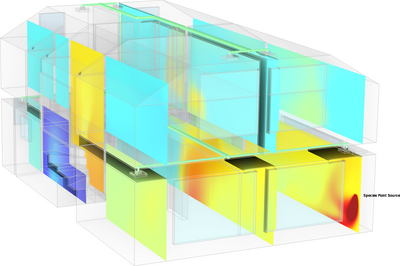
This model of a two-story house can be used to examine a contaminant leak and the subsequent contaminant dispersion that occurs due to convection and diffusion. Airflow and recirculation within the home are dependent on vent placement, and flow velocity may also vary at each vent. ... Read More
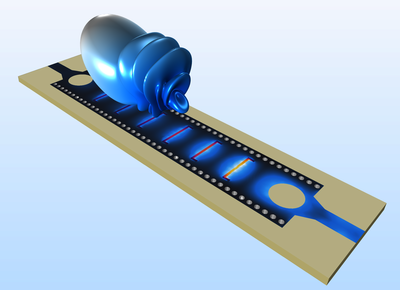
Substrate Integrated Waveguides (SIW) can be used in antenna applications. Leaky waves from a slot array on the top surface of the SIW in this model generate a beam in a certain direction that can be steered by choosing a different operating frequency. Read More
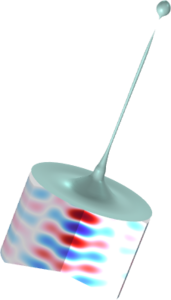
Acoustic droplet ejection is a non-contact, highly controllable method for liquid handling emerging in applications such as printing, biomedical, semiconductor assembly, and mass spectroscopy. The modeling approach assumes separation of acoustic and flow time scales. First, a focused ... Read More
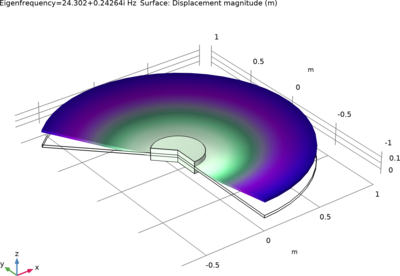
This model illustrates how to perform prestressed eigenfrequency and frequency response analyses in a contact problem. A circular plate is squeezed between two thicker plates. The peak of the prestressed frequency response analysis is compared with the prestressed eigenfrequencies as ... Read More
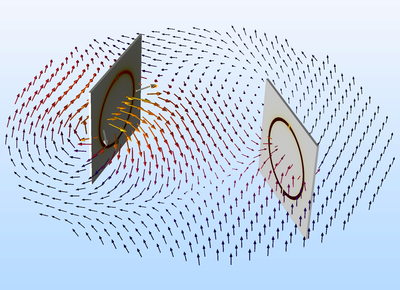
This model addresses the concept of wireless power transfer by studying the energy coupling between two circular loop antennas tuned for UHF RFID frequency whose size is reduced using chip inductors. The circular loop antenna provides inherent inductive coupling by its shape, and it can ... Read More
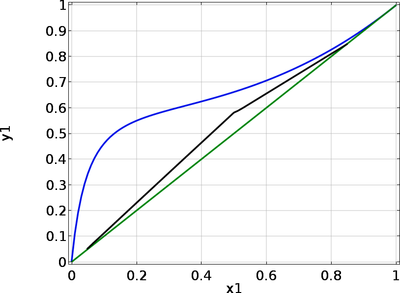
This example shows how to make a simple model for a binary distillation process. A thermodynamics property package, available in the Chemical Reaction Engineering Module, is created to study the separation of a nonideal mixture of ethanol and water. The required equilibrium relationship ... Read More


