
The Application Gallery features COMSOL Multiphysics® tutorial and demo app files pertinent to the electrical, structural, acoustics, fluid, heat, and chemical disciplines. You can use these examples as a starting point for your own simulation work by downloading the tutorial model or demo app file and its accompanying instructions.
Search for tutorials and apps relevant to your area of expertise via the Quick Search feature. Note that many of the examples featured here can also be accessed via the Application Libraries that are built into the COMSOL Multiphysics® software and available from the File menu.
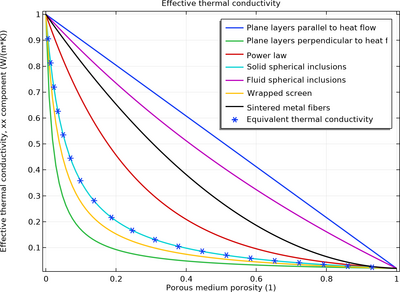
This tutorial presents the averaging models available within the Heat Transfer in Porous Media interface, used to compute the effective thermal conductivity, when the local thermal equilibrium assumption is made. The models are compared for porosities ranging from 0 to 1, and for a ... Read More
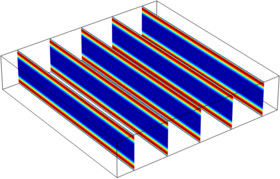
Whenever dimensions in waveguides become small compared to the viscous and thermal boundary layers it is necessary to model acoustics using thermoacoustics. In the present model the thermoacoustic wave field in a shallow uniform waveguide is modeled and compared to an analytical solution. Read More
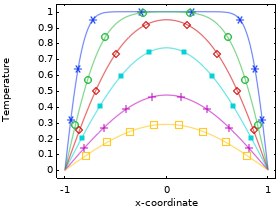
This simple example covers the heating of a finite slab and how the temperature varies with time. We will set up the problem in COMSOL Multiphysics after which we compare the solution to the analytical solution. Read More
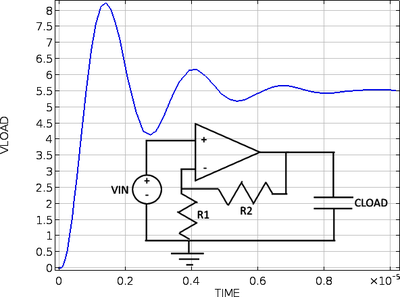
An operational amplifier (op-amp) is a differential voltage amplifier with a wide range of applications in analog electronics. This tutorial models an op-amp connected to a feedback loop and a capacitive load. The op-amp is modeled as an equivalent linear subcircuit in the Electrical ... Read More
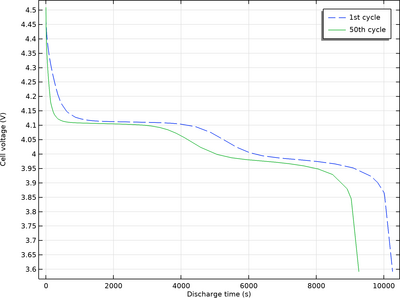
Some positive electrode materials are known to deteriorate in overcharged lithium-ion battery cells. Predominantly, manganese containing electrode materials such as LMO and NMC can loose capacity due to manganese dissolving from the materials at overcharge. This decomposition is a ... Read More
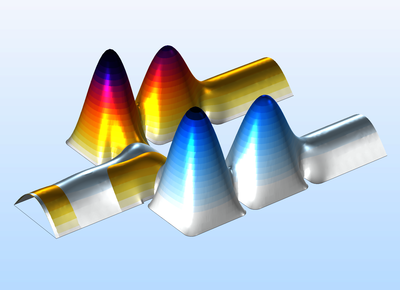
A diplexer is a device that combines or splits signals into two different frequency bands, widely used in mobile communication systems. This model simulates splitting properties using a simplified 2D geometry. The computed S-parameters and electric fields at the lower and upper bands ... Read More
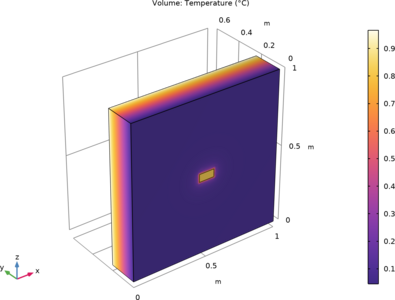
This model studies the heat conduction in a thermal bridge made up of an iron bar and an insulation layer that separates a hot internal side from a cold external side. The heat flux between internal and external side and the maximum temperature on the external wall are compared them with ... Read More
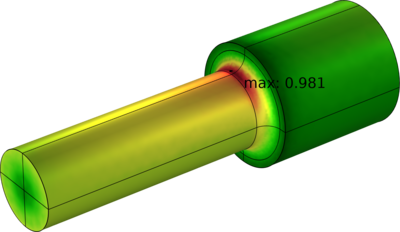
This example shows how to perform a High Cycle Fatigue (HCF) analysis with a non-proportional load history caused by a transversal force and a torque which are applied in different combinations. Three different fatigue models (Findley, Matake, and Dang Van) are compared. Read More


