
The Application Gallery features COMSOL Multiphysics® tutorial and demo app files pertinent to the electrical, structural, acoustics, fluid, heat, and chemical disciplines. You can use these examples as a starting point for your own simulation work by downloading the tutorial model or demo app file and its accompanying instructions.
Search for tutorials and apps relevant to your area of expertise via the Quick Search feature. Note that many of the examples featured here can also be accessed via the Application Libraries that are built into the COMSOL Multiphysics® software and available from the File menu.

This model demonstrates how to simulate a piezoelectric transducer as both a sound transmitter and a receiver in a well logging setup. Other applications of this setup are, for example, in the field of nondestructive testing. A transmitting transducer is connected to an electrical ... Read More
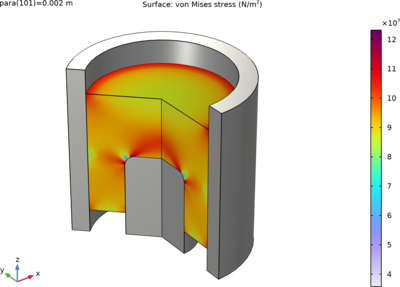
The fabrication of a cup through powder compaction is simulated in this tutorial model. The powder compaction process is becoming common in the manufacturing industry, due to its potential for producing components of complex shape and high strength. Combining the Fleck–Kuhn–McMeeking ... Read More
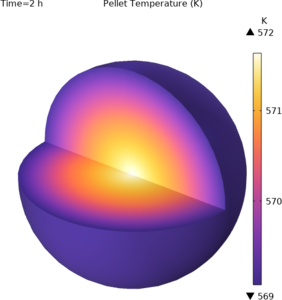
1D model of a thermal energy storage (TES) system consisting of a packed bed of pellets. Three approaches for heat transfer in porous media are compared: A one-equation local thermal equilibrium (LTE) model A two-equations local thermal nonequilibrium (LTNE) model A multiscale ... Read More
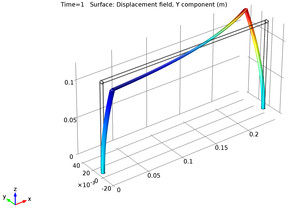
This is a benchmark model for flexible multibody dynamics. This model simulates the dynamic behavior of a planar four-bar mechanism when one of the joints has a defect. The out-of-plane motion in the mechanism, caused by the defect in the joint, is compared with the results from the ... Read More
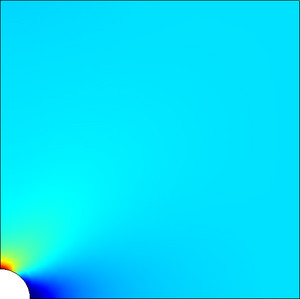
This model describes a static stress analysis to obtain the stress distribution in the vicinity of a small hole in an infinite plate. The model is a classic benchmark and is described in Mechanics of Material, by D. Roylance. The stress level is then compared with the theoretical values. Read More

In this example, the natural frequencies of a double hat beam are studied. The beam is made of two thin steel plates, joined together by spot welds along the flanges. The Spot Welds feature sets up multiple mesh-independent connections between the shells. Read More
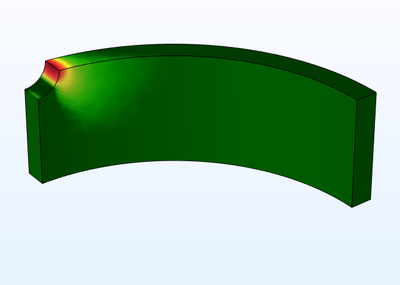
A load carrying component of a structure is subjected to multi-axial cyclic loading during which localized yielding of the material occurs. In this model you perform a low cycle fatigue analysis of the part based on the Smith-Watson-Topper (SWT) model. Due to localized yielding, you ... Read More
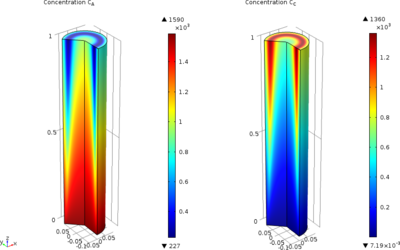
This application uses the Chemical Reaction Engineering Module to study an elementary, exothermic, irreversible reaction in a tubular reactor (liquid phase, laminar flow regime). To keep its temperature down, the reactor uses a cooling jacket with a constant coolant temperature. The ... Read More


