
The Application Gallery features COMSOL Multiphysics® tutorial and demo app files pertinent to the electrical, structural, acoustics, fluid, heat, and chemical disciplines. You can use these examples as a starting point for your own simulation work by downloading the tutorial model or demo app file and its accompanying instructions.
Search for tutorials and apps relevant to your area of expertise via the Quick Search feature. Note that many of the examples featured here can also be accessed via the Application Libraries that are built into the COMSOL Multiphysics® software and available from the File menu.
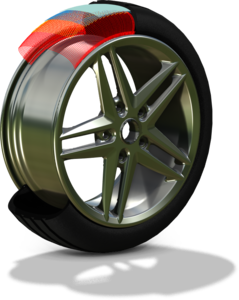
This model showcases how to use fibers in thin layers to model thin anisotropic composites embedded in a solid without explicitly drawing either the layer of material or the reinforcing fibers. Here, it is used to model steel cords in tire belts that are used to provide structural ... Read More
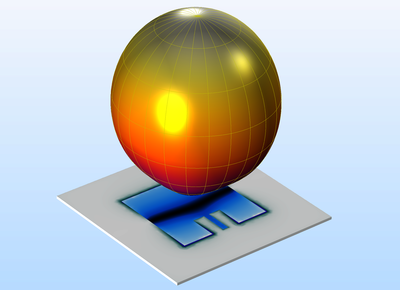
The microstrip patch antenna is used in a wide range of applications since it is easy to design and fabricate. The antenna is attractive due to its low-profile conformal design, relatively low cost and very narrow bandwidth. It is known that the antenna impedance will be higher than an ... Read More
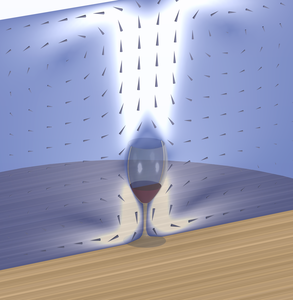
During professional wine tasting, several samples of wine are judged in one session. It is important that each sample is covered, since evaporation of ethanol and water will change the taste. This model simulates the evaporation of ethanol and water from a wine glass. Evaporation of ... Read More
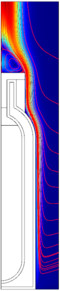
The following example solves a pure conduction and a free-convection problem in which a vacuum flask holding hot coffee dissipates thermal energy. The main interest is to calculate the flask's cooling power; that is, how much heat it loses per unit time. This tutorial model treats the ... Read More
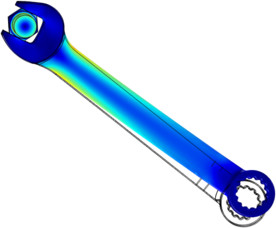
This tutorial demonstrates how to set up a simple static structural analysis. The analysis is exemplified on a combination wrench during the application of torque on a bolt. Despite its simplicity, and the fact that very few engineers would run a structural analysis before trying to turn ... Read More
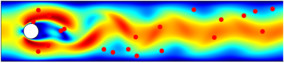
The following model examines unsteady, incompressible flow past a long cylinder placed in a channel at right angle to the oncoming fluid. The cylinder is offset somewhat from the center of the flow to make the steady-state symmetrical flow unstable. The simulation time necessary for a ... Read More
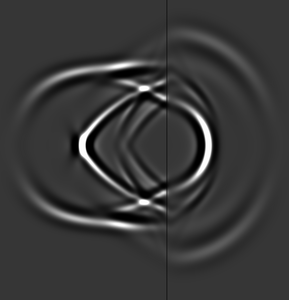
In this 2D tutorial, a test sample consists on one side of an isotropic material and on the other side of a heterogeneous anisotropic material (a transverse anisotropic zinc crystal). Elastic waves in the sample are excited by a point-like force. The model is solved with the Elastic ... Read More
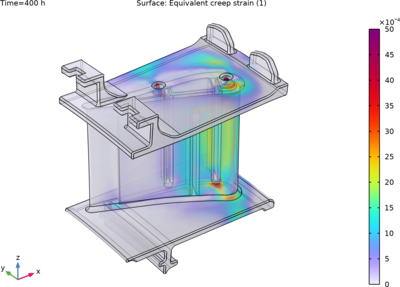
This example shows how to compute deformations caused by secondary creep in a turbine stator blade. The creep rate is highly influenced by temperature, and the deformation and stress relaxation is thus controlled by the temperature field. Read More


