
The Application Gallery features COMSOL Multiphysics® tutorial and demo app files pertinent to the electrical, structural, acoustics, fluid, heat, and chemical disciplines. You can use these examples as a starting point for your own simulation work by downloading the tutorial model or demo app file and its accompanying instructions.
Search for tutorials and apps relevant to your area of expertise via the Quick Search feature. Note that many of the examples featured here can also be accessed via the Application Libraries that are built into the COMSOL Multiphysics® software and available from the File menu.
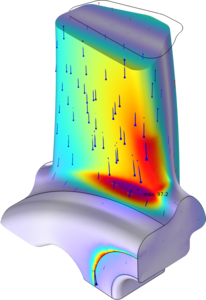
This tutorial uses the submodeling technique to accurately resolve the stress concentrations in a wheel rim. First a global model is solved to obtain the displacements, which are then used as boundary conditions in a local model of the region where the stress concentrations occur. Read More
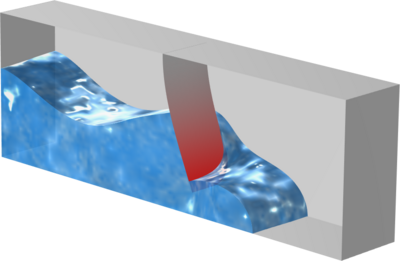
The following example demonstrates techniques for modeling a fluid-structure interaction containing two fluid phases in COMSOL Multiphysics. It illustrates how a heavier fluid can induce movement in an obstacle using the arbitrary Lagrangian-Eulerian (ALE) technique along with the Two ... Read More
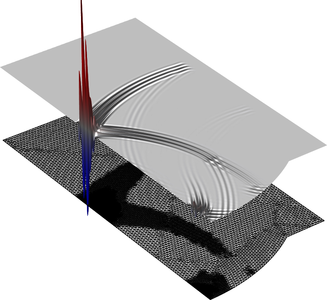
This tutorial studies the propagation of high intensity focused ultrasound (HIFU) though a tissue phantom. HIFU is used in many different biomedical applications such as thermal ablation of tumors, transcranial HIFU surgery, shock wave lithotripsy, etc. A HIFU transducer typically ... Read More
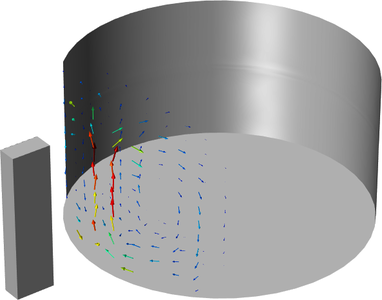
This is a tutorial how to set up electric machinery in 3D using a combination of the magnetic fields and magnetic fields no currents interfaces. Read More
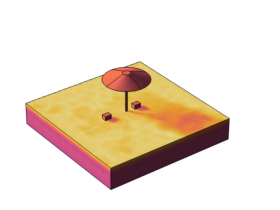
This tutorial model illustrates how to analyze the thermal effects of the sun as an external radiative source and considers wavelength-dependent surface emissivities. Specifically, the model features two coolers containing beverage cans that are exposed to ambient conditions and a beach ... Read More

This example shows how to perform a fatigue analysis of a structure subjected to random vibrations. Times to failure using the cycle counting models according to Bendat and Dirlik are compared. Read More
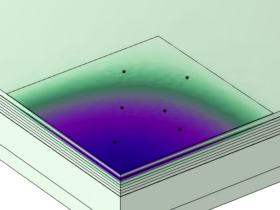
A solidly-mounted resonator (SMR) is a piezoelectric MEMS resonator formed on top of an acoustic mirror stack deposited on a thick substrate. This tutorial shows how to simulate an SMR in 3D. In this example, the eigenmodes were computed with varying number of particles attached to the ... Read More
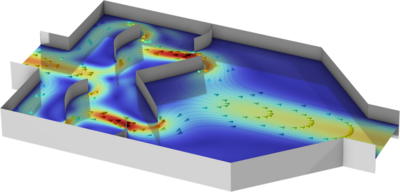
The topology optimized Tesla microvalve is used as an inspiration for an initial geometry. Second order Bernstein polynomials are used to perturb the shape of the geometry. The resulting design is remeshed in the deformed configuration and the performance is investigated for a range of ... Read More


