
The Application Gallery features COMSOL Multiphysics® tutorial and demo app files pertinent to the electrical, structural, acoustics, fluid, heat, and chemical disciplines. You can use these examples as a starting point for your own simulation work by downloading the tutorial model or demo app file and its accompanying instructions.
Search for tutorials and apps relevant to your area of expertise via the Quick Search feature. Note that many of the examples featured here can also be accessed via the Application Libraries that are built into the COMSOL Multiphysics® software and available from the File menu.
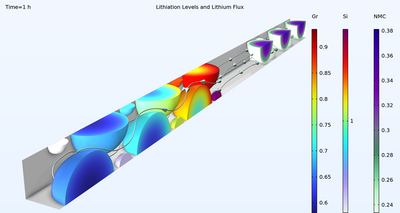
This model describes the behavior of a lithium-ion battery unit cell modeled using an idealized heterogeneous three-dimensional geometry. In contrast to the typical homogenized approach for describing porous electrodes, heterogeneous models define the actual shapes of the electrode ... Read More
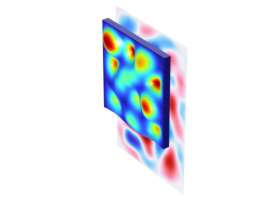
This model presents a practical and efficient method to compute the sound transmission loss (STL) through a building component, specifically this example treats the case of a concrete wall. The method used here is valid as long as the component has little influence on the acoustic field ... Read More
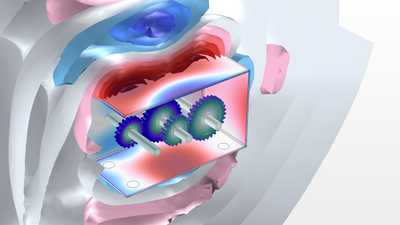
Predicting the noise radiation from a dynamic system gives designers insight into the behavior of moving mechanisms early in the design process. For example, consider a gearbox in which the change in the gear mesh stiffness causes vibrations. These vibrations are transmitted to the ... Read More
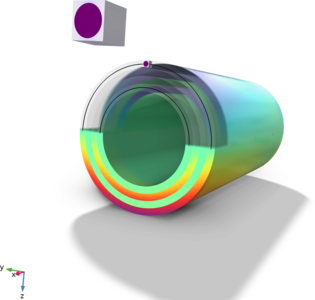
In this example, the structural integrity of a cylinder made of a fiber-reinforced composite is assessed at both the macroscale and the microscale. In addition to macroscale analyses, structural composites require microscale stress and failure analyses to identify the critical ... Read More
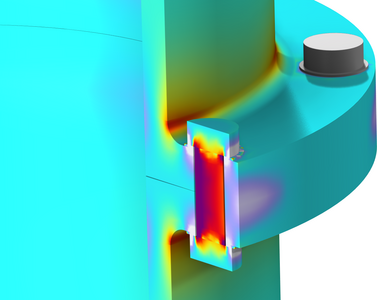
A tube connection consisting of a flange with eight prestressed bolts is subjected to a set of loads: an internal pressure, an axial force, and an external bending moment. Due to two symmetry planes, it is sufficient to only consider one quarter of the full geometry. The study ... Read More
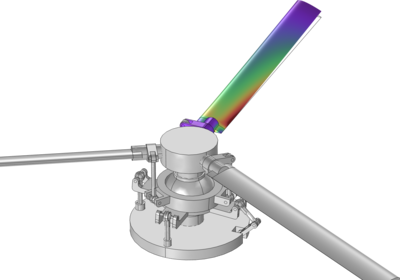
This model illustrates the operation of a swashplate mechanism used in helicopters to translate the input of helicopter flight control into the motion of the rotor blades, and hence controls the orientation of the rotor blades. In this model, the rotor blades are modeled as either rigid ... Read More
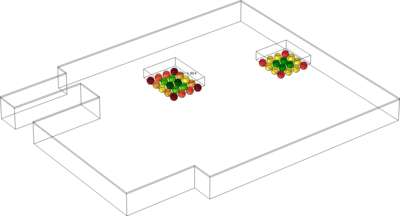
In a cooling system, a microelectronic component has been identified as the critical link. Since the power is repeatedly switched on and off, the component is subjected to thermal cycling. As a results a crack grows through a solder joint and disconnects the chip from the printed circuit ... Read More
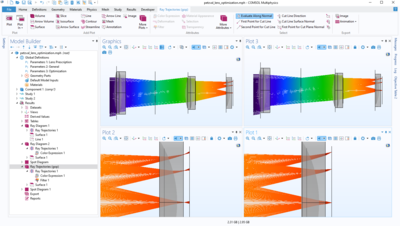
This example shows how to perform parameter optimization on a lens system. The optimization is motivated by the replacement of one of the glasses in a prior optical prescription with a new glass having slightly different optical dispersion coefficients. The control parameters are the ... Read More


