
The Application Gallery features COMSOL Multiphysics® tutorial and demo app files pertinent to the electrical, structural, acoustics, fluid, heat, and chemical disciplines. You can use these examples as a starting point for your own simulation work by downloading the tutorial model or demo app file and its accompanying instructions.
Search for tutorials and apps relevant to your area of expertise via the Quick Search feature. Note that many of the examples featured here can also be accessed via the Application Libraries that are built into the COMSOL Multiphysics® software and available from the File menu.
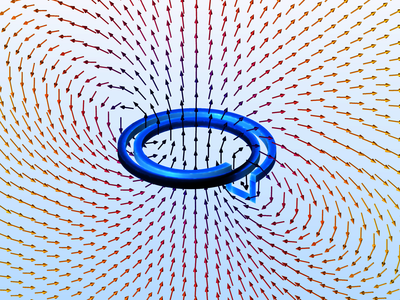
RF coils are important in numerous applications ranging from wireless technology to MRI scanning equipment. This introductory tutorial model demonstrates how to find the fundamental resonance frequency of an RF coil as well as how to perform a frequency sweep to extract the coil's Q ... Read More

Gas cells have several applications in the design of scientific instruments. A gas cell is used to define a high-pressure region within the instrument's main vacuum system. For example, in this application, note we are designing a high-pressure region 100 mm long, with an operating ... Read More
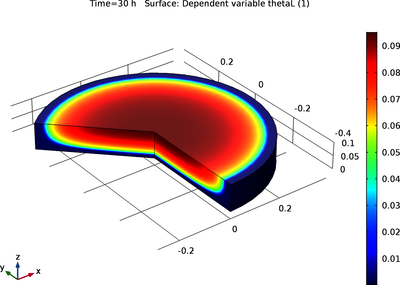
Vacuum drying is a chemical process frequently used in the pharmaceutical and food industries to remove water or an organic solvent from a wet powder. When designing a vacuum drying system, engineers aim to minimize the drying time while maintaining high quality in the product. This ... Read More
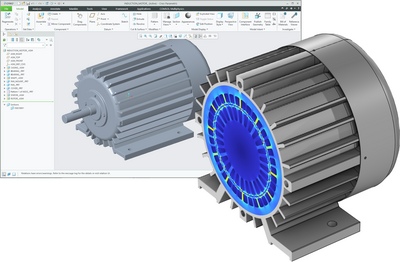
This model illustrates how to compute the torque of a three-phase squirrel-cage induction motor at various speeds. In the example the torque is computed by averaging the results from simulations performed on 2D cross sections at several locations along the induction motor. The 3D ... Read More
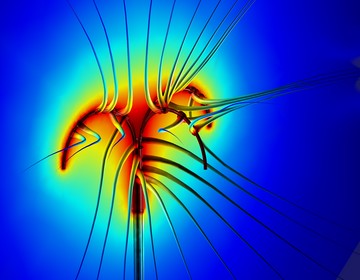
One method for removing cancerous tumors from healthy tissue is to heat the malignant tissue to a critical temperature that kills the cancer cells. This example accomplishes the localized heating by inserting a four-armed electric probe through which an electric current runs. Equations ... Read More
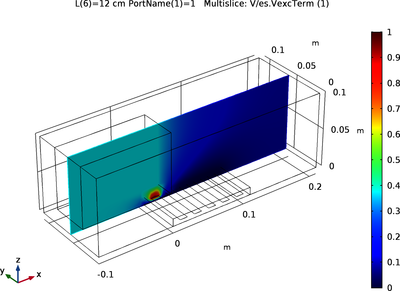
This tutorial model explains how to extract lumped matrices by means of the Stationary Source Sweep study. The capacitance matrix of a five-terminal system is used to infer the position of a metallic object similar to real-world capacitive position sensors. The example illustrates the ... Read More
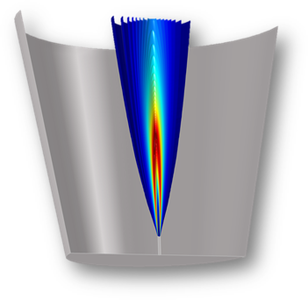
The model simulates non-premixed turbulent combustion of syngas (synthesis gas) in a simple round-jet burner. Syngas is a gas mixture, primarily composed of hydrogen, carbon monoxide and carbon dioxide. The name syngas relates to its use in creating synthetic natural gas. In the model, ... Read More
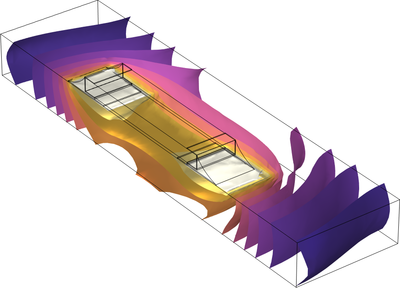
The drive for miniaturizing electronic devices has resulted in today’s extensive use of surface-mount electronic components. An important aspect in electronics design and the choice of materials is a product’s durability and lifetime. For surface-mount resistors and other components ... Read More
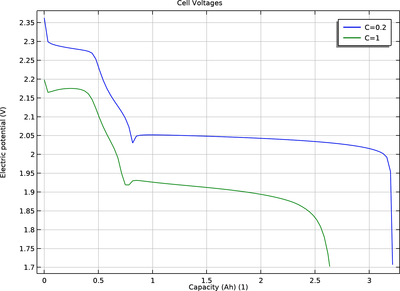
Lithium-sulfur (Li-S) batteries are used in niche applications with high demands for specific energy densities, which may be as high as 500-600 Wh/kg. The chemistry is fairly complex, since multiple polysulfide species participate in the various charge transfer reactions. The chemistry ... Read More
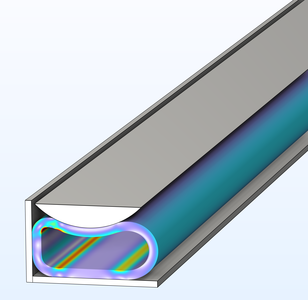
In this model you study the force-deflection relation of a car door seal made from a soft rubber material. The model uses a hyperelastic material model together with formulations that can account for the large deformations and contact conditions. Read More


