
The Application Gallery features COMSOL Multiphysics® tutorial and demo app files pertinent to the electrical, structural, acoustics, fluid, heat, and chemical disciplines. You can use these examples as a starting point for your own simulation work by downloading the tutorial model or demo app file and its accompanying instructions.
Search for tutorials and apps relevant to your area of expertise via the Quick Search feature. Note that many of the examples featured here can also be accessed via the Application Libraries that are built into the COMSOL Multiphysics® software and available from the File menu.
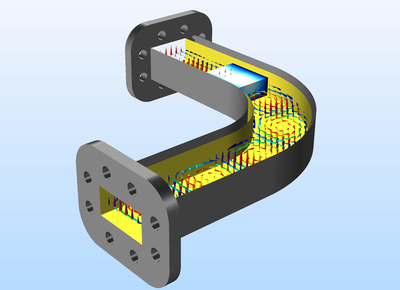
This is a model of an RF waveguide bend with a dielectric block inside. There are electromagnetic losses in the block as well as on the waveguide walls which cause the assembly to heat up over time. The material properties of the block are functions of temperature. The transient thermal ... Read More

Lamb wave resonators are useful components for many radio-frequency applications. This tutorial shows how you model an aluminum nitride Lamb wave resonator and perform eigenfrequency and frequency-response analyses to characterize the device. Read More
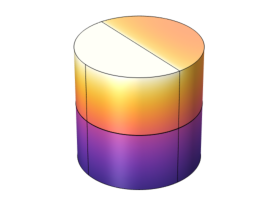
This example shows how to set up multiple sandwiched thin layers with different thermal conductivities in two different ways. First, the composite is modeled as a 3D object. In the second approach the Thin Layer boundary condition with the thermally thick option is used to avoid ... Read More
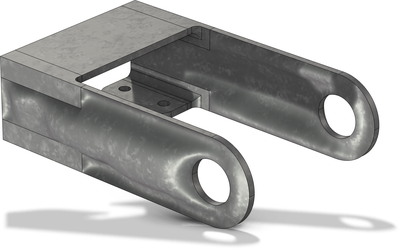
In his example, the lowest natural frequency of a 3D bracket are maximized using shape optimization. Read More
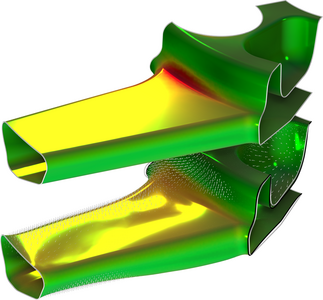
Shape optimization with respect to fatigue properties is not supported, but fatigue properties are well correlated with the maximum stress. The model demonstrates how optimization with respect to a p-norm of the von Mises stress can be used to improve fatigue properties without ... Read More

This model shows how to use the scattered-field formulation to compute the transmission coefficient for impinging P and S plane elastic waves onto a finite-size phononic crystal. The transmission tends to zero in the frequency ranges corresponding to P- and S-wave band gaps, as ... Read More
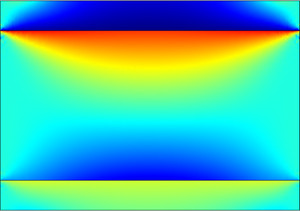
The thermal stress in a layered plate is studied in this example. A plate consisting of two layers, a coating and a substrate layer, is stress and strain free at 800 degrees C. The temperature of the plate is reduced to 150 degrees C and thermal stresses are induced due to the difference ... Read More
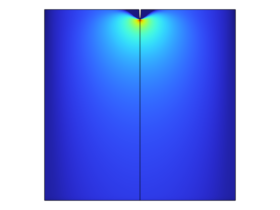
This tutorial model presents a study of a negative corona discharge in dry air at atmospheric pressure in a point-to-plane configuration. An elliptical electrode with millimeter dimensions creates a high intensity electric field where the corona discharge occurs. A ground plane is placed ... Read More
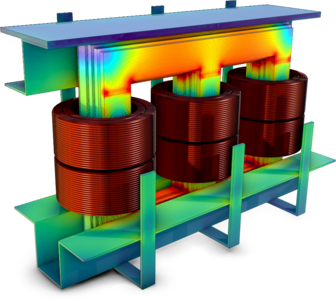
Electromagnetic analysis of a 400kVA, 15kV/400V three-phase power transformer with Y-d connection and multiple primary and secondary coils with hundreds of turns. The model features the standard open- and short-circuit test in 2Daxi and 3D simulations to estimate electrical quantities ... Read More

This example illustrates multiphase flow modeling in an airlift loop reactor. The reactor is filled with water and air bubbles are injected at the bottom through two frits. Due to buoyancy, the bubbles rise, inducing a circulating motion of the liquid. The model specifically investigates ... Read More


