
The Application Gallery features COMSOL Multiphysics® tutorial and demo app files pertinent to the electrical, structural, acoustics, fluid, heat, and chemical disciplines. You can use these examples as a starting point for your own simulation work by downloading the tutorial model or demo app file and its accompanying instructions.
Search for tutorials and apps relevant to your area of expertise via the Quick Search feature. Note that many of the examples featured here can also be accessed via the Application Libraries that are built into the COMSOL Multiphysics® software and available from the File menu.

This example applies an Oldroyd-B fluid to model the thinning of a viscoelastic filament under the action of surface tension. For times smaller than the polymer relaxation time, the filament develops a beads-on-string structure. At times much larger than the relaxation time, the solution ... Read More
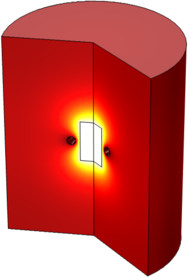
The induced currents in a copper cylinder produce heat that in turn change the electrical conductivity. This means that the field propagation has to be solved simultaneously with the heat transfer through the cylinder and surrounding system. This model shows this coupling between eddy ... Read More
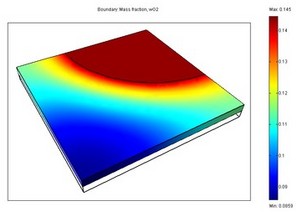
A stationary 3D model of a generic fuel cell cathode describing the mass fraction distribution of oxygen, water, and nitrogen, as well as the current distribution. The model uses Darcy's Law to describe convection, and couples this to Maxwell-Stefan diffusivities to also describe mass ... Read More
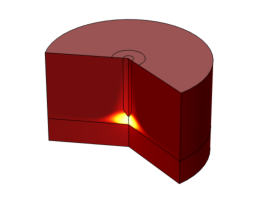
This example investigates the electrical and thermal characteristics of a plasma DC arc created in a point-to-plane configuration. The discharge is assumed to be in local thermodynamic equilibrium. The plasma is considered a conductive fluid medium and is modeled using a ... Read More
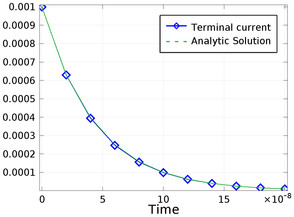
A transient model of a capacitor is solved in combination with an external electrical circuit. The finite element model of the capacitor is combined with a circuit model of a voltage source and a resistor. A step change in voltage is applied, and the transient current through the ... Read More
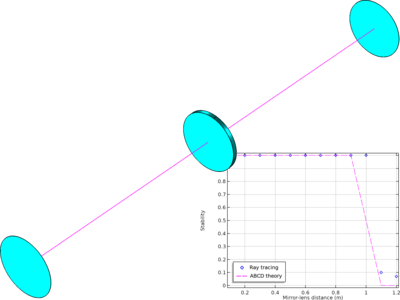
In this model, two flat end mirrors are placed at a distance and a spherical lens is inserted in the middle of the cavity. A ray is released from a point inside the cavity. Then the ray is traced for a predefined time period that is sufficiently long. Ray tracing continues until the ... Read More
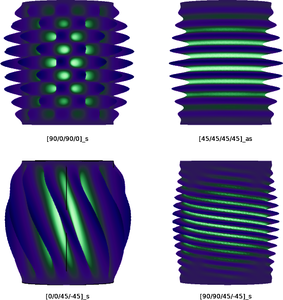
Buckling is a structural instability that can cause a component to fail even when the material remains within the elastic regime. Therefore, determining the critical buckling loads and corresponding mode shapes can be important from a design perspective, even when the applied loads ... Read More
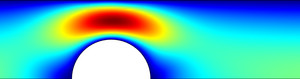
Many complex fluids of interest exhibit a combination of viscous and elastic behavior under strain. Examples of such fluids are polymer solutions and melts, oil, toothpaste, and clay, among many others. The Oldroyd-B fluid presents one of the simplest constitutive models capable of ... Read More

The present model example is based on Copper Deposition in a Trench model available in Electrodeposition Application Library. The nonuniform deposition along the trench surface leads to formation of a cavity/void. Since the Deformed Geometry interface cannot handle topological changes, ... Read More
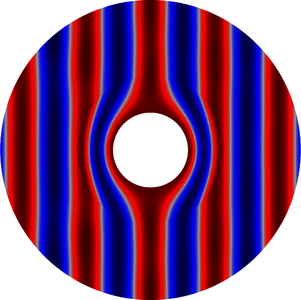
This example demonstrates how to use a background field in a sound scattering problem. The application is an acoustic invisibility cloak made of a metamaterial. Two different types of metamaterials are used, one using an anisotropic acoustic material with varying properties and one using ... Read More


