
The Application Gallery features COMSOL Multiphysics® tutorial and demo app files pertinent to the electrical, structural, acoustics, fluid, heat, and chemical disciplines. You can use these examples as a starting point for your own simulation work by downloading the tutorial model or demo app file and its accompanying instructions.
Search for tutorials and apps relevant to your area of expertise via the Quick Search feature. Note that many of the examples featured here can also be accessed via the Application Libraries that are built into the COMSOL Multiphysics® software and available from the File menu.
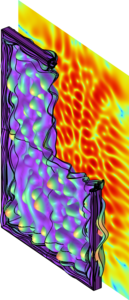
This model presents a practical and efficient method to compute the sound transmission loss (STL) through a building component. Specifically, this example treats the case of a double-glazed window. The method used here is valid for structural components that have a small influence on ... Read More
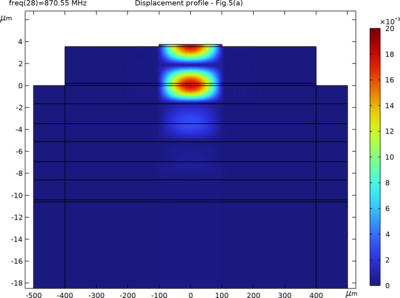
A solidly-mounted resonator (SMR) is a piezoelectric MEMS resonator formed on top of an acoustic mirror stack deposited on a thick substrate. This tutorial shows how to simulate an SMR in 2D. In this example, the eigenmodes were computed and the frequency response from 500 to 1200 MHz ... Read More

This example models the desalination of water by capacitive deionization in a "flow-between" cell (fbCDI). The model geometry is in 2D. Steady Brinkman flow, a tertiary current distribution, and the improved modified Donnan description of the deionization process is assumed. Read More
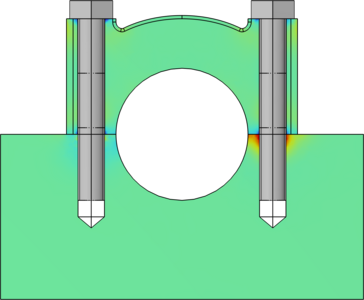
This example shows how to model prestressed bolts. The bolt geometry is taken from the Part Libraries. For comparison, one of the bolts is modeled using a thread contact formulation, whereas the other bolt is connected to the bolt hole by a pure continuity condition. The reduced ... Read More
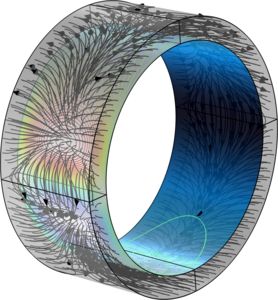
This example describes how to simulate the self-lubricating phenomenon of a liquid lubricant in a journal bearing. A porous bushing is press-fitted to a bearing and saturated with a lubricant. It acts as a reservoir for the redistribution of the thin film of lubricant between regions of ... Read More
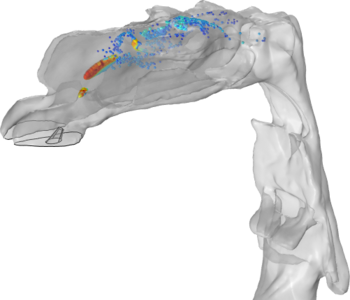
This example demonstrates how to import and repair a surface mesh from an STL file, and to create a mesh to simulate nasal spray application inside the human upper airways. It further demonstrates how to combine the repaired mesh with the geometry of a nasal spray, then to remesh and ... Read More
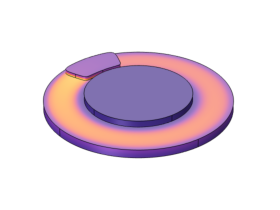
This example models the transient heating, and final temperature, of a disc brake of a car in brake-and-release sequence. It is important to model the transient heating and the following convective cooling to determine the minimum interval between a series of similar brake engagements. ... Read More
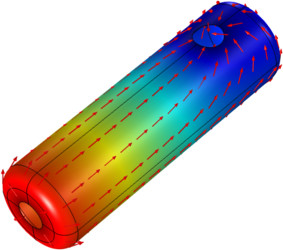
A goal for many applications is to predict physics in thin structures, such as shells, without modeling the thickness of the structure. This is because large aspect ratios can cause meshing and geometry analysis problems. This model demonstrates how to use the tangential derivative ... Read More
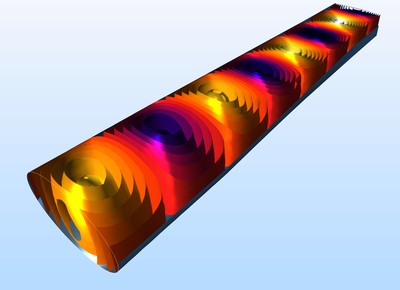
This is a model of an adapter for microwave propagation in the transition between a rectangular and an elliptical waveguide. Such waveguide adapters are designed to keep energy losses due to reflections at a minimum for the operating frequencies. To investigate the characteristics of the ... Read More
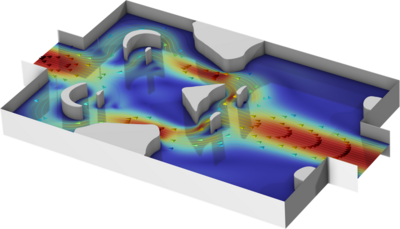
This model performs a topological optimization for a Tesla microvalve. A Tesla microvalve inhibits backwards flow using friction forces rather than moving parts. The design can be optimized by distributing a specific amount of material within the modeling domain. The goal is to maximize ... Read More


