
The Application Gallery features COMSOL Multiphysics® tutorial and demo app files pertinent to the electrical, structural, acoustics, fluid, heat, and chemical disciplines. You can use these examples as a starting point for your own simulation work by downloading the tutorial model or demo app file and its accompanying instructions.
Search for tutorials and apps relevant to your area of expertise via the Quick Search feature. Note that many of the examples featured here can also be accessed via the Application Libraries that are built into the COMSOL Multiphysics® software and available from the File menu.
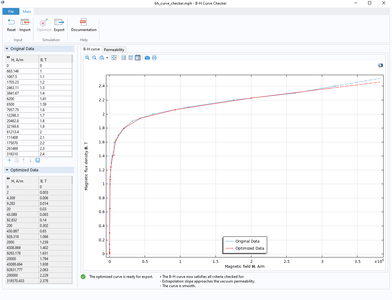
This app demonstrates the following: Importing measured data from a text file Handling measured data using methods Exporting the results to a text file. The app can be used to verify and optimize B–H curves using experimental data. It also generates curve data in the over-fluxed ... Read More
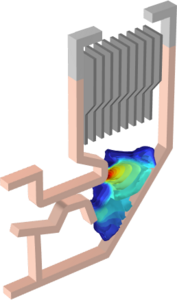
Unwanted electrical arcing poses significant risks to the reliability and safety of electrical and electronic systems. To enhance predictive capabilities and deepen understanding of arc behavior, we present a comprehensive numerical model for simulating transient arc discharge phenomena ... Read More
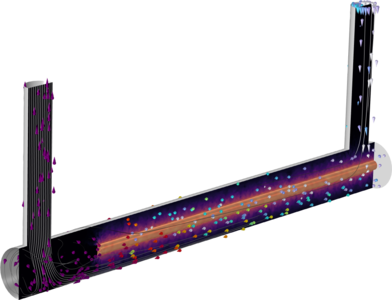
In this example, a simple ultraviolet (UV) water purification reactor is modeled using a combination of ray tracing, computational fluid dynamics, and Lagrangian particle tracking. First, the volumetric fluence rate is accumulated along rays released from the surface of the UV lamp using ... Read More
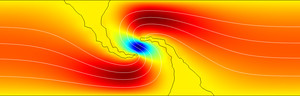
Topology optimization of the Navier-Stokes equations is encountered in different branches and applications, such as in the design of ventilation systems for cars. A common technique applicable to such problems is to let the distribution of porous material vary continuously. In this ... Read More

A cylindrical magnet falling through a copper tube induces eddy currents on the tube walls, which in turn, create a magnetic field that opposes the magnetic field of the magnet and induces a braking force that opposes the motion of the magnet. This model computes the velocity of the ... Read More
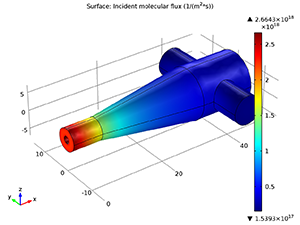
This model computes the transmission probability through an RF coupler using both the angular coefficient method available in the Free Molecular Flow interface and a Monte Carlo method using the Mathematical Particle Tracing interface. The computed transmission probability determined by ... Read More
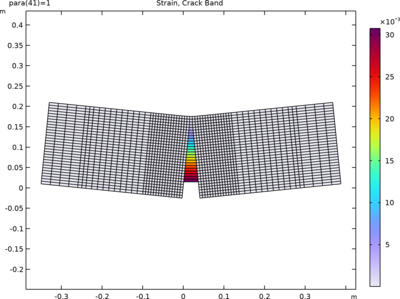
In this example, two model for brittle damage are used to evaluate the fracture of a notched concrete beam subjected to three point bending. The results are compared with experimental data. Read More

Aldicarb is a commercial pesticide, used on a variety of crops, including cotton, fruits, potatoes, and beans. This arises in the possibility that the general population may be exposed to aldicarb through the ingestion of contaminated water and foods. This example looks at the ... Read More
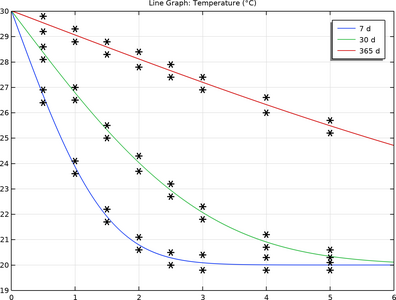
The model is defined as a benchmark case in norm 15026:2007 annex A. The purpose of the model is to calculate the temperature and moisture profiles at different times after a change in the external conditions (temperature and relative humidity) inside a wall material (kind of concrete). ... Read More
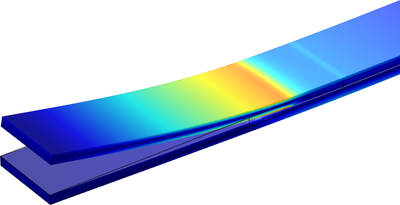
Interfacial failure by delamination or debonding can be simulated with a Cohesive Zone Model (CZM). This example shows the implementation of a CZM with a bilinear traction-separation law. It is used to predict the mixed-mode softening onset and delamination propagation in a composite ... Read More


