
The Application Gallery features COMSOL Multiphysics® tutorial and demo app files pertinent to the electrical, structural, acoustics, fluid, heat, and chemical disciplines. You can use these examples as a starting point for your own simulation work by downloading the tutorial model or demo app file and its accompanying instructions.
Search for tutorials and apps relevant to your area of expertise via the Quick Search feature. Note that many of the examples featured here can also be accessed via the Application Libraries that are built into the COMSOL Multiphysics® software and available from the File menu.
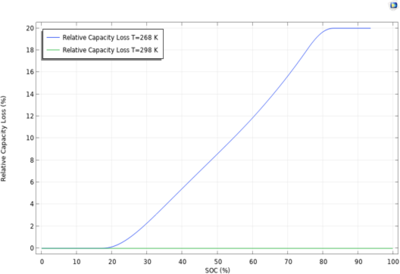
Deposition of metallic lithium on the negative electrode in preference to lithium intercalation is known to be a capacity loss and safety concern for lithium-ion batteries. Harsh charge conditions such as high currents (fast charging) and/or low temperatures can lead to lithium plating. ... Read More
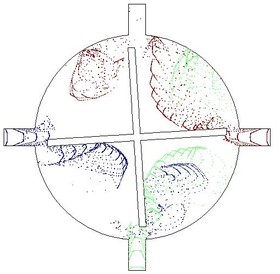
Micromixers can either be static or dynamic depending on the required mixing time and length scale. For static mixers, the Reynolds number has to be suitable high to induce turbulence enhanced mixing. Often micromixers operate in the laminar flow regime due to their small characteristic ... Read More
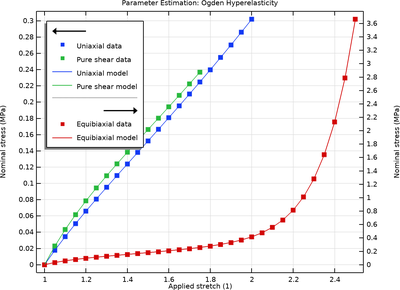
This tutorial model demonstrates how to set up a parameter estimation study for fitting the material parameters of an Ogden hyperelastic model to experimental data. The procedure considers multiple load cases under large deformations, which is often necessary to obtain constitutive ... Read More
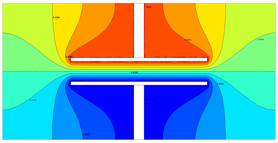
A capacitor, in its simplest form, is a two terminal electrical device that stores electric energy when a voltage difference is applied across the terminals. The stored electric energy is proportional to the applied voltage squared and is quantified by the capacitance of the device. This ... Read More
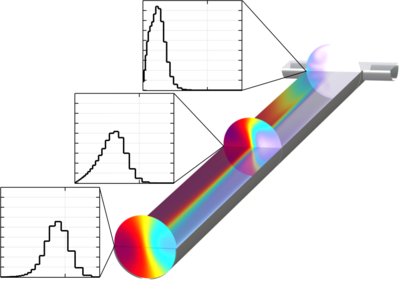
Crystallization is an important separation process in the chemical industry. It is used for the production of pharmaceuticals and industrial chemicals. It can also be used in resource recovery as a way of separating valuable materials from waste. This model solves a discretized ... Read More
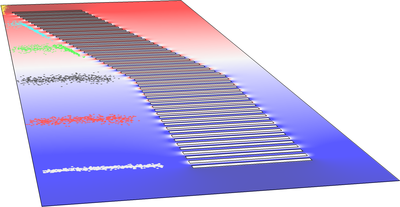
An electrodynamic ion funnel provides an efficient means of transferring ions from regions of high pressure to high vacuum. The ion funnel can couple devices which generally operate at pressures of different orders of magnitude, such as ion mobility spectrometers and mass spectrometers, ... Read More
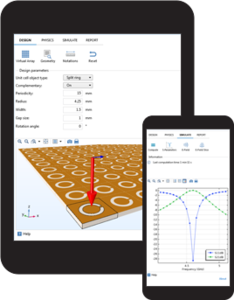
This app demonstrates the following: Designing an app for small screens such as smartphones User-interface navigation with a top menu typically used on websites Geometry parts and parameterized geometries Visualizing periodicity of a geometry with material rendering Warning messages on ... Read More
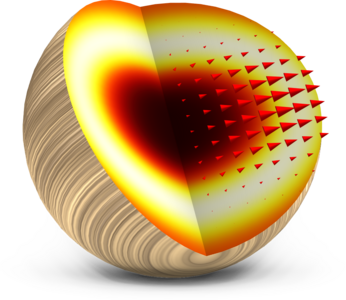
The pyrolysis of a centimeter-sized wood particle presents a fully coupled multiphysics problem with mass transfer, fluid flow, and heat transfer. This example model consists of two parts. The first part demonstrates how to set up a model describing the pyrolysis of a porous, ... Read More
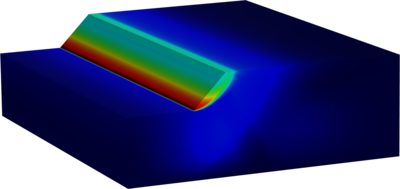
The strength reduction technique is a tool to find the factor of safety (FOS) in geotechnical problems, particularly in slope stability analyses. To determine the factor of safety of the slope, the strength properties in the Mohr–Coulomb model are gradually reduced until failure occurs. ... Read More
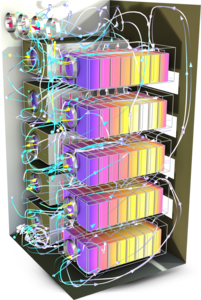
Tutorial model of an air-cooled battery energy storage system (BESS). The model includes conjugate heat transfer with turbulent flow, fan curves, internal screens, and grilles. It features several interesting aspects: Fully parameterized geometry, which can be modified for different ... Read More


