
The Application Gallery features COMSOL Multiphysics® tutorial and demo app files pertinent to the electrical, structural, acoustics, fluid, heat, and chemical disciplines. You can use these examples as a starting point for your own simulation work by downloading the tutorial model or demo app file and its accompanying instructions.
Search for tutorials and apps relevant to your area of expertise via the Quick Search feature. Note that many of the examples featured here can also be accessed via the Application Libraries that are built into the COMSOL Multiphysics® software and available from the File menu.
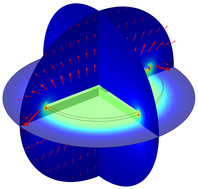
A typical capacitor is composed of two conductive objects with a dielectric in between them. A voltage difference applied between these objects results in an electric field between them. This electric field exists not just directly between the conductive objects, but extends some ... Read More
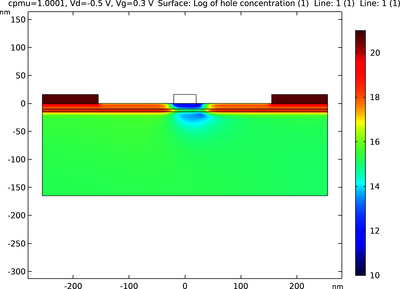
This tutorial analyzes the DC characteristics of an InSb p-Channel FET, using the density-gradient theory to add the effect of quantum confinement to the conventional drift-diffusion formulation, without a large increase of computational resources. The confinement effect is applied both ... Read More
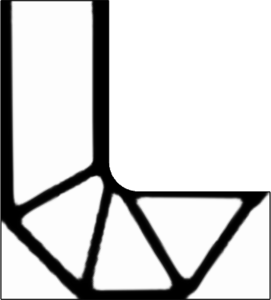
Imagine that you are designing a light-weight mountain bike frame that should fit in a box of a certain size and should weigh no more than 8 kg. Given that you know the loads on the bike, you can achieve this by distributing the available material while making sure that the stiffness of ... Read More
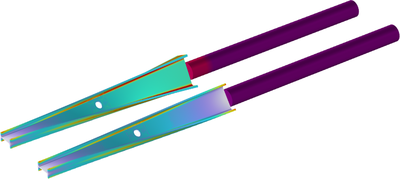
This example demonstrates the use of the Solid-Beam Connection multiphysics coupling to create transitions between the Solid Mechanics and Beam interfaces. Two different connection types are discussed, and a comparison of the stress distributions at the transition is made. Read More
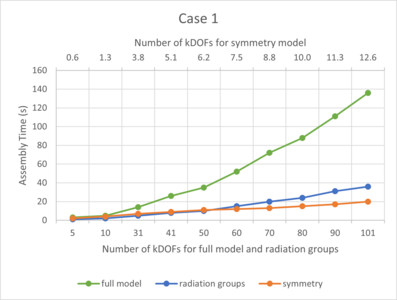
This model shows how to use the features of the Heat Transfer Module to reduce the computation time and memory usage in view factor computations. Illustrative results of speedup and memory usage reduction are given on a benchmark model. The solution is not computed, only the view ... Read More
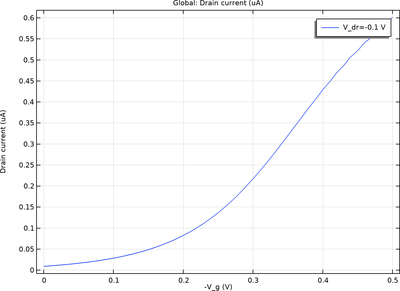
This model shows how to model an electrolyte-gated organic field-effect transistor based on a general drift–diffusion model. The model uses the Transport of Charge Carriers interface and the Electrostatics interface. The transistor characteristics are visualized. Formation of the EDLs in ... Read More
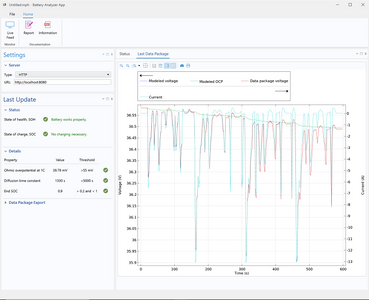
These two apps can be run to set up a digital twin of an electric scooter battery. The Digital Twin Simulator of an Electric Scooter Battery (the "simulator" app) simulates the use of an electric scooter and generates battery current and voltage data over time. The Digital Twin ... Read More
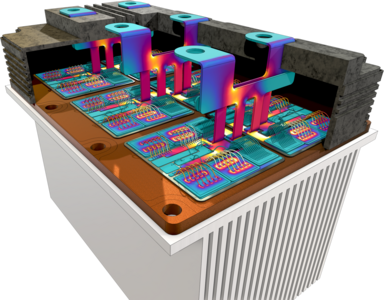
This industrial-scale proof of concept (POC) model demonstrates how to perform an electric-thermal analysis of a high-power insulated-gate bipolar transistor module (IGBT module). The module has a rated voltage of 1200 V, and nominal current of 1800 A. Using a stationary study the ... Read More
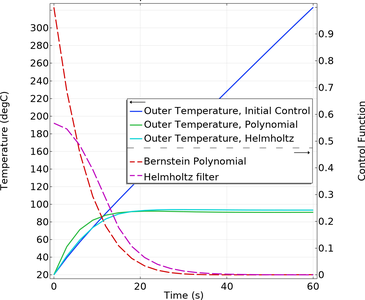
This is an example of optimal control, where the input heating power to a rod is optimized to give a certain temperature on the outside of the rod. This is where the maximum water temperature occurs, while the minimum occurs at the center. Therefore this problem corresponds to the ... Read More
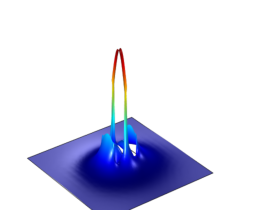
The model analyses the mode propagation within a nano slot waveguide. In a slot waveguide configuration, two high refractive index slabs (~3.48) are placed adjacent to the low refractive index slot (~1.44). Mode analysis was performed on a 2D cross section of a slot waveguide for an ... Read More


