
The Application Gallery features COMSOL Multiphysics® tutorial and demo app files pertinent to the electrical, structural, acoustics, fluid, heat, and chemical disciplines. You can use these examples as a starting point for your own simulation work by downloading the tutorial model or demo app file and its accompanying instructions.
Search for tutorials and apps relevant to your area of expertise via the Quick Search feature. Note that many of the examples featured here can also be accessed via the Application Libraries that are built into the COMSOL Multiphysics® software and available from the File menu.
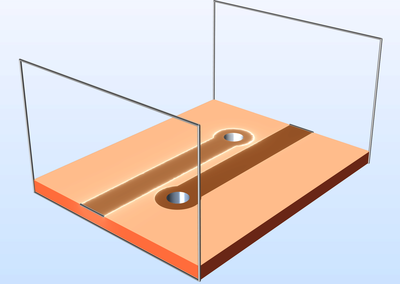
There are multiple ways to excite and terminate transmission lines using different types of port and lumped port features. In this example, transverse electromagnetic (TEM) type ports and a via type lumped port are used to simulate two adjacent microstrip lines. One via end is terminated ... Read More
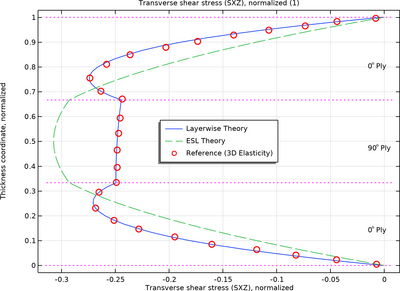
This example demonstrates the bending analysis of a simply supported composite laminate under sinusoidal distributed transverse load. The composite laminate is thick, with a thickness to side length ratio of 1/4. The laminate has three layers in a cross-ply layup. The model is solved ... Read More
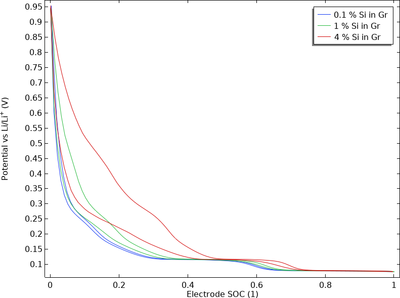
Due to its high capacity, silicon (Si) is often added to graphite in the negative electrode of lithium-ion batteries. Silicon–graphite blended electrodes may exhibit significant thermodynamic voltage hysteresis (“path dependence”) because the equilibrium potential of the lithium–silicon ... Read More
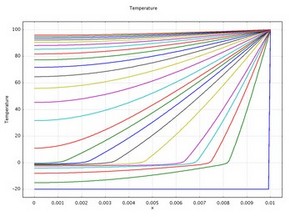
This example demonstrates how to model a phase change and predict its impact on a heat transfer analysis. When a material changes phase, for instance from solid to liquid, energy is added to the solid. Instead of creating a temperature rise, the energy alters the material’s molecular ... Read More
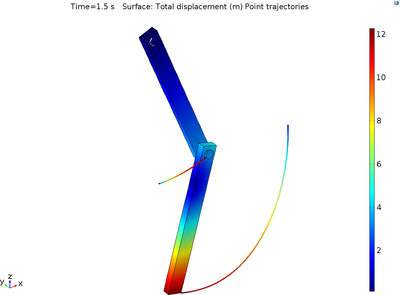
This tutorial application demonstrates how to model a hinge joint between two bodies in COMSOL Multiphysics. It also demonstrates various features available for joints, including Constraints, Locking, Spring, Damper, Prescribed Motion, and Friction. Many real structures can be ... Read More
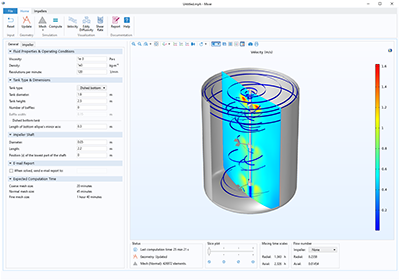
This app demonstrates the following: Multiple tabs in the ribbon Geometry parts and parameterized geometries Parts and cumulative selections can be used to automatically set domain and boundary settings in the embedded model Adding or removing geometry parts with different geometrical ... Read More
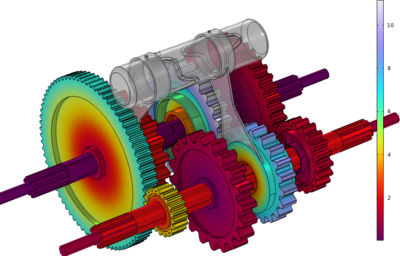
This example illustrates the modeling of a sequential manual transmission, where the gears are selected sequentially with the help of a rotating drum. The shift drum has two grooves of specific profile carved around the circumference. As the drum rotates, the grooves on the drum guide a ... Read More
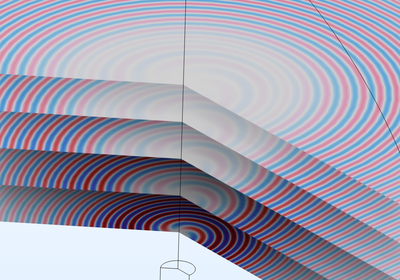
Model of the sound radiation from a circular duct with uniform flow. The convected acoustic problem is described using the linearized potential flow equations, solved in the frequency domain. The acoustic inlet is treated including higher order modes using the Port boundary condition and ... Read More
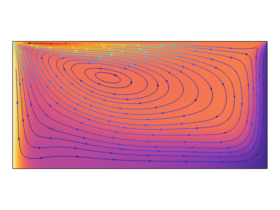
Marangoni convection occurs when the surface tension of an interface (generally liquid-air) depends on the concentration of a species or on the temperature distribution. In the case of temperature dependence, the Marangoni effect is also called thermo-capillary convection. The Marangoni ... Read More
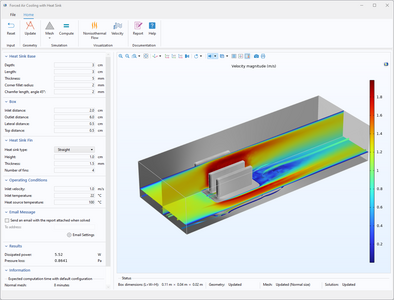
This app demonstrates the following: Geometry parts and parameterized geometries Sending an email with a report when the computation is finished User-defined email server settings which is useful when running compiled standalone applications Options for setting different mesh sizes ... Read More


