
The Application Gallery features COMSOL Multiphysics® tutorial and demo app files pertinent to the electrical, structural, acoustics, fluid, heat, and chemical disciplines. You can use these examples as a starting point for your own simulation work by downloading the tutorial model or demo app file and its accompanying instructions.
Search for tutorials and apps relevant to your area of expertise via the Quick Search feature. Note that many of the examples featured here can also be accessed via the Application Libraries that are built into the COMSOL Multiphysics® software and available from the File menu.
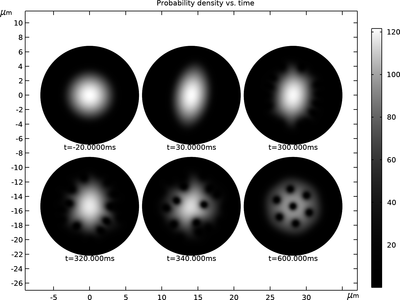
This tutorial model solves the Gross–Pitaevskii Equation for the vortex lattice formation in a rotating Bose–Einstein condensate bound by a harmonic trap. The equation is essentially a nonlinear single-particle Schrödinger Equation, with the inter-particle interaction represented by a ... Read More
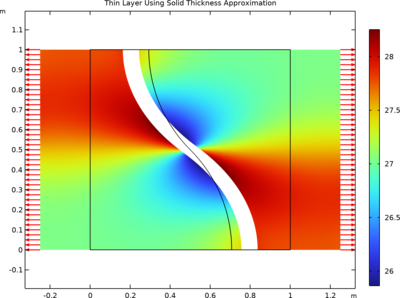
This model demonstrates alternative implementations used for describing a thin layer and the impact of the choice on the continuity of the displacement and stress fields. It is shown how a perfect interface can be obtained by asymptotically changing the material parameters. Read More
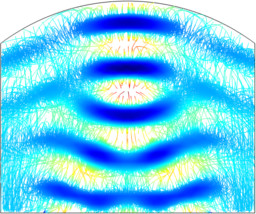
An ultrasonic standing wave levitator, also called acoustic levitator, is a device used for levitating fluid and solid particles in an acoustic field. The standing acoustic waves exert an acoustic radiation force on the particles. The force is a second order effect and stems from a ... Read More
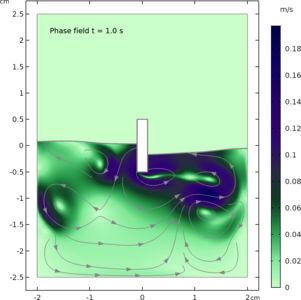
We present the results from a comparison of the level set, phase field, and moving mesh methods for modeling free liquid surfaces in the COMSOL Multiphysics® software. The comparison is carried out using an example problem. The example studies the formation of surface waves ... Read More
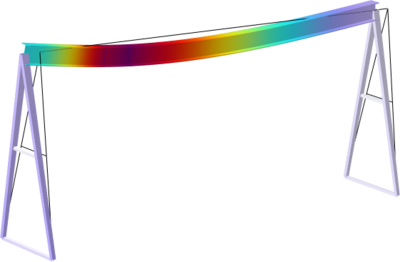
Portal Cranes are common when handling heavy loads. In this example, the Beam interface is used to compute the stresses in a portal crane designed for lifting 15 tons. Three load cases are considered: self weight, payload, and thermal expansion on a hot summer day. An internal hinge ... Read More
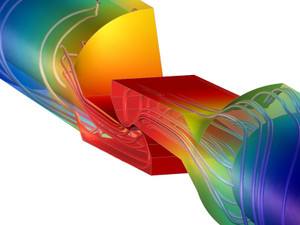
This model illustrates how to implement a multiphysics contact. It models the thermal and electrical behavior of two contacting parts of a switch. The electrical current and the heat flow from one part to the other only through the contact surface. The contact switch device has a ... Read More
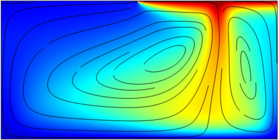
Density variations can initiate flow even in a still fluid. In earth systems, density variations can arise from naturally occurring salts, subsurface temperature changes, or migrating pollution. This buoyant or density-driven flow factors into fluid movement in salt-lake systems, saline ... Read More
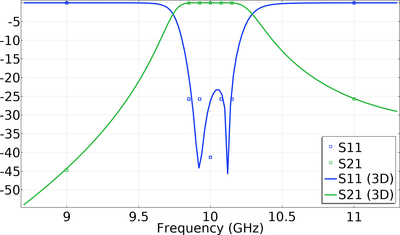
A waveguide filter is designed using shape optimization by moving and scaling rectangles in the geometry. The irises of the initial geometry are optimized to ensure good bandpass response and out-of-band rejection, while maintaining the double mirror symmetry. Read More
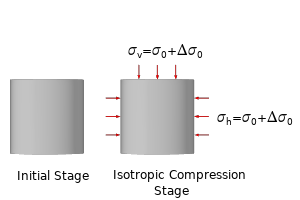
This model simulates the isotropic compression of naturally structured and artificially structured clays using the Modified Structured Cam-Clay (MSCC) material model. The aim of the example is to reproduce the compression behavior given in a benchmark for four structured clays. Read More
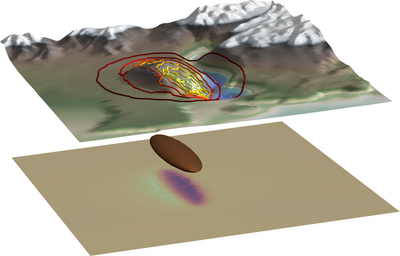
Magnetic prospecting is a geological exploration method that is applicable to certain types of iron ore deposits, in particular those made up of magnetite and hematite. The method consists of measuring the magnetic anomalies (changes in the earth's magnetic field) due to the presence of ... Read More


