
The Application Gallery features COMSOL Multiphysics® tutorial and demo app files pertinent to the electrical, structural, acoustics, fluid, heat, and chemical disciplines. You can use these examples as a starting point for your own simulation work by downloading the tutorial model or demo app file and its accompanying instructions.
Search for tutorials and apps relevant to your area of expertise via the Quick Search feature. Note that many of the examples featured here can also be accessed via the Application Libraries that are built into the COMSOL Multiphysics® software and available from the File menu.
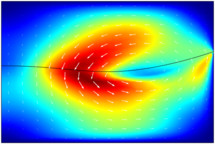
The contact angle of a two-fluid interface with a solid surface is determined by the balance of the forces at the contact point. In electrowetting the balance of forces at the contact point is modified by the application of a voltage between a conducting fluid and the solid surface. In ... Read More
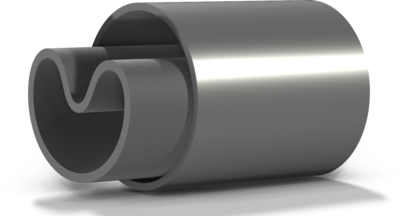
In this example, the Bergstrom–Bischoff material model is used to model the temperature and strain dependent behavior of High Density Polyethylene (HDPE) used, for example, to make liners for damaged pipes in oil and gas applications, or to make type IV hydrogen storage vessels for fuel ... Read More
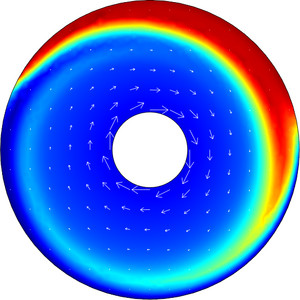
Liquid-solid mixtures (suspensions) are important in a variety of industrial fields, such as oil and gas refinement, paper manufacturing, food processing, slurry transport, and wastewater treatment. Several different modeling approaches have been developed by the CFD community, ranging ... Read More
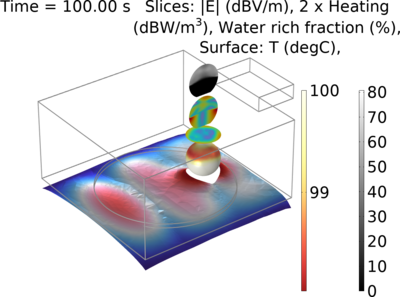
A spherical water-rich load (potato) is placed on the rotating glass tray of a microwave oven some distance from the center of rotation. 1 kW of 2.45 GHz microwave power is applied via a waveguide feed. The plate rotates at 9 degrees per second. The heat transfer model involves the ... Read More
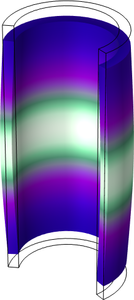
This model calculates the eigenfrequencies and mode shapes of an unconstrained cylinder in axisymmetry. The model is taken from NAFEMS Free Vibration Benchmarks. The eigenfrequencies are compared with the values given in the benchmark report. Three different physics interfaces are ... Read More
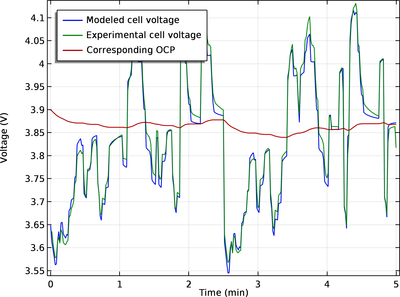
This tutorial uses a “black-box” approach to define a battery model based on a small set of lumped parameters, assuming no knowledge of the internal structure or design of the battery electrodes, or choice of materials. The input to the model is the battery capacity, the initial state ... Read More
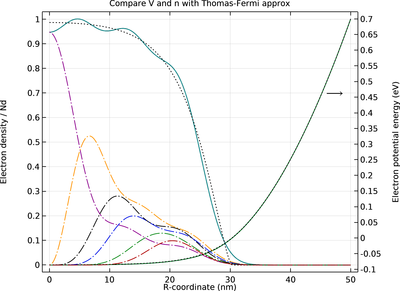
This benchmark model simulates a GaAs nanowire using the self-consistent Schrödinger-Poisson theory to compute the electron density and the confining potential profiles. The predefined Schrödinger-Poisson multiphysics coupling feature is combined with the dedicated Schrödinger-Poisson ... Read More
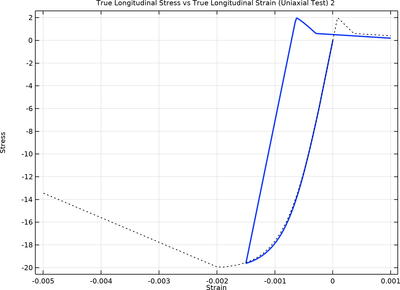
This example shows the behavior of the coupled damage-plasticity material model for concrete when subjected to different loading conditions. Read More
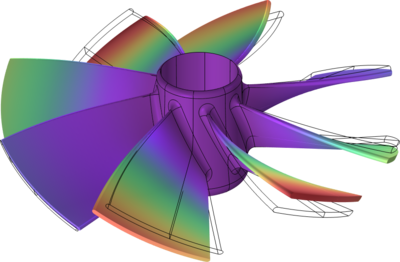
This tutorial model demonstrates the use of dynamic cyclic symmetry with postprocessing on the full geometry. A 3D impeller with eight identical blades can be divided into eight sectors of symmetry. The model computes the fundamental frequencies for the full impeller geometry and ... Read More
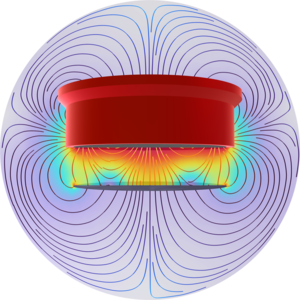
One-sided magnets are magnets designed to have both magnetic poles emerging from the same side of the magnet. This results in the magnetic flux being concentrated on one side of the magnet. These kinds of magnets are found in many applications from the common fridge magnet to particle ... Read More


