
The Application Gallery features COMSOL Multiphysics® tutorial and demo app files pertinent to the electrical, structural, acoustics, fluid, heat, and chemical disciplines. You can use these examples as a starting point for your own simulation work by downloading the tutorial model or demo app file and its accompanying instructions.
Search for tutorials and apps relevant to your area of expertise via the Quick Search feature. Note that many of the examples featured here can also be accessed via the Application Libraries that are built into the COMSOL Multiphysics® software and available from the File menu.

The powder compaction process is becoming common in the manufacturing industry, thanks to its potential to produce components of complex shape and high strength. In this example, the compaction of iron powder to form an axisymmetric rotational flanged component is analyzed with capped ... Read More
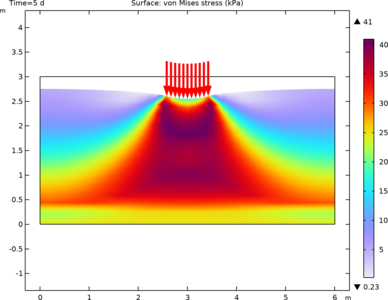
In this example, the transient response of a shallow foundation resting on an unsaturated soil stratum is investigated. The changes in pore suction due to water infiltration and evaporation are analyzed using the Extended Barcelona Basic soil model. The results show how the deformation ... Read More
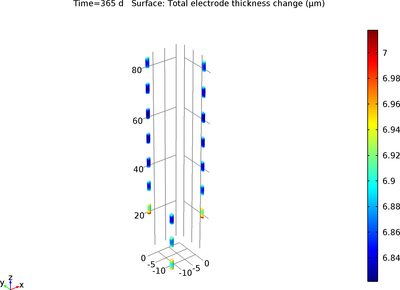
This model exemplifies how the rate of steel corrosion in an oil platform increases over time due to build-up of a resistive film on the sacrificial anodes, formed by reaction products. The model also includes secondary current distribution electrode kinetics on the protected steel ... Read More
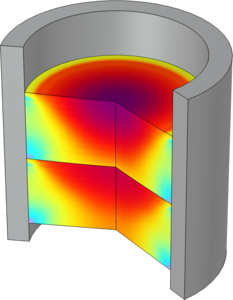
Powder compaction is a key process in powder metallurgy, where it gives the flexibility to produce quality products of complex shapes for sintering. The density of the compact is a key factor to determine the overall quality of the sintered product, as regions with lower density could ... Read More
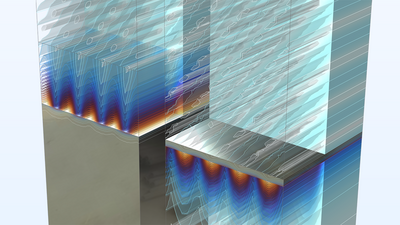
This example demonstrates a simulation setup for exciting surface plasmon polaritons using Otto and Kretschmann configurations. The underlying mechanism is enabled by the interplay between total internal reflection and evanescent-wave coupling phenomena. It also calculates the ... Read More
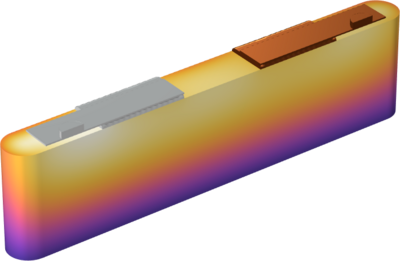
This model exemplifies how to compute the internal temperature distribution in a prismatic battery during a high-rate charge. The electrochemistry is described by a a lumped two-electrode model, which is coupled to the heat transfer model. The heat transfer model includes the effects of ... Read More
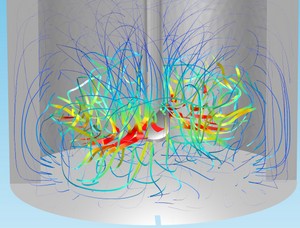
This model exemplifies the use of the Rotating Machinery interface, which allows you to model moving rotating parts in, for example, stirred tanks, mixers, and pumps. The Rotating Machinery interface formulates the Navier-Stokes equations in a rotating coordinate system. Parts that are ... Read More
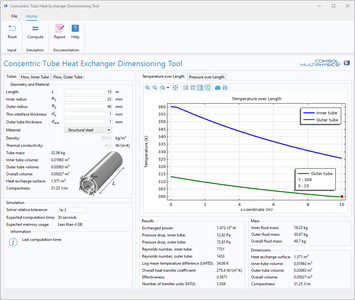
This app demonstrates the following: Selecting predefined or user-defined materials User option to switch between laminar flow or turbulent flow Changing boundary conditions using methods Visualizing temperature dependent material properties as graph plots User option to set the solver ... Read More
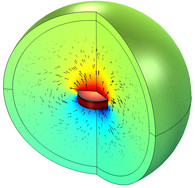
This tutorial shows how you can use the Electromechanics interface in COMSOL's MEMS Module to model Electrostriction. Electrostrictive materials (e.g. PMN-PT) exhibit nonlinear strain as a function of electric field. This 2D axisymmetry model uses a parametric sweep of voltage to ... Read More
The following example is a 2D tutorial model of a lithium-ion battery. The cell geometry is not based on a real application; it is only meant to demonstrate a 2D model setup. Read More


