Explore the innovative ways multiphysics simulation is being used worldwide to advance research
Multiphysics modeling and simulation drives innovation across industries and academia — as is evidenced by the many uses showcased in the technical papers and posters presented by engineers, researchers, and scientists at the COMSOL Conference each year.
Draw inspiration from the recent proceedings collected below, or, to find a specific presentation or filter by application area or conference year/location, use the Quick Search tool.
View the COMSOL Conference 2026 Collection

Porous media fluid dynamic modeling has been widely explored and utilized in many academic and industrial applications. Cross flow filtration being one attractive application, whereas the fluid and filtrate flow parallel the porous media, and thereby induce shearing stress along the ... Read More
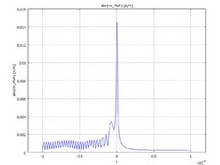
Metamaterials are a new class of artificial materials, which possess various unusual properties. One of these properties is a negative index of refraction produced by setting both the dielectric permittivity ε and the magnetic permeability μ of the material less than zero. Unique ... Read More
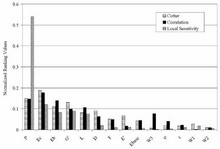
Computational models of biological systems are becoming more and more common in medical research areas. Evidence of this can be found by examining the number of articles containing the term “finite element” in the expansive National Institutes of Health (NIH) digital research archive ... Read More
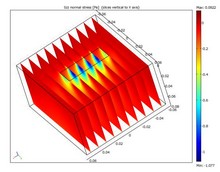
Finite element models using COMSOL Multiphysics and MATLAB were developed to solve the problem of stress distribution interior homogeneous, isotropic, incompressible elastic solid material under known vertical external compression with a rectangular contact surface. Moreover, comparison ... Read More
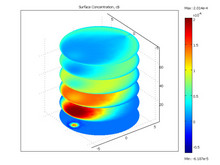
Increasing attention has been paid to application of the quartz crystal microbalance with dissipation (QCM-D) sensor for monitoring biomolecular interactions. This paper focuses on a practical application of protein-protein binding affinity measurement at low concentrations and minimal ... Read More
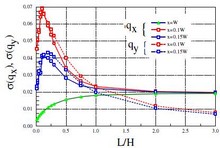
Heat conduction through a slab, 0 ≤ x ≤ W is one dimensional. However, if one of the edges, say x=0, is rough the conduction will be two dimensional. The two dimensionality varies with the correlation length with a maximum at a length approximately 10% of the slab width. ... Read More
This paper develops a computational model for determining the total damping coefficient for a unit cell of a MEMS microscale device containing a repetitive pattern of holes. The basic cell of the microstructure is approximated by an axi-symmetric domain and the velocity and pressure ... Read More
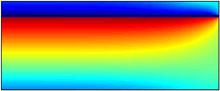
A Finite element model of plasma sprayed TBC’s was developed to estimate the stress induced by thermal cycling experiments. A heat transfer analysis was performed to evaluate the temperature distribution on the specimen during the cooling under an impinging air jet; temperature ... Read More