
Lorenzo Bortot, CERN, Switzerland
Engineers and physicists at CERN go to great lengths to ensure that the high-power superconducting magnets that maintain the circular trajectory of particles inside the Large Hadron Collider (LHC) do not revert to a resistive state, an event known as a quench. To understand and prevent quench events, Lorenzo Bortot, an electrical engineer and research fellow at CERN, used numerical simulation to develop a multiphysics, multiscale, and multirate representation of the electrodynamics and thermal evolution of a quench event.
Suggested Stories
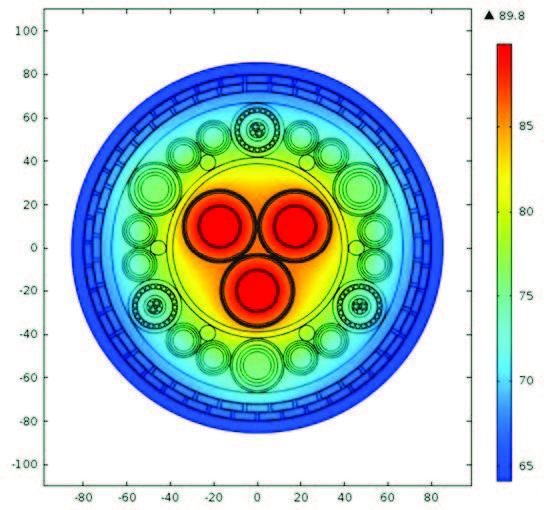
Simulation Software Brings Big Changes to Cable Industry
The design and testing of high-voltage cables for terrestrial and submarine applications is paramount to Prysmian's ...
Complex Fenestration System for Energy Efficiency
Fenestration systems can greatly impact the energy efficiency of buildings. Eurac Research is using simulation to ...
Multiphase Flow Simulation Guides Wastewater Treatment Plant Design
To improve the health of the Dommel river, an aeration unit has been added to the Eindhoven wastewater treatment plant ...
Designing a Miniaturized Wastewater Treatment Plant for Micropollutant Degradation
Eden Tech uses multiphysics simulation to design a miniaturized wastewater treatment system made from compact discs. ...


