
Lorenzo Bortot, CERN, Switzerland
Engineers and physicists at CERN go to great lengths to ensure that the high-power superconducting magnets that maintain the circular trajectory of particles inside the Large Hadron Collider (LHC) do not revert to a resistive state, an event known as a quench. To understand and prevent quench events, Lorenzo Bortot, an electrical engineer and research fellow at CERN, used numerical simulation to develop a multiphysics, multiscale, and multirate representation of the electrodynamics and thermal evolution of a quench event.
Suggested Stories
A STEP in the Right Direction: Modeling AC Losses in a Tokamak Design
The Spherical Tokamak for Energy Production (STEP) program aims to deliver a prototype fusion energy plant in the ...
Shape Changing Lubricants
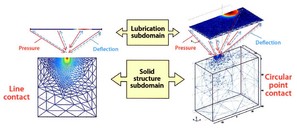
Shell Global Solutions UK is conducting research to optimize lubricants for the fuel economy. A problem exists in ...
Driving EV Development with a Twin-Battery Approach
IAV developed an approach for combining sodium-ion and solid-state lithium iron phosphate battery technologies to form ...

Predicting Blood Damage with Surrogate Modeling
Veryst developed a surrogate model to better understand the relationship between a nozzle and blood damage. Learn more ...


