
Lorenzo Bortot, CERN, Switzerland
Engineers and physicists at CERN go to great lengths to ensure that the high-power superconducting magnets that maintain the circular trajectory of particles inside the Large Hadron Collider (LHC) do not revert to a resistive state, an event known as a quench. To understand and prevent quench events, Lorenzo Bortot, an electrical engineer and research fellow at CERN, used numerical simulation to develop a multiphysics, multiscale, and multirate representation of the electrodynamics and thermal evolution of a quench event.
Suggested Stories
Addressing Oil Spill Cleanup Using Hydrophobic Meshes
Engineers at Amphos 21 tested a new solution for different oil spill scenarios, hydrophobic meshes, with numerical ...
Get an Inside Look at How Veryst Engineering Looks Inside Designs
Step into the material test lab at Veryst Engineering to see how they develop accurate material models for use in ...
Investigating Intrabody Communication for Leadless Cardiac Pacemakers
MicroPort CRM used numerical simulation to optimize leadless cardiac pacemaker (LCP) designs and how they communicate ...
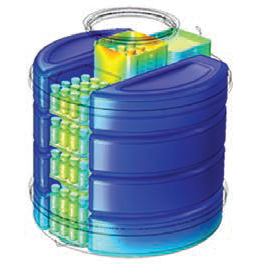
Innovative Thermal Insulation Techniques Bring Vaccines to the Developing World
When medical professionals transport vaccines, their cargo needs to be kept at a cool temperature. This limits their ...


