
Lorenzo Bortot, CERN, Switzerland
Engineers and physicists at CERN go to great lengths to ensure that the high-power superconducting magnets that maintain the circular trajectory of particles inside the Large Hadron Collider (LHC) do not revert to a resistive state, an event known as a quench. To understand and prevent quench events, Lorenzo Bortot, an electrical engineer and research fellow at CERN, used numerical simulation to develop a multiphysics, multiscale, and multirate representation of the electrodynamics and thermal evolution of a quench event.
Suggested Stories
Music to Your Ears: New Transducers Meet Electrostatic Headphones
Electrostatic transducers offer enhanced clarity, less distortion, and a wider bandwidth than transducers in ...
Efficient Grid Operation and Maintenance with Simulation Apps
Engineers at NARI Group Corporation developed the Cable Condition Analysis Expert System App, based on their ...
Developing a Novel Battery Model to Answer Classical Chemistry Questions
Researchers at the Flemish Institute for Technical Research (VITO/EnergyVille) and KU Leuven developed a model of a ...
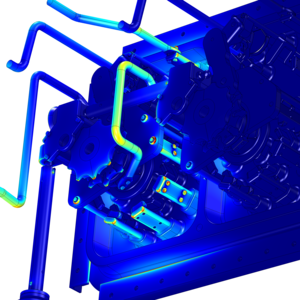
Dielectric Stress Simulation Advances Design of ABB Smart Grid-Ready Tap Changers
Consumers of power rely on fairly stable voltages. Transformers contain tap changers which vary the ratio of secondary ...


