
Jean-Louis Gelet and Antoine Gerlaud
Mersen, France
Large electrical systems carrying high currents could pose a danger if any of their components, such as fuses and bus bars, fail. In order to increase safety and improve manufacturing, it is necessary to understand the failure mechanisms of those components. One of those components, a bus bar, is made up of a single piece of conducting metal that replaces individual, thick cables when conducting a large current across a short distance and to many loads.
Mersen, an international company with expertise in surge protection, manufactures bus bars that are laminates with a film of insulating material glued between conducting plates at different potentials. If the temperature in a bus bar gets too high, however, the glue or insulation can be destroyed.
A group at Mersen, focusing on electric protection, used COMSOL simulations to determine the temperature field generated by the Joule effect, and eliminate any identified hot spots.
Suggested Stories
Addressing Oil Spill Cleanup Using Hydrophobic Meshes
Engineers at Amphos 21 tested a new solution for different oil spill scenarios, hydrophobic meshes, with numerical ...
Optimizing Built-in Tire Pressure Monitoring Sensors
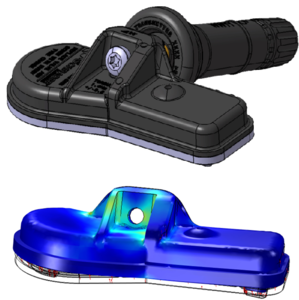
Built-in tire pressure sensors need to be able to withstand the wear and tear of working within a car’s tire rim. ...

Numerical Simulation-Based Topology Optimization Leads to Better Cooling of Electronic Components in Toyota Hybrid Vehicles
The Toyota Research Institute in Ann Arbor drives cutting-edge research in energy efficiency, mobility infrastructure, ...
Forecasting the Ice Loss of Greenland’s Glaciers with Viscoelastic Modeling
The Northeast Greenland Ice Stream’s discharge of ice into the ocean has been accelerating. To help forecast future ...


