
Jean-Louis Gelet and Antoine Gerlaud
Mersen, France
Large electrical systems carrying high currents could pose a danger if any of their components, such as fuses and bus bars, fail. In order to increase safety and improve manufacturing, it is necessary to understand the failure mechanisms of those components. One of those components, a bus bar, is made up of a single piece of conducting metal that replaces individual, thick cables when conducting a large current across a short distance and to many loads.
Mersen, an international company with expertise in surge protection, manufactures bus bars that are laminates with a film of insulating material glued between conducting plates at different potentials. If the temperature in a bus bar gets too high, however, the glue or insulation can be destroyed.
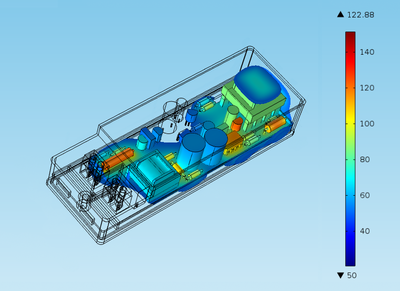
A group at Mersen, focusing on electric protection, used COMSOL simulations to determine the temperature field generated by the Joule effect, and eliminate any identified hot spots.
Suggested Stories
3D Parametric Full Eye Model Gives 20+ Years of Better Vision
To correct presbyopia, researchers at Kejako, a medical device company in Switzerland, are developing a noninvasive ...
Virtual Material Design in 3D Printing Makes Headway with Multiscale Modeling
The advantages of anisotropic properties in 3D printing materials have been difficult to exploit for product design, ...
Defying Convention to Achieve Faster Signal and Simulation Speeds
As the demand grows for faster electronic devices in smaller packages, we need to develop optimized high-speed ...
Keeping LEDs Cool Gets More Manageable Through Simulation
Light-emitting diodes (LEDs) offer many benefits over incandescent lighting, such as long life spans and high luminous ...


